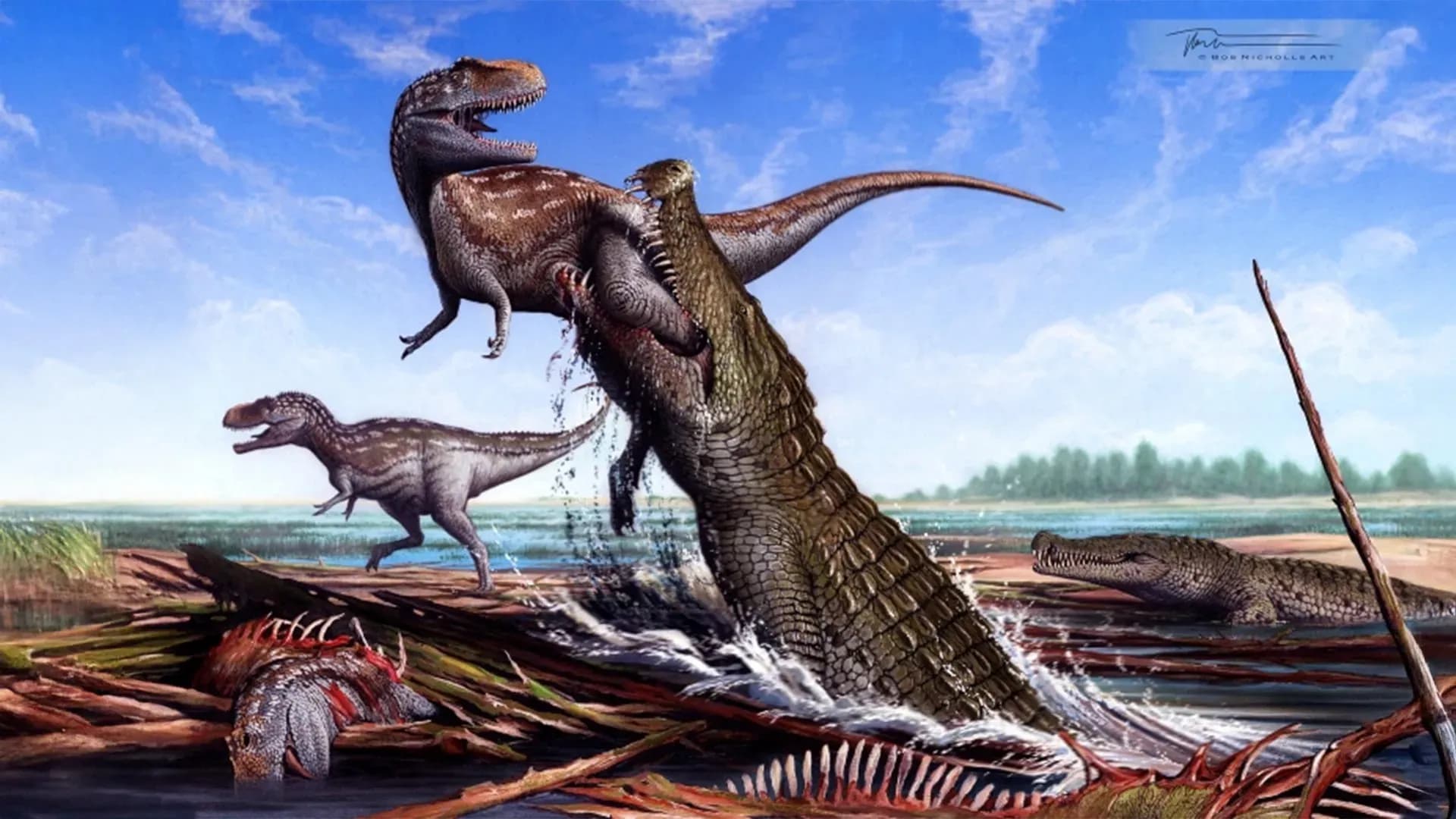
Meet the 31-Foot 'Terror Croc' That Hunted Dinosaurs — And Just Came Back to Life
A scientifically accurate, full-scale skeleton of Deinosuchus schwimmeri — a bus-sized ancient crocodilian — is now on display at a Georgia museum.
The Ancient Predator That Made Dinosaurs Its Prey
Long before modern alligators patrolled the swamps of the American South, a far more terrifying creature ruled those waters. Deinosuchus schwimmeri — a colossal crocodilian stretching over 31 feet in length — stalked the eastern United States more than 75 million years ago, hunting dinosaurs with a bite force that left little chance of escape. Now, this prehistoric giant has been reconstructed in extraordinary detail, giving the public its first look at a full, scientifically accurate skeleton replica of the species.
The life-size model is currently on permanent display at the Tellus Science Museum in Cartersville, Georgia — the only institution in the world to house this remarkable cast.
Decades of Dedication Behind One Groundbreaking Replica
The Scientist Who Made It Possible
The driving force behind this achievement is Dr. David Schwimmer, a geology professor at Columbus State University and one of the foremost authorities on Deinosuchus in the world. Over more than four decades of field research, Schwimmer has scoured fossil sites across Alabama, Georgia, and Texas, uncovering specimens that now reside in some of America's most prestigious institutions — including the Smithsonian Institution and the American Museum of Natural History.
In recognition of his monumental contributions to Late Cretaceous paleontology, a team of researchers officially named the species Deinosuchus schwimmeri in his honor in 2020. The announcement appeared in the Journal of Vertebrate Paleontology, citing his "tireless work on the Late Cretaceous paleontology of the Southeast and Eastern Seaboard, USA."
Two Years in the Making
Building the replica was no small undertaking. Schwimmer partnered with Triebold Paleontology Inc. — a company internationally recognized for crafting museum-quality fossil skeleton models — on a two-year collaboration. Using high-resolution 3D scans of actual fossil specimens, the team painstakingly reconstructed the animal's complete skeletal framework along with its distinctive armored skin features. The result is both visually striking and scientifically valuable.
What Made Deinosuchus So Fearsome?
Living between approximately 83 million and 76 million years ago, Deinosuchus schwimmeri was a distant relative of today's alligators — but on an entirely different scale. Growing up to 31 feet (roughly 9.45 meters) long and comparable in size to a school bus, this apex predator almost certainly sat at the very top of its ecosystem's food chain.
Its territory covered what is now the southeastern United States, where it ambushed and consumed dinosaurs that ventured too close to the water's edge. Fossil evidence, including bite marks found on dinosaur bones, confirms its role as one of the most formidable hunters of the Cretaceous period.
"Understanding dinosaurs' predatory habits helps us decode some of nature's greatest survival strategies," Schwimmer explained. "By studying these ancient apex predators, we are essentially looking back in time to see exactly how life adapted and dominated a changing world."
A Museum Experience Unlike Any Other
For the Tellus Science Museum, acquiring this replica represents a significant milestone in science education and public engagement.
"Each year, thousands of students visit us from across Georgia and neighboring states," said Hannah Eisla, the museum's director of education. "The addition of Deinosuchus schwimmeri allows us to provide a more detailed picture of this area's ecosystem in the Cretaceous Period."
Rebecca Melsheimer, the museum's curatorial coordinator, echoed that sentiment, emphasizing the unique power of seeing the creature at full scale. "We can tell you that Deinosuchus is 30 feet long, but seeing it is far more impactful," she noted. "Tellus is currently the only museum to have a cast of Deinosuchus schwimmeri, so this is an experience our visitors simply cannot get anywhere else."
A Lifelong Obsession Rooted in New York City
Schwimmer's fascination with Deinosuchus stretches back to his childhood in New York City, where he grew up just ten blocks from the American Museum of Natural History. A museum display featuring a large skull ignited his curiosity at a young age — a curiosity that never faded.
After joining Columbus State University (then Columbus College), Schwimmer discovered his first Deinosuchus fossil in 1979. From that moment, his research became increasingly focused on reconstructing the biology, behavior, and environment of this extraordinary animal.
His expertise eventually led him to publish the definitive reference on the subject: King of the Crocodylians: The Paleobiology of Deinosuchus (2002), which became a top seller in its Amazon category and a popular choice among science reading groups. An updated edition is currently in development.
Research That Extends Beyond the Lab
Publishing Landmark Studies
In 2010, Schwimmer contributed to two significant papers related to Deinosuchus. One analyzed bite marks preserved on dinosaur bones, offering direct evidence of predatory behavior. The other examined fossilized dung, known as coprolites, and was developed in collaboration with undergraduate student Samantha (Harrell) Stanford. Both studies were published in the New Mexico Museum of Natural History and Science Bulletin and presented at the Geological Society of America Northeastern-Southeastern Annual Meeting.
Empowering the Next Generation of Scientists
Schwimmer is also deeply committed to mentoring young researchers. He emphasized that regional universities like Columbus State provide undergraduates with hands-on field and research experiences that are rare at larger institutions.
"At most universities, undergraduates rarely collaborate on or publish peer-reviewed research," he said. "Institutions of our size provide students with greater one-on-one access to faculty mentors and field-based research opportunities that, while local, are still quite impactful on the field."
A Regional Fossil Hotspot
With multiple confirmed Deinosuchus fossil sites located within 40 miles of Columbus, Georgia, the surrounding region is remarkably fertile ground for paleontological discovery. This proximity makes the Tellus Science Museum a particularly fitting home for the replica — situated near the very land where the creature once lived.
"Bones and fossils tell us only part of the story," Schwimmer said. "Fully assembled, life-size replicas become a blueprint for better understanding the dynamic animals that creatures like Deinosuchus really were."
For students, families, and science enthusiasts alike, the display offers something genuinely rare: a face-to-face encounter with one of prehistory's most formidable predators — and a vivid reminder of just how dramatic life on Earth once was.