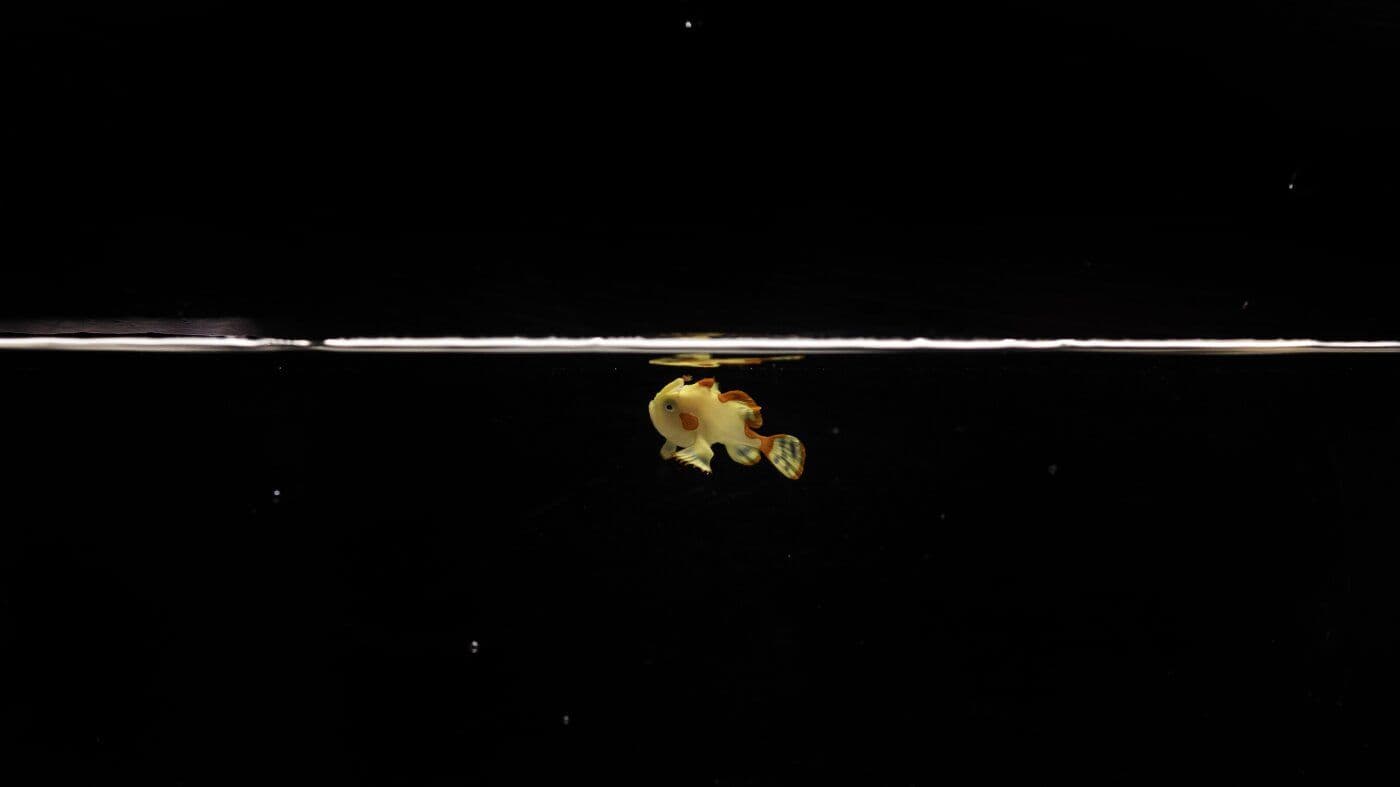
Meet Domino: The World's First Warty Frogfish Ever Successfully Raised in Captivity
A tiny, tennis ball-sized fish named Domino has made history at Chicago's Shedd Aquarium — and scientists say it could change how we protect marine life.

A Historic First at Chicago's Shedd Aquarium
Tucked inside the vibrant Wild Reef exhibit at Chicago's Shedd Aquarium is a small but significant tank. It houses two warty frogfish — a species native to the Indo-Pacific ocean — each roughly the size of a tennis ball, dressed in yellow and red, and covered in bumpy, wart-like textures that give the species its memorable name.
Jenny Richards, a senior aquarist at Shedd who oversees the care of numerous fish species, has a fondness for them that's hard to miss.
"I definitely think they look cute," she says with a smile, describing them as "comically round."
Cute they may be — but these creatures are also remarkably fierce. The warty frogfish is an ambush predator, equipped with a modified dorsal fin that doubles as a lure, mimicking the appearance of a small shrimp to draw unsuspecting prey within striking range.
From Thousands of Eggs to One Survivor
Last year, the female frogfish in the exhibit began showing signs of bloating. Then, in September, she released a massive, tightly coiled mass of tens of thousands of translucent eggs, which were subsequently fertilized by the male.
Aquarists on the Wild Reef team spotted the egg raft floating in the habitat and wasted no time. They carefully retrieved it and moved it behind the scenes, where a dedicated effort to raise the offspring began.
Out of those tens of thousands of eggs, just one warty frogfish survived to become a juvenile. That survivor is now named Domino — and according to Richards, no aquarium or research institution had ever successfully reared a warty frogfish from egg to juvenile before.
"It was definitely a little nerve-wracking trying to make sure that we made the most of this rare opportunity," she admits.
Why This Achievement Matters
While warty frogfish are not currently listed as endangered, they face mounting pressure from climate change, habitat degradation, and collection for the aquarium trade. Richards believes that Domino's story offers a valuable blueprint for the future of marine conservation.
"This could help us with raising other species in the future," she explains. "With changing oceans and climate change, being able to raise these species in captivity is becoming increasingly important."
The broader scientific community agrees. As ocean ecosystems face unprecedented stress, the ability to successfully breed and raise marine animals in controlled environments becomes a critical conservation tool.
The Painstaking Science Behind the Process
The Shedd Aquarium team brought considerable experience to this project, having previously raised a range of other marine species. But every fish presents its own unique challenges — and raising larvae in a 15-gallon tank while replicating the open ocean is no small feat.
"Marine fish larvae are incredibly fragile," Richards explains. "They have completely different habits than the adults, and they spend their early lives drifting among zooplankton in the open ocean. We have to get the lighting, water flow, temperature, and diet exactly right."
Within days of the eggs being collected, thousands of tiny larvae hatched — each one resembling a miniature tadpole. The team concentrated their intensive care efforts on 500 of them, monitoring conditions around the clock and adjusting the environment based on behavioral cues.
Feeding the Future
One of the most critical early challenges was nutrition. Once the larvae exhausted their natural yolk reserves, they needed to feed immediately or they wouldn't survive.
"If we don't have the proper food, none of them are going to make it," Richards says. Fortunately, the larvae readily accepted copepods — microscopic crustaceans — as their primary food source, giving the team a much-needed early win.
A Dramatic Transformation
Over the following weeks, the larvae underwent a series of extraordinary physical changes. Their vertebrae and fins shifted position, their musculature evolved, and the ranks of surviving larvae steadily dwindled. The team made constant micro-adjustments — dimming the lights when the larvae appeared stressed, reducing water flow when swimming seemed labored.
This natural attrition mirrors what happens in the wild, where only a tiny fraction of larvae manage to avoid predation, secure enough food, and survive the biological demands of development.
By around day 90, just one larva completed the transition into a juvenile. That was Domino — pea-sized, bright yellow, freckled with orange, and already sporting its own tiny lure. Richards describes it as looking like "a little fishy Pokémon."
Experts Applaud the Breakthrough
The Shedd Aquarium is part of a growing network of institutions working to advance marine aquaculture. Nicole Rhody, program manager for the aquaculture research department at Mote Marine Laboratory in Sarasota, Florida, says breakthroughs like this one deserve recognition.
"When people are successful, it's something to celebrate because it's really not that easy to take what happens in nature and be able to recreate that," she says.
Rhody speaks from hard-won experience. She spent approximately 15 years working to close the life cycle of the common snook — a popular sport fishing species — before achieving success. By comparison, the speed with which the Shedd team succeeded with the warty frogfish is remarkable.
She emphasizes that this kind of work pays dividends far beyond a single species, supporting conservation initiatives as well as commercial and recreational aquaculture industries.
Domino's Future
For now, Domino lives in a tank away from public view, tucked inside a purple aquatic plant and growing steadily. Richards visits regularly and admits she has grown attached to the little fish that she watched develop from a speck of life into a fully formed creature.
"We did watch him grow," she says warmly, "so definitely a little attached to the baby."
She looks forward to the day Domino makes its public debut — a living symbol of what patience, scientific dedication, and a little luck can accomplish when it comes to protecting our planet's ocean life.