JWST Encounters Its Match: A Planet Shrouded in an Impenetrable Haze
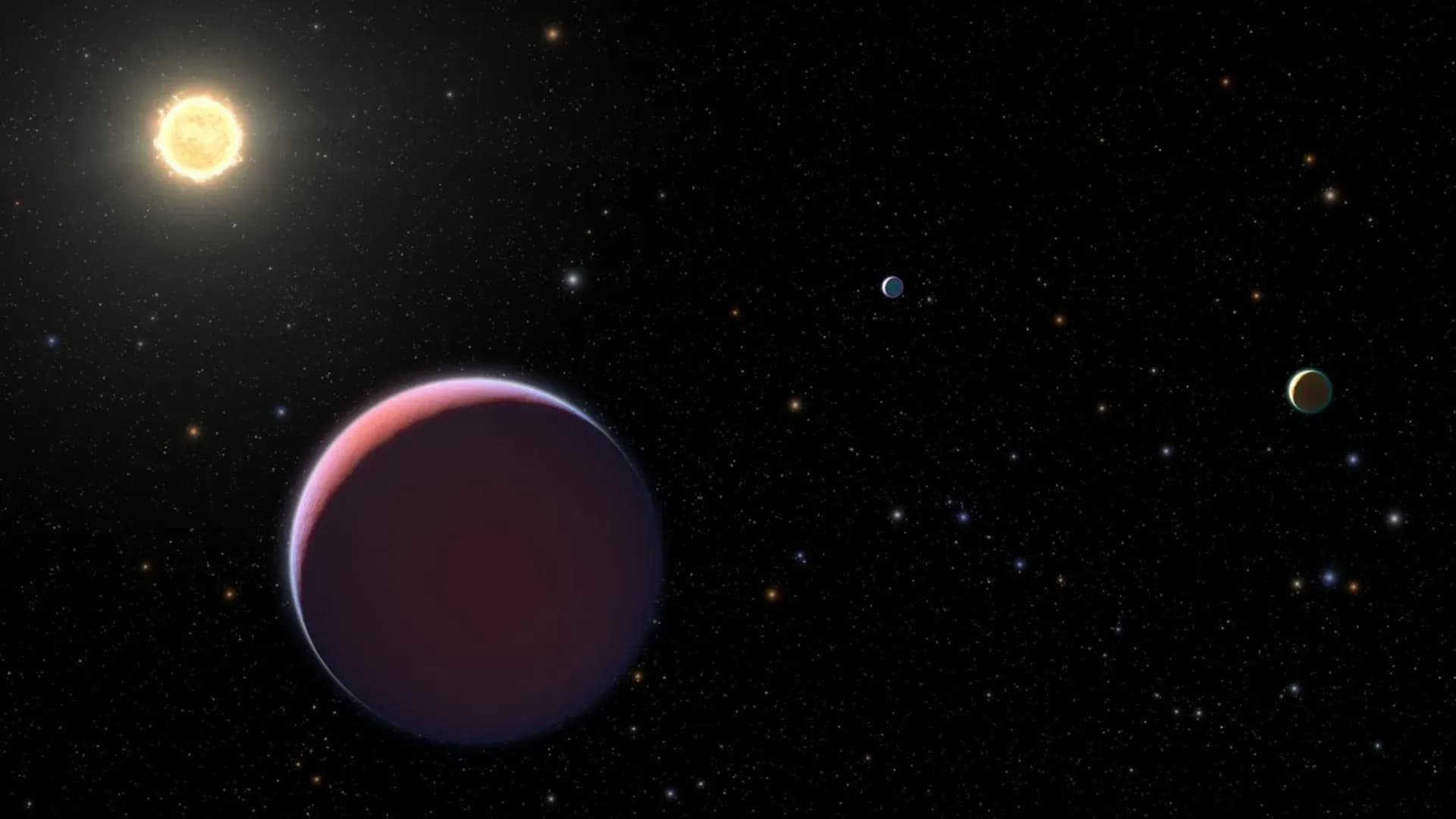
Kepler-51d, a bizarre ultra-light exoplanet, is wrapped in haze so thick that even the most powerful space telescope ever built can't see through it.

A Planet That Breaks All the Rules
Deep in the constellation Cygnus, roughly 2,615 light years from Earth, orbits one of the strangest planets ever discovered. Kepler-51d is what astronomers call a "super-puff" — a giant world so extraordinarily low in density that scientists have compared it to cotton candy. But its bizarre composition isn't the only thing that has researchers scratching their heads. A new study reveals that this peculiar planet is also enveloped in a haze so extraordinarily thick that even NASA's James Webb Space Telescope (JWST), the most advanced observatory humanity has ever launched, cannot peer through it.
The findings, published on March 16 in the Astronomical Journal, were led by a team of researchers from Penn State and represent one of the most puzzling atmospheric discoveries in modern exoplanet science.
What Is a Super-Puff Planet?
Kepler-51d belongs to a rare and poorly understood category of worlds known as super-puffs. These planets are roughly comparable in physical size to Saturn but carry only a fraction of the mass — just a few times that of Earth. The result is an almost impossibly low density that defies conventional models of planetary formation.
The star Kepler-51 hosts at least four known planets, and at least three of them fall into this unusual super-puff classification. Among all of them, Kepler-51d stands out as the coldest and least dense of the group.
"We think the three inner planets orbiting Kepler-51 have tiny cores and huge atmospheres giving them a density akin to cotton candy," said Jessica Libby-Roberts, a postdoctoral fellow at Penn State's Center for Exoplanets and Habitable Worlds at the time of the research and the paper's lead author. "These ultra-low-density super-puff planets are rare, and they defy conventional understanding of how gas giants form. And if explaining how one formed wasn't difficult enough, this system has three!"
Why Kepler-51d Shouldn't Exist
Under standard planetary science models, gas giants form far from their host stars, where cold temperatures allow hydrogen and helium to accumulate around a dense, gravitationally powerful core. Think of Jupiter and Saturn — massive, core-heavy worlds that formed in the outer reaches of our solar system.
Kepler-51d follows almost none of these rules. It appears to lack a substantial dense core, and it orbits at a distance from Kepler-51 that is roughly comparable to Venus's proximity to our own Sun — far closer than where a gas giant should be able to survive.
The star itself makes matters worse. Kepler-51 is a relatively active star, and its stellar winds should theoretically be powerful enough to strip gas away from a planet with such low density. How Kepler-51d has held onto its atmosphere at all remains an open question.
"It's possible that the planet formed further away and moved inward, but we are still left with a ton of questions about how this planet — and the other planets in this system — formed," said Libby-Roberts, who now serves as an assistant professor of physics and astronomy at the University of Tampa.
How Scientists Study Distant Atmospheres
Because Kepler-51d is far too distant to photograph directly, researchers rely on a technique called transit observation. When a planet passes in front of its host star, a small portion of the star's light filters through the planet's outer atmosphere before reaching Earth-based instruments. Different molecules absorb different wavelengths of light, leaving behind a kind of spectral fingerprint that can reveal the chemical composition of the atmosphere.
"A star's light is filtered through the atmosphere of the planet before it reaches our telescopes," Libby-Roberts explained. "If we look across a range of wavelengths, across a spectrum, we get a sort of fingerprint of the planet's atmosphere that reveals its composition."
This method has successfully characterized dozens of exoplanet atmospheres. With Kepler-51d, however, it hit an unprecedented wall.
JWST Pushed to Its Limits
Earlier observations using NASA's Hubble Space Telescope had already scanned Kepler-51d in near-infrared wavelengths ranging from approximately 1.1 to 1.7 microns. The JWST's Near-Infrared Spectrograph extended that range significantly, pushing all the way to 5 microns — a range that should have yielded clear atmospheric signals. Instead, scientists detected nothing distinctive at all.
The culprit, researchers concluded, is an extraordinarily dense haze layer blanketing the entire planet. This haze appears to absorb the wavelengths of light that scientists were examining, effectively acting as an impenetrable curtain over the planet's atmosphere.
"We think that the planet has such a thick haze layer that is absorbing the wavelengths of light we looked at, so we can't actually see the features underneath," said Suvrath Mahadevan, Verne M. Willaman Professor of Astronomy and Astrophysics at Penn State and a co-author of the study.
Mahadevan drew a comparison to Titan, Saturn's largest moon, which is well known for its thick hydrocarbon haze composed of compounds like methane. But Kepler-51d's haze appears to operate on an entirely different scale. Estimates suggest the haze layer could extend nearly as wide as the entire Earth — potentially making it one of the largest atmospheric hazes ever identified on any known world.
Could Rings Be the Answer?
The research team also considered an alternative hypothesis: planetary rings. If Kepler-51d were encircled by rings tilted at just the right angle, those rings could block incoming starlight during transit observations, making the planet appear both larger and less dense than it truly is.
However, the data doesn't cleanly support this scenario. Instead of the flat signal that rings would typically produce, scientists observed what Libby-Roberts described as a linear trend, with progressively more light being blocked at longer wavelengths. This pattern aligns more naturally with thick atmospheric haze than with a ring system.
"Rings would have to be short-lived, composed of very particular materials, and situated in just the right angle, which seems unlikely," Libby-Roberts acknowledged. "But we can't completely rule it out. If we could observe the planet at even longer wavelengths — such as with JWST's Mid Infrared Instrument — we might be able to detect the materials that would be in a ring or see the full extent of the haze layer."
What Comes Next
The mystery of Kepler-51d is far from solved, and scientists are actively pursuing new data. The research team is currently analyzing JWST observations of Kepler-51b, another super-puff planet in the same system, to determine whether dense hazes are a shared trait among these unusual worlds or whether Kepler-51d represents an extreme outlier even among its own rare category.
The broader implications extend well beyond this single star system. Super-puff planets challenge nearly every established framework for how planets grow and survive, and understanding them could reshape our fundamental models of planetary science.
"Before astronomers found planets outside our solar system, we thought we had a pretty good grasp on how planets formed," Libby-Roberts reflected. "But we started to find exoplanets that didn't match our solar system at all, and we have these alien worlds that really challenge our understanding of planet formation. Being able to explain how all these different planets formed helps us understand how we fit into the big picture and our place in the universe."
The research was supported by NASA through a JWST grant and received additional backing from the Penn State Center for Exoplanets and Habitable Worlds. Computational work was performed using Penn State's Institute for Computational and Data Sciences Advanced CyberInfrastructure.