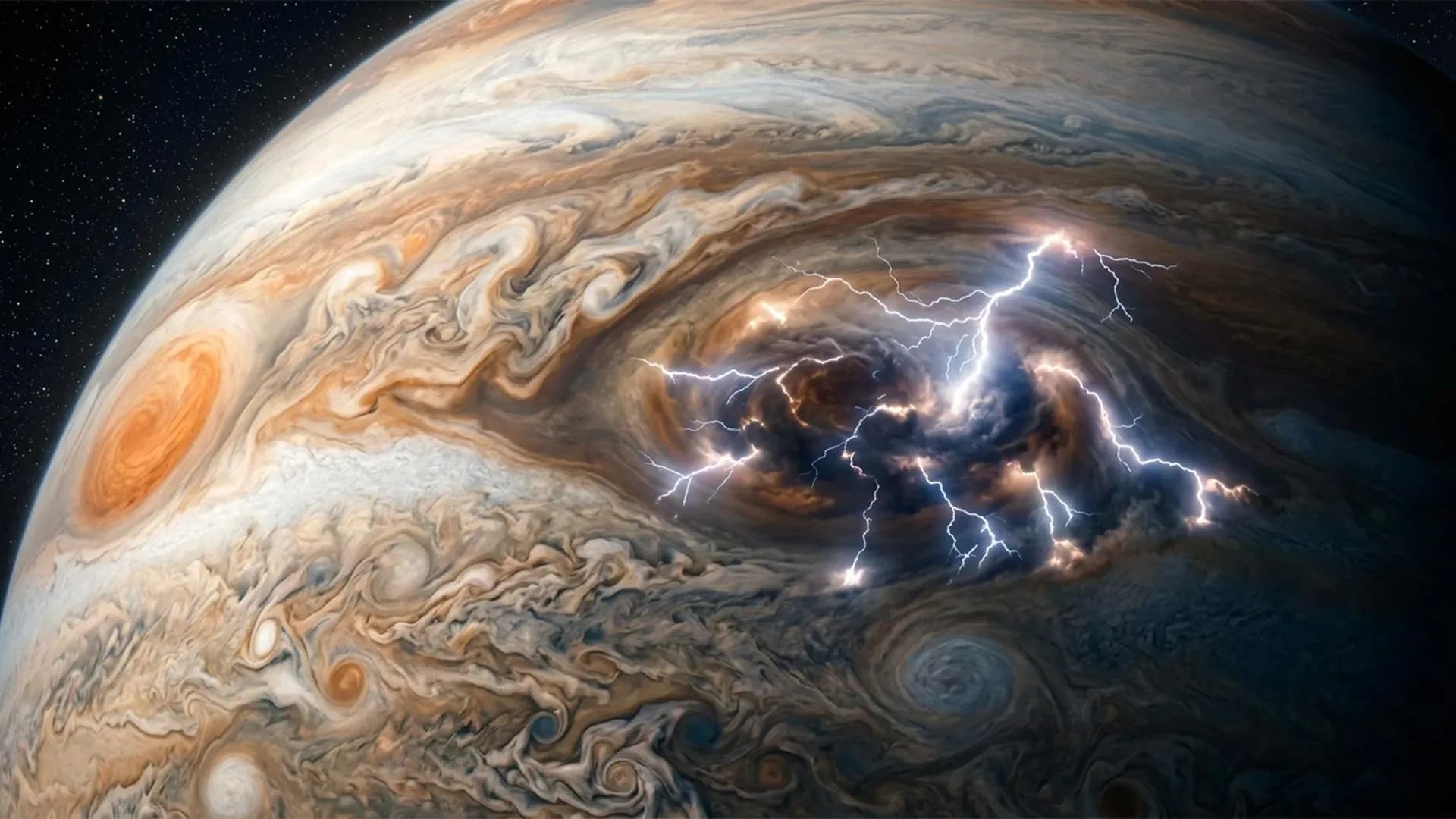
Jupiter's Lightning Strikes Up to 100 Times Harder Than Earth's Most Powerful Bolts
NASA's Juno spacecraft has revealed that lightning on Jupiter can be extraordinarily more powerful than anything we experience on Earth, reshaping our understanding of planetary storms.

Jupiter's Lightning Is in a League of Its Own
When we think of lightning, we picture dramatic flashes splitting open a stormy sky. But compared to what Jupiter produces, Earth's lightning is little more than a spark. New research using data from NASA's Juno spacecraft suggests that lightning bolts on the solar system's largest planet can be up to 100 times more powerful than those on Earth — and in some cases, potentially far stronger still.
The study, published in the journal AGU Advances, was led by Michael Wong, a planetary scientist at UC Berkeley's Space Sciences Laboratory. His team's findings shed light on the extraordinary atmospheric forces at work on Jupiter and may even offer fresh perspectives on how weather systems behave closer to home.
How Scientists Measured Jupiter's Lightning
Juno has been orbiting Jupiter since 2016, and one of its instruments — a microwave radiometer — has been quietly collecting data on the planet's atmosphere. Although the device was not originally built to study lightning, it can detect the microwave emissions that lightning discharges produce. Because microwaves pass through cloud cover, this approach gives researchers a clearer window into storm activity than visible-light observations alone.
Earlier spacecraft missions had hinted that Jupiter's lightning was exceptionally energetic, but those instruments could only pick up the brightest flashes, skewing the results. Juno's more sensitive star-tracking camera later muddied the picture by detecting many smaller, weaker flashes more comparable in scale to terrestrial lightning.
The challenge then became isolating individual storms. Jupiter's massive cloud belts often host multiple simultaneous storm systems, making it nearly impossible to determine which storm generated a given signal. Wong likened the problem to trying to identify whether a loud popping sound at a parade came from nearby popcorn or distant fireworks.
A Rare Calm Offered a Critical Window
Scientists caught a lucky break between 2021 and 2022 when storm activity in Jupiter's North Equatorial Belt temporarily quieted down. This lull allowed Wong's team to focus on individual, isolated storm systems one at a time.
By combining observations from the Hubble Space Telescope, Juno's onboard camera, and photographs submitted by amateur astronomers, the team was able to pinpoint the exact locations of several unusual storm structures — which Wong described as "stealth" superstorms. These systems persisted for months and visibly disrupted surrounding cloud formations, yet their cloud towers remained comparatively modest in height.
During this calmer period, Juno completed 12 passes over isolated storms. On four of those flybys, the spacecraft flew close enough to directly measure microwave signals from lightning activity.
What the Data Revealed
Across those encounters, scientists recorded an average of three lightning flashes per second. During one single pass alone, Juno detected 206 distinct microwave pulses. Analyzing a total of 613 recorded pulses, the research team determined that the lightning ranged from roughly Earth-equivalent strength at the lower end to more than 100 times stronger at the upper end.
Wong acknowledged that some uncertainty remains in these comparisons, as Jupiter and Earth lightning were measured at different radio wavelengths. At least one prior study has suggested Jupiter's lightning could theoretically be up to a million times more powerful than what we see on Earth.
When it comes to total energy output, Wong estimates that a Jovian lightning bolt may release anywhere from 500 to 10,000 times more energy than a typical bolt on Earth. For context, an average terrestrial lightning strike releases approximately one gigajoule — enough electricity to power roughly 200 homes for a full hour.
Why Jupiter's Storms Hit So Much Harder
The root cause of Jupiter's extreme lightning lies in the fundamental differences between its atmosphere and Earth's. Our planet's atmosphere is dominated by nitrogen, which is heavier than water vapor. This means that warm, moist air rises relatively easily, fueling thunderstorms in an efficient and ongoing cycle.
Jupiter, by contrast, has a hydrogen-dominated atmosphere, and in that environment, moist air is actually heavier than the surrounding gases. This makes it far more difficult for storm systems to push upward through the atmosphere. However, when conditions finally allow a storm to rise, it has accumulated an enormous amount of pent-up energy — energy that eventually gets unleashed in the form of violent winds and intense cloud-to-cloud lightning.
Jupiter's lightning is believed to form through a process broadly similar to Earth's thunderstorms: water vapor rises, condenses into droplets and ice crystals, becomes electrically charged through collisions, and ultimately generates massive voltage differences between cloud layers — or between clouds and lower atmospheric levels.
Why This Research Matters
Beyond satisfying our curiosity about the solar system's most dramatic weather, studying Jovian lightning has practical scientific value. Wong noted that observing how electrical storms behave on other planets can deepen our understanding of meteorological processes right here on Earth — a planet whose own lightning still holds plenty of mysteries.
"There's so much we don't know about lightning on Earth," Wong said.
Researchers have also been exploring a range of unusual electrical phenomena associated with Earth's thunderstorms, collectively known as transient luminous events, or TLEs. These include sprites, jets, halos, and ELVEs — all of which occur high above storm systems and remain an active area of scientific inquiry.
As Juno continues its mission, each new pass over Jupiter's turbulent cloud tops brings scientists closer to understanding one of the most electrifying environments in the entire solar system.