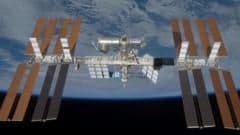
ISS Crew Returns to Station After Emergency Shelter Triggered by Worsening Air Leak
Five astronauts aboard the ISS were ordered into a docked SpaceX spacecraft as a precaution while Russian cosmonauts attempted a critical repair.
ISS Astronauts Stand Down After Tense Air Leak Emergency
Five astronauts aboard the International Space Station were temporarily ordered to take shelter inside a docked SpaceX spacecraft on Friday, following a sudden escalation in an ongoing air leak within the Russian section of the orbiting laboratory. The situation prompted emergency safe-haven procedures before NASA ultimately cleared the crew to return to normal operations.
What Triggered the Emergency?
The source of the problem was a worsening pressure leak in a transfer corridor known as the PrK tunnel, which connects to the Zvezda service module — part of the Russian segment of the ISS. While air loss of around half a pound per day has historically been considered manageable, the rate had climbed significantly enough to demand immediate action.
The situation became more urgent after a Russian cargo vessel docked at the station last month. Following that arrival, the Russian space agency Roscosmos detected a fresh drop in pressure within the tunnel, pushing officials to move beyond temporary fixes and attempt a more comprehensive repair.
Crew Ordered Into SpaceX Dragon as Precaution
As Russian cosmonauts — station commander Sergey Kud-Sverchkov and flight engineer Sergei Mikayev — began their repair work, NASA took swift precautionary action. Five crew members, including Jessica Meir, Jack Hathaway, Sophie Adenot, Andrey Fedyaev, and Chris Williams, were directed to board the docked SpaceX Dragon spacecraft, named Freedom.
The astronauts suited up and prepared for a potential emergency undocking and return to Earth on short notice. The Dragon, in this context, effectively served as a lifeboat — securely attached to the station but ready to detach instantly if conditions demanded it. The two Russian cosmonauts, meanwhile, had their own escape route available via the separately docked Soyuz MS-28 spacecraft.
NASA and Roscosmos at Odds Over Repair Method
According to Reuters, the specific repair technique being employed by the Russian crew raised concerns at NASA's mission control in Houston. Reports indicated that Kud-Sverchkov and Mikayev were using a saw in an attempt to access the precise location of the crack. NASA reportedly disagreed with this approach, which contributed to the decision to initiate safe-haven procedures for the rest of the crew.
Once Roscosmos instructed its cosmonauts to halt the repair attempt, NASA gave the all-clear for the five sheltering astronauts to leave the Dragon and resume their regular duties aboard the station.
NASA spokeswoman Bethany Stevens confirmed the development via X, stating: "Given this development, NASA has instructed the crew members inside the Dragon spacecraft to end the safe haven procedures and return to planned operations aboard the International Space Station."
Roscosmos, for its part, maintained through Russian news agency TASS that crew safety and the station's onboard systems had not been under any genuine threat.
A Leak Years in the Making
This incident is not an isolated event. The cracks responsible for the ongoing pressure loss have been a recurring issue for approximately six years. Retired Canadian astronaut Chris Hadfield, who commanded the ISS back in 2012, put the situation into perspective during an interview with BBC Newshour.
"When you have an area that's leaking a little more, you get up to a pound a day, maybe a pound and a half or even two, then we hit a threshold where, okay, we've got to do something about this," Hadfield explained. He also noted that life on the ISS always carries an inherent level of risk. "You're always one breath away from having to take shelter somewhere if the station has a problem. It's just a matter of fact of living on board a spaceship."
About the International Space Station
The ISS stretches the length of an American football field, making it the largest human-made structure ever placed in orbit. It has been continuously inhabited since 1998, operated through a multinational partnership led by the United States and Russia, with contributions from Canada, Japan, and 11 European nations. With its aging infrastructure now facing increasingly frequent maintenance challenges, incidents like this serve as a reminder of the complex and demanding nature of long-term human spaceflight.