Iran's Cheap Drone Swarms Are Bleeding the U.S. Dry — And That's Exactly the Point
Iran's mass drone campaign is forcing America into a costly defensive war. Experts warn the strategy is designed to drain resources and prolong conflict.
Iran's Drone War Strategy: Flooding the Skies to Break the Bank
Iran has launched a sweeping drone offensive across the Middle East, deploying thousands of low-cost, one-way attack UAVs against targets linked to the United States and its allies. Defense analysts warn that Tehran's approach is not about winning outright — it is about making the conflict unbearably expensive for Washington.
Cameron Chell, CEO of drone technology company Draganfly, put it plainly: Iran is engineering a situation where advanced, high-cost Western defense systems are forced to neutralize cheap, mass-produced aerial threats — an exchange rate that heavily favors Tehran.
"Even a hundred of these drones in the hands of a decentralized unit can cause terror in a neighboring state like never before imagined," Chell told Fox News Digital.
An Asymmetric Weapon Designed to Prolong the Fight
Chell drew a sharp historical comparison, likening Iran's drone doctrine to the guerrilla tactics employed by the Viet Cong during the Vietnam War. The goal, he argued, is not battlefield supremacy but strategic endurance.
"The Iranians cannot win the war with these drones, but like the Viet Cong, they have an asymmetric capability that can prolong this war and create political pressure," Chell explained. "Iran can drive terror in unimaginable ways and impose exponential costs on the U.S. side, which is forced to hunt down small, incredibly difficult-to-detect drone units."
This strategy has unfolded against a backdrop of rapidly escalating regional tensions, following joint U.S.-Israeli strikes on Iran that targeted nuclear installations, missile infrastructure, and senior leadership — including Supreme Leader Ayatollah Ali Khamenei and several military commanders.
A Trail of Deadly Strikes Across the Region
The human and strategic toll of Iran's drone campaign has already begun to mount:
- Kuwait: Six U.S. service members were killed in a drone strike on a tactical operations center.
- Saudi Arabia: A CIA station inside the U.S. Embassy in Riyadh was struck by an Iranian drone, sparking a fire with no reported casualties.
- Bahrain: Drones consistent with Iranian Shahed models struck the upper floors of the Era View Tower in Manama — roughly one mile from a U.S. Navy installation.
- UAE: An Iranian drone hit a parking lot adjacent to the U.S. Consulate in Dubai, while the United Arab Emirates reported intercepting additional missile and drone attacks targeting the country.
Analyzing footage of the Dubai consulate strike, Chell identified the weapon as likely being a Shahed-class one-way attack drone, possibly a Shahed-191 model, based on its engine signature, approach angle, and speed.
Underground Stockpiles Fuel Propaganda — and Questions
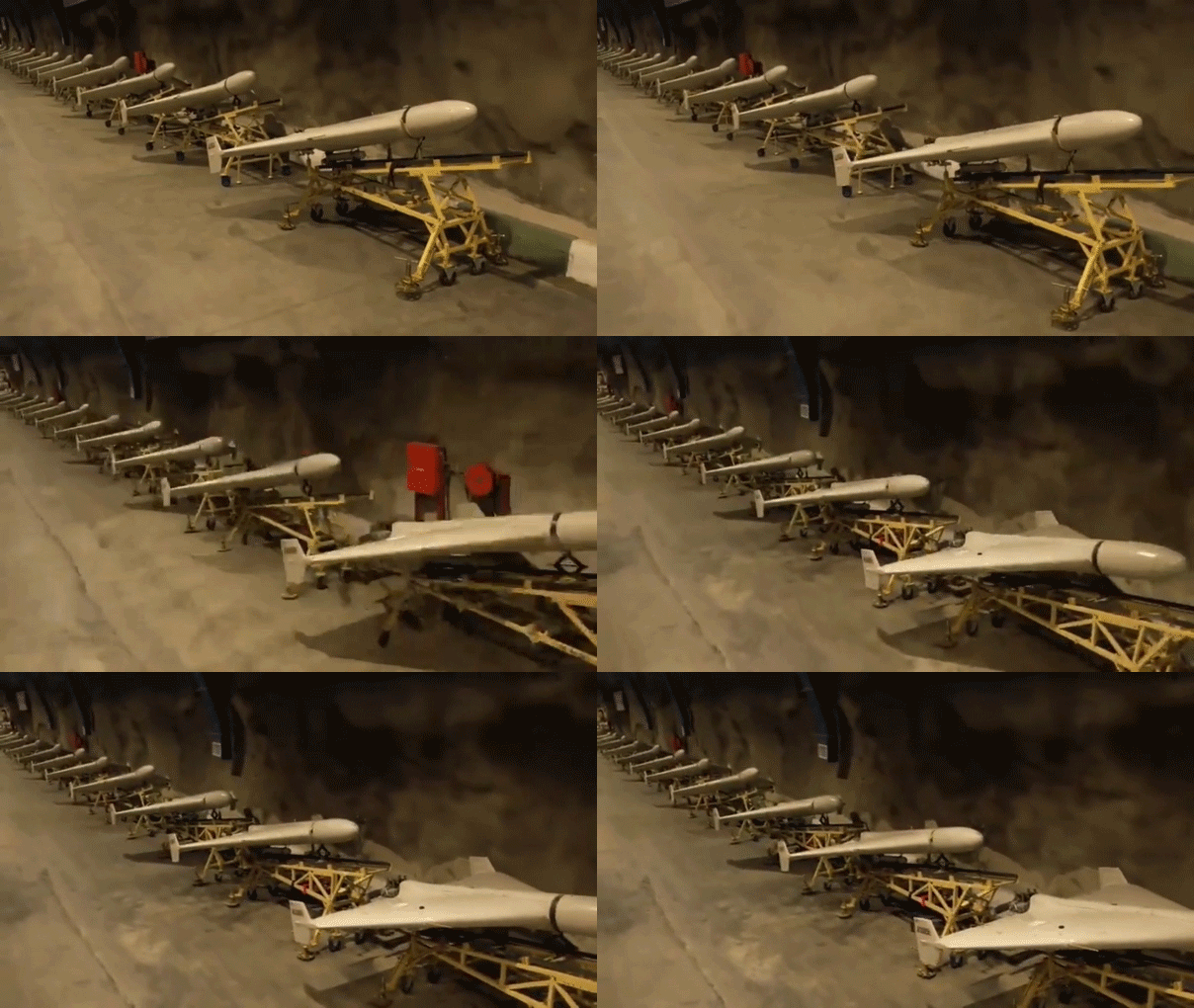
Iranian state broadcaster Fars News Agency released footage purportedly showing vast underground tunnel complexes packed with attack drones mounted on rocket launchers, alongside rows of missiles and imagery of the late Supreme Leader. While the footage drew international attention, analysts and media outlets cautioned that its precise timing and location remain unverified.
Chell expressed measured skepticism about Iran's claimed production capacity. "It is hard to confirm that Iran has the capability now to produce these drones in these volumes during wartime," he said. He also noted that a substantial portion of Iran's Shahed drone output has historically been directed toward Russia, adding another layer of complexity to the stockpile claims.
The Hidden Cost: Draining America's Defense Interceptors
The Carnegie Endowment for International Peace has added institutional weight to these concerns. Senior fellow Dara Massicot highlighted the resource drain that Iran's combined ballistic missile and drone campaign is placing on U.S. and allied defense infrastructure.
"The methods are effective, but targeting drones in this way is resource-intensive and expensive, and it will drain certain types of interceptors quickly," Massicot warned. "Ground-based air defense interceptor missiles are not infinite, and the United States and its partners have had stockpile challenges in this area for years."
The Dawn of a New Era in Drone Warfare
Steve Feldstein, another senior fellow at the Carnegie Endowment, offered a broader perspective on what Iran's campaign represents on a global scale.
"An important point is that the world is entering a new age of drone war as unmanned aircraft are proliferating on the battlefield in major conflicts and smaller ones," Feldstein observed.
The conflict in the Middle East has become a live demonstration of that new reality — one where a nation armed with cheap, mass-produced drones can impose disproportionate costs on even the most sophisticated military powers on earth. For the United States, the challenge is no longer simply about firepower. It is about sustainability.
