Inside the US-Israel Joint Air Campaign Reshaping Modern Warfare Against Iran
A sweeping joint air offensive by the United States and Israel is systematically dismantling Iran's missile infrastructure in what experts are calling an unprecedented chapter in allied military opera
A New Era of Allied Military Power
A sweeping joint air offensive launched by the United States and Israel is systematically dismantling Iran's ballistic missile infrastructure, drawing widespread attention from military analysts who say the campaign represents a watershed moment in the history of allied warfare. Secretary of Defense Pete Hegseth declared that the operation has fundamentally shifted control of Iranian airspace.
"Starting last night and to be completed in a few days… the two most powerful air forces in the world will have complete control of Iranian skies," Hegseth stated. "Uncontested airspace."
He further emphasized the relentless pace of operations: "We will fly all day, all night… flying over Tehran, flying over Iran, flying over their capital. Iranian leaders are looking up and seeing only U.S. and Israeli air power every minute of every day until we decide it's over."
Unprecedented Military Coordination
Israel Defense Forces spokesperson Brigadier General Effie Defrin described the level of bilateral cooperation as extraordinary, telling Fox News Digital that "the cooperation between us and the American military is amazing. We have mutual planning and mutual executing for the plans in Iran and beyond."
John Spencer, Executive Director of the Urban Warfare Institute, noted that Israel matched the United States nearly stride for stride in the opening phase of the campaign.
"Israel matched the United States in the number of aircraft in the air," Spencer explained. "For Israel, that represents roughly 80% of its entire air force capability."
Spencer described the coordination between Washington and Jerusalem as something qualitatively different from previous coalition warfare.
"This isn't separate work," he said. "This is combined work — integrated, synchronized operations combining the powers of two nations."
"In the past, we've seen coalitions built from dozens of countries," Spencer added. "But having a partner that is both willing and capable of bringing immense capabilities like this to the table is extraordinarily rare."
Operation Roaring Lion: The Largest Israeli Air Campaign in History
The Israeli component of the offensive, designated Operation Roaring Lion, was launched with approximately 200 fighter jets executing the most expansive coordinated air strike in the history of the Israeli Air Force.
Within the first 24 hours alone, Israeli aircraft had carved out an operational corridor enabling sustained missions over the Iranian capital, Tehran. Leveraging intelligence gathered jointly by Israel's Intelligence Directorate and the CIA, Israeli jets simultaneously struck missile launch sites and air defense systems across western and central Iran — hitting hundreds of targets in the opening wave.
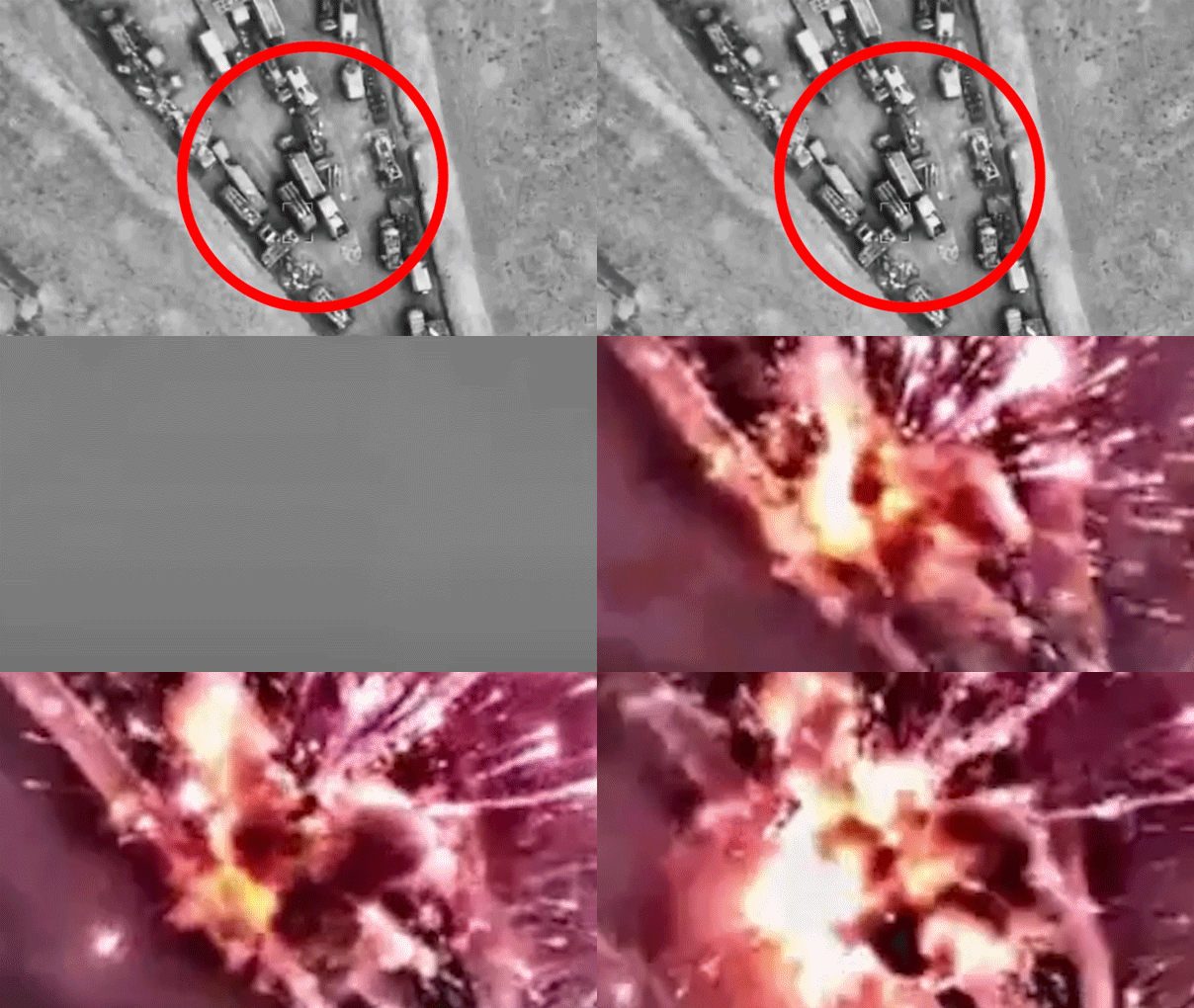
Combined, the allied forces deployed hundreds of munitions against roughly 500 targets, including missile launchers, command-and-control centers, and air defense batteries.
Striking the Leadership First
Israeli intelligence chief Major General Shlomi Binder revealed the stunning speed of the opening strike.
"In 40 seconds, we eliminated more than 40 of the most important people in Iran," Binder said, referencing senior regime officials and military commanders, including Supreme Leader Ali Khamenei. "We are sending a clear message to our enemies — there is no place where we will not find them."
Spencer called the strategic logic behind this approach a dramatic break from conventional military doctrine.
"What Israel did in this opening campaign just wasn't imaginable in the history of war. It never happened," he said. "Usually you target the military first. Here, they targeted political and military leadership simultaneously and had the ability to neutralize them within hours."
Spencer, a veteran of the 2003 Iraq War, placed the achievement in historical context: "Something like this was simply unthinkable even 20 years ago."
Scale and Scope of the Strike Campaign
The sheer volume of military activity has been staggering. As of Wednesday, Israeli aircraft had flown more than 1,600 sorties and deployed over 5,000 munitions since the operation began.
According to the IDF, the strikes have destroyed approximately 300 missile launchers and targeted more than 600 Iranian military infrastructure sites across the country.
In a historic first, an IDF spokesperson confirmed that an Israeli Air Force F-35 fighter jet shot down an Iranian aircraft during the campaign — the first time in history that an F-35 has downed a manned aircraft in combat, and the first aerial kill by an Israeli fighter in over four decades.
Neutralizing Iran's Long-Range Missile Threat
A central objective of the operation has been the degradation of Iran's ballistic missile program. Pre-operation intelligence assessments revealed that Iran had been aggressively scaling up missile production, with plans to reach a stockpile of 8,000 ballistic missiles by 2027. At the start of the campaign, Iran was estimated to hold approximately 3,000 missiles.
The IDF reports that the strikes have already prevented the future production of at least 1,500 ballistic missiles while simultaneously destroying hundreds already in Iran's active arsenal.
"The possession of missiles by a regime that openly declares its intent to destroy the State of Israel constitutes an existential threat," the IDF stated, adding that American forces and regional allies face equal danger from Iran's missile capabilities.
Casualties and Human Cost
The human toll of the conflict continues to mount on multiple sides. Six American service members have been killed and several more wounded during Operation Epic Fury, the U.S. component of the campaign.
In Israel, at least 13 civilians have been killed and more than 1,000 injured as of Wednesday night, the result of Iranian retaliatory missile and drone strikes. The United Arab Emirates has also reported three fatalities and 68 injuries since hostilities began.
Casualty figures within Iran remain difficult to independently verify. Media accounts indicate that dozens of senior Iranian military commanders were killed during the opening phase of the operation, along with additional military personnel and civilians in the vicinity of struck facilities.
Expanding Fronts and the Battle of Endurance
As the conflict continues to widen geographically, Israeli forces have struck more than 160 Hezbollah positions in southern Lebanon over recent days. To sustain operations across multiple simultaneous fronts, Israel has called up approximately 110,000 military reservists.
Spencer framed the broader strategic challenge in stark terms.
"Wars are contests of will," he said. "Iran's strategy is to break the will of the United States and Israel to continue the operation. The question is whether they can endure the pressure long enough to make that happen."
What is unfolding in Iranian skies is, by most expert assessments, a genuine inflection point — a glimpse into the future of high-intensity, technologically integrated allied warfare that military strategists will be studying for decades to come.