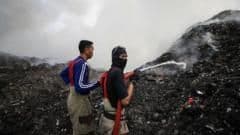
Indonesia's Burning Landfill Crisis: A Wake-Up Call on Waste Mismanagement
A massive landfill fire near Jakarta has burned for over a week, exposing Indonesia's deepening waste management crisis and endangering thousands of residents.

A Fire That Refuses to Die
For more than eight days, a relentless blaze has consumed a towering mountain of garbage at the Jatiwaringin landfill, located on the outskirts of Jakarta, Indonesia. Spreading across more than 15 hectares, the fire has blanketed surrounding neighborhoods in dense, poisonous smoke, forcing hundreds of residents to abandon their homes and seek emergency shelter.
Firefighting teams have deployed an extensive arsenal of resources — including helicopters, water tankers, bulldozers, and drones — in an effort to bring the inferno under control. Authorities remain hopeful the fire can be fully extinguished before the week is out, but environmental advocates warn this disaster is far more than an isolated incident.
Residents Left Gasping for Air
The human toll of the blaze has been severe. Health officials have recorded at least 234 residents seeking medical attention for respiratory problems directly linked to the fire, with 72 of those cases diagnosed as acute respiratory tract infections.
Sarmanah, a 45-year-old local resident, described the harrowing conditions that forced her and her child to flee their home.
"The smoke was so thick you couldn't see anyone," she told reporters. "It stings the nose, makes you cough and have a runny nose, and makes you unable to breathe. We were forced to leave because we couldn't take it anymore."
Another displaced resident, 37-year-old Tosiyani, said she was barred from returning home due to dangerous levels of toxic gas in the smoke. Measurements taken by Indonesia's Ministry of Environment confirmed that air quality near the landfill had reached hazardous levels, though conditions have shown some improvement in recent days.
Why the Fire Is So Difficult to Extinguish
Djohan Darmawan, Director of Emergency Operations Control Coordination at the National Disaster Management Agency (BNPB), explained that the fire presents unique challenges for firefighters. Unlike a conventional surface fire, this blaze is smoldering deep within the compacted layers of rubbish — making it extraordinarily difficult to locate and suppress.
Active fire spots continue to burn in several waste piles, particularly in areas to the west and south of the landfill site.
The Indonesian environmental organization Walhi (Forum for the Environment) has attributed the fire's origin to a buildup of methane gas produced by decomposing organic waste — a direct consequence of the country's largely unregulated open dumping practices.
"This is a time bomb of accumulated waste management problems that have been ignored for years without fundamental improvements," said Wahyu Eka Styawan, a Walhi campaigner.
A Landfill Stretched Far Beyond Its Limits
At the heart of this crisis lies a fundamental mismatch between waste generation and infrastructure capacity. According to Walhi, the Jatiwaringin landfill is designed to handle up to 2,700 tons of waste per day — yet that figure accounts for only 59% of the total waste produced by Tangerang Regency alone.
The overflow has led to widespread illegal open dumping across Tangerang, with informal trash mountains sprouting up within meters of residential neighborhoods. Long before the fire erupted, locals living in the shadow of Jatiwaringin's waste piles complained of overwhelming odors, persistent fly infestations, and constant anxiety over the threat of garbage landslides.
When methane accumulation is compounded by increasingly intense heat waves driven by the climate crisis, these dumping sites can effectively become tinderboxes.
"As soon as there is a small spark or heat, the methane gas under the mountain of rubbish immediately ignites," Wahyu explained.
A Pattern of Recurring Disasters
The Jatiwaringin fire is not an anomaly — it is part of a disturbing pattern. In 2023, a string of major landfill fires broke out across Indonesia. The Sarimukti Landfill in Bandung Regency burned through dozens of hectares, with cigarette butts and methane buildup suspected as causes. Months later, a separate landfill fire in Tangerang destroyed approximately 80% of a 35-hectare site under similar circumstances.
The fire at Jatiwaringin reportedly ignited on June 30, started by a small spark that was rapidly spread by strong winds across multiple sections of the site — including areas laden with deep waste accumulation that proved nearly inaccessible to emergency crews.
Government Response and Systemic Failures
Rizal Irawan, Deputy for Environmental Law Enforcement at Indonesia's Ministry of Environment and Forestry, confirmed that a formal investigation into the fire's cause will be launched once the blaze is fully contained. He also noted that the Jatiwaringin landfill had already received administrative sanctions in 2025 for inadequate management practices.
Looking ahead, the Ministry has announced plans to evaluate 390 landfills across Indonesia in early August 2026. Authorities have also instructed regional governments to transition toward a controlled landfill system, in which waste is flattened and compacted by heavy machinery before being covered with periodic layers of soil. This method can significantly reduce methane buildup, lower disease risks, and improve overall site conditions.
However, environmental campaigners remain skeptical that meaningful change will follow without genuine political commitment.
"Regulation is not implemented because there is no firmness and sanctions, the budget for waste management in the regions is minimal, and there is a lack of focus on educating residents about sorting organic waste from home," said Wahyu.
An Ecological Crisis Born of Neglect
Walhi has characterized the Jatiwaringin disaster as an "ecological disaster resulting from systemic negligence" — a damning indictment of decades of inadequate waste policy at both the national and regional levels.
Until Indonesia's central and local governments demonstrate a concrete, sustained commitment to overhauling their waste management infrastructure — backed by meaningful enforcement, adequate funding, and public education — experts warn that fires like this one will continue to ignite, and communities will keep paying the price.