How Your Zip Code Shapes Your Child's Brain Development
Groundbreaking research reveals that socioeconomic conditions are physically altering children's brain structure in ways clearly visible on MRI scans.

Socioeconomic Conditions Are Physically Rewiring Children's Brains
A landmark study published in the journal Science has revealed that where a child grows up may matter far more to their brain development than previously understood. Analyzing data from over 2,300 children between the ages of 9 and 10, researchers discovered that socioeconomic factors — including household income, access to education, and neighborhood quality — are the dominant drivers of measurable differences in brain structure and function.
What the Research Found
Using MRI scans drawn from the federally funded Adolescent Brain Cognitive Development (ABCD) Study, scientists identified clear structural and network-based differences in children's brains. When they ranked every possible contributing factor by influence, the results were striking: nearly every top-ranking variable was tied to socioeconomic opportunity.
Scott Marek, the study's lead author and an assistant professor of radiology at WashU School of Medicine, admitted the findings initially caught the team off guard. "The pattern that emerged was, at first, very confusing to us," he said. "We need to find out how socioeconomics is becoming biologically embedded."
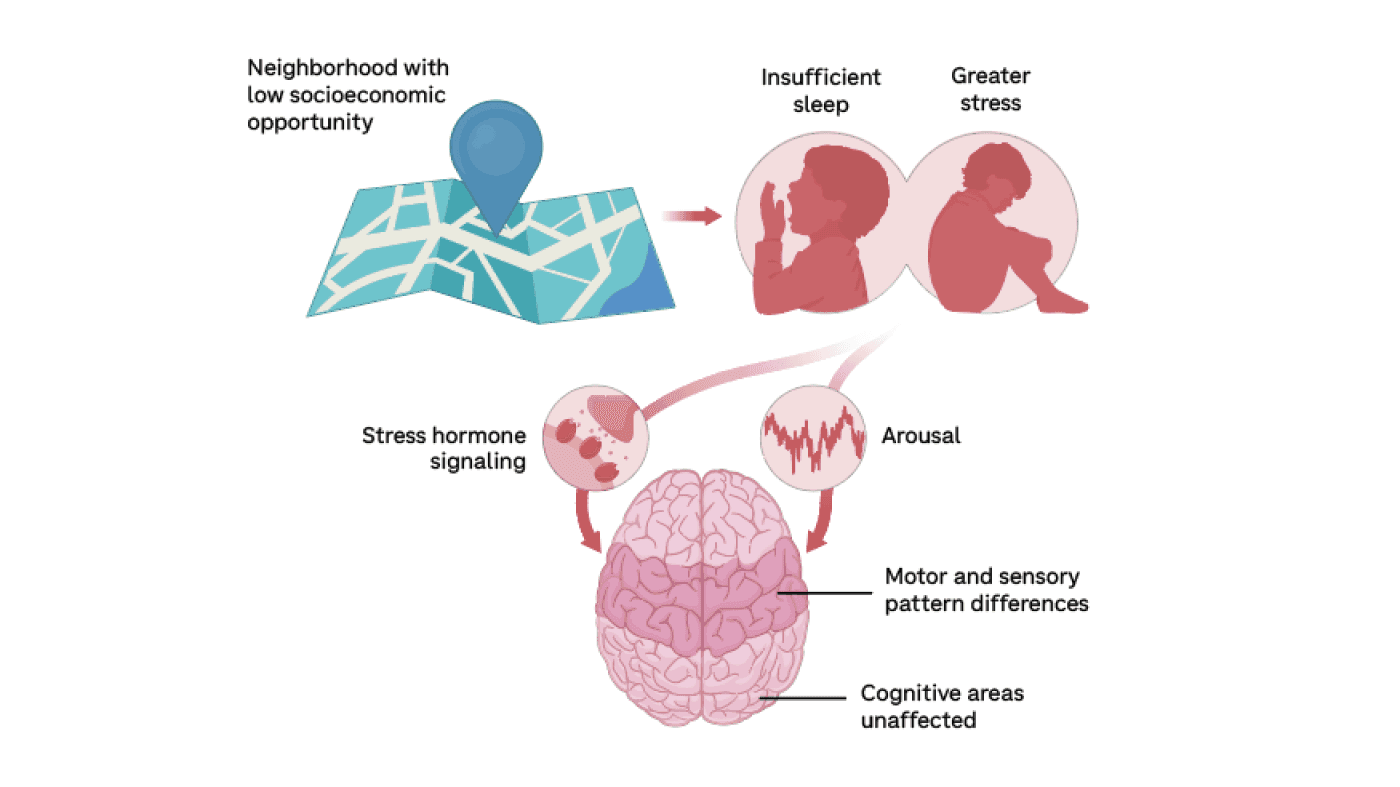
Notably, these brain differences were concentrated in regions responsible for sensory processing and motor control — not higher cognitive areas like memory or attention.
The Sleep, Stress, and Screen Time Connection
Researchers dug deeper to understand the mechanism behind these changes. Their investigation pointed to brain circuits that regulate wakefulness and alertness — circuits known to be disrupted by chronic stress, poor sleep, and excessive screen time.
Children raised in lower-income neighborhoods with limited social resources were found to experience all three of these stressors at significantly higher rates. The cumulative effect appears to leave a measurable biological imprint on developing brains.
"The data are screaming that we should be looking at sleep, stress, and screens if we want to get somewhere," Marek noted, while clarifying that the study establishes association rather than direct causation.
Challenging Earlier Assumptions
The findings also call into question a body of prior research that examined brain development through the lens of IQ and mental health alone — without accounting for the overriding influence of socioeconomic environment.
Dr. Theodore D. Satterthwaite, an associate professor at the University of Pennsylvania Perelman School of Medicine and co-author of an accompanying perspective piece, suggested that some of those earlier studies "may require re-evaluation." By failing to control for socioeconomic variables, those studies may have drawn misleading conclusions about the relationship between cognitive performance and brain structure.
A Growing Body of Evidence
Dr. Nico Dosenbach, a co-author of the new study and professor at WashU Medicine in St. Louis, emphasized just how dominant the socioeconomic variable proved to be. "Socioeconomics was, by a wide margin, absolutely the dominant variable," he said, noting that factors like IQ and mental health did show a modest influence — but nothing comparable.
Russell Poldrack, a psychology professor at Stanford University who was not involved in the research, described the study as a powerful reminder that "the environment in which we grow up and live has powerful impacts on our brain."
For researchers, policymakers, and parents alike, the message is increasingly difficult to ignore: childhood poverty and neighborhood disadvantage are not just social issues — they are neurological ones.

