How Young Dinosaurs Could Stand Tall — And Why Size Eventually Stopped Them
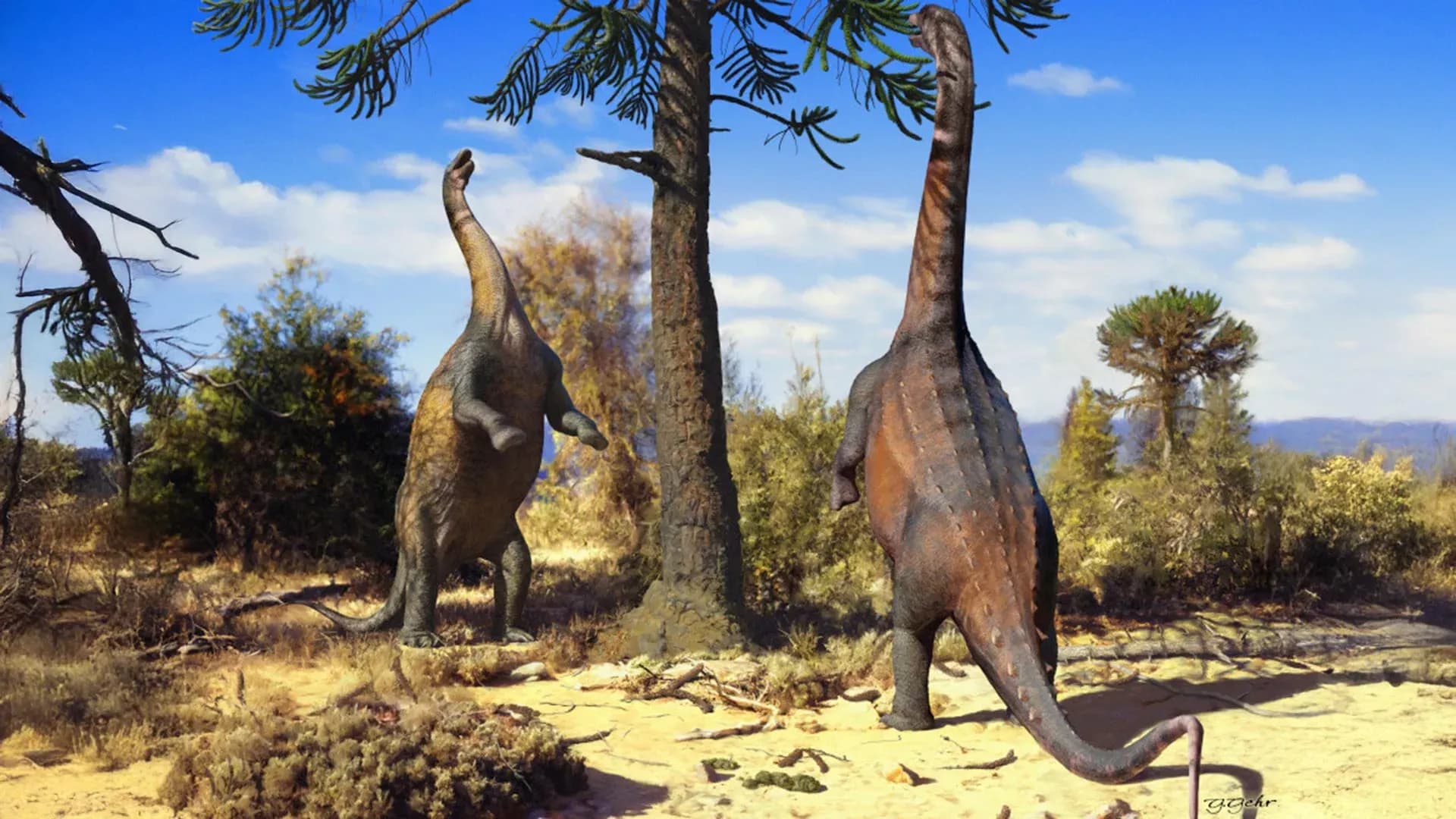
Some smaller sauropods could rear up on two legs with ease, but as they grew, their own weight made this powerful posture increasingly difficult to sustain.

When Dinosaurs Stood on Two Legs
Long before the age of modern giants, certain dinosaurs were pulling off a remarkable physical feat — rising up on their hind legs to tower over their surroundings. New research reveals that some smaller sauropods were surprisingly well-equipped for this upright posture, using it to access food, intimidate predators, and potentially attract mates. But there was a catch: the bigger they got, the harder it became.
A study published in the journal Palaeontology, led by an international team of researchers from Brazil, Germany, and Argentina, sheds new light on this extraordinary behavior — and explains why body size was ultimately the limiting factor.
Two Species That Could Rise Above the Rest
Approximately 66 million years ago, during the Late Cretaceous period, two South American sauropods demonstrated a rare ability among their kind. The Brazilian Uberabatitan ribeiroi and the Argentine Neuquensaurus australis — both roughly comparable in size to modern elephants — were capable of standing upright on their hind legs for extended periods of time.
Though considered small by sauropod standards, these were still formidable creatures. Adult Uberabatitan individuals may have stretched up to 26 meters in length, earning the species the title of the largest dinosaur ever discovered in Brazil. Despite their impressive scale, the research suggests that prolonged bipedal standing was primarily a behavior observed in younger, lighter individuals.
Standing tall on two legs offered these plant-eating giants significant survival advantages. By rearing up, they could browse vegetation far beyond the reach of competing herbivores. The posture may also have served as a visual threat display against predators, making the animal appear considerably larger. Researchers also suggest it could have played a role in mating behaviors, from physical mounting to elaborate courtship displays.
Engineering Science Meets Paleontology
To investigate how these ancient animals handled the physical demands of bipedal posture, researchers turned to a technique borrowed from structural engineering — finite element analysis (FEA). This computational method is commonly used to assess how materials and structures respond to physical forces, such as the stress calculations performed when designing a bridge.
The team digitally reconstructed femur bones from seven different sauropod species, drawing on fossil specimens held in museum collections across the globe. Each species was chosen to represent a diverse range of evolutionary lineages, body sizes, and skeletal characteristics.
Simulating Stress From Two Angles
The simulations examined stress on the femur from two distinct perspectives. The first — an extrinsic scenario — modeled the downward force of gravity and the dinosaur's own body weight pressing on the femur while the animal stood on two legs. The second — an intrinsic scenario — calculated the force generated by the animal's own muscles acting on the same bone.
"Using this technique, we performed two simulations," explained Julian Silva Júnior, postdoctoral researcher at São Paulo State University (FEIS-UNESP) and the study's lead author. "One dealt with the extrinsic scenario — gravity and the animal's weight on the femur. In the other, we analyzed the intrinsic scenario — the force that the muscles would exert on the femur."
By combining both results, the team was able to estimate the total mechanical stress each species would have experienced when standing upright.
South American Species Had a Structural Advantage
The findings revealed that Uberabatitan and Neuquensaurus registered the lowest stress levels in their femur bones across all species studied. Their skeletal architecture — featuring more robust femurs capable of distributing force more effectively — gave them a distinct physical edge when it came to sustaining an upright stance.
Larger sauropods, despite possessing enormous muscles and massive femurs of their own, simply couldn't overcome the mechanical disadvantage of their extraordinary body weight. The stress placed on their leg bones during bipedal posture would have been substantially greater, making prolonged upright standing impractical.
"They had more robust femurs and could dissipate stress better," said Silva Júnior. "The bigger ones had very large muscles and even giant femurs, but not enough to support their weight. That doesn't mean they couldn't stand up, but they probably chose the best time to do so — because it must have been an uncomfortable position."
Importantly, adult Uberabatitan individuals — unlike the juvenile specimen analyzed in the study — would likely have faced the same biomechanical challenges as other large sauropods, suggesting this ability diminished significantly with age and growth.
Acknowledging the Limits of the Model
The researchers were transparent about the boundaries of their analysis. The simulations did not account for cartilage, which would have cushioned joint stress in living animals, nor did they factor in the stabilizing role of the tail — which may have functioned as a third support point in a tripod-like stance during bipedal posture.
Because no direct cartilage evidence was preserved in any of the fossil specimens, the team applied consistent assumptions across all species. "The tool we use is very efficient for comparisons, even if the answer isn't exact for each one," Silva Júnior noted. "By comparing representatives from different lineages, we can get a fairly accurate picture of how these animals behaved millions of years ago."
A Behavior That Faded With Growth
What emerges from this research is a nuanced portrait of dinosaur behavior shaped by the realities of biology and physics. For young, lighter sauropods, rearing up on two legs was a genuinely useful and relatively comfortable strategy. As these animals matured and their mass increased, the same posture became a calculated, energy-costly decision rather than a routine behavior.
What was once an agile and effective tactic in youth gradually transformed into an occasional, strategic act in adulthood — a vivid reminder that even in the age of giants, size always came with trade-offs.

