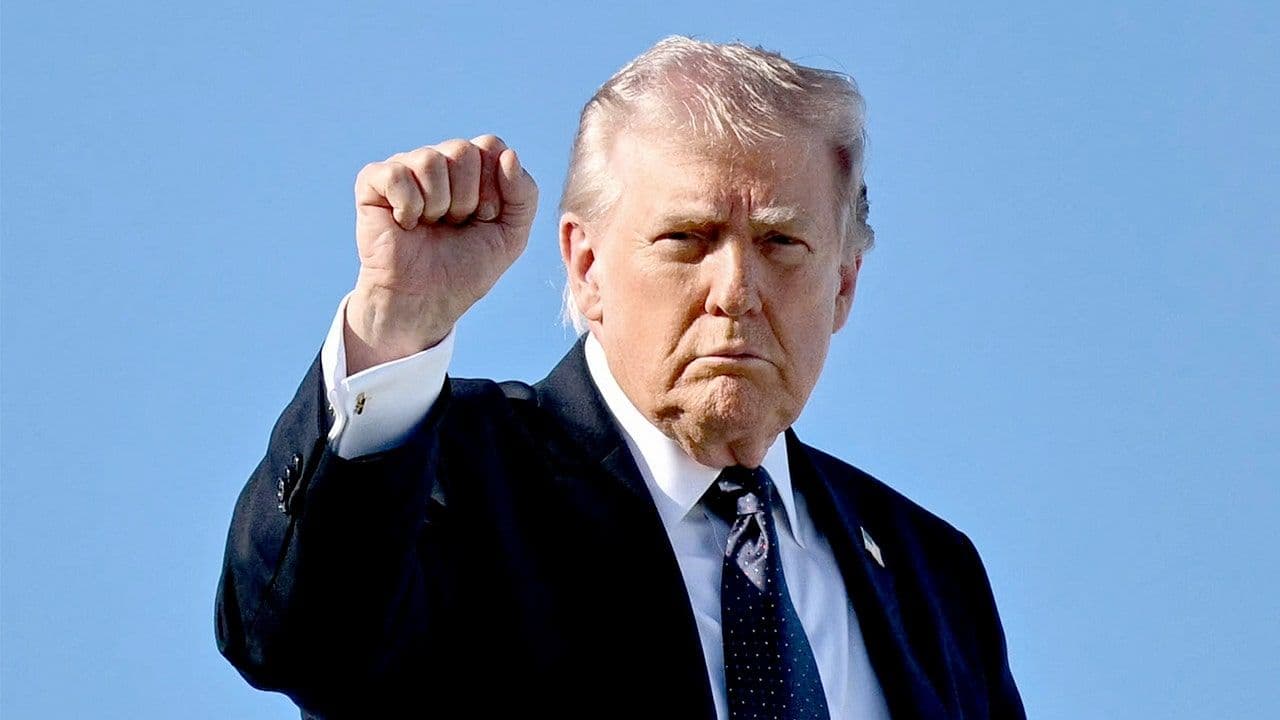
How Trump's Bold Stand Against Iran's Nuclear Ambitions May Have Secured America's Future
Critics called him reckless and unqualified. But President Trump's decisive actions against Iran's nuclear program may prove to be one of history's most consequential national security decisions.

Critics Got It Wrong: Trump's National Security Legacy Reexamined
When Donald Trump entered the 2016 presidential race, the foreign policy establishment wasted no time in condemning him. More than 50 former Republican national security officials warned that he would endanger the country. A former Secretary of Defense accused him of being cavalier with nuclear weapons. Experts from across the political spectrum dismissed him as dangerous and unprepared.
History, however, is telling a different story.
Those critics fundamentally misread the man. They failed to understand that Trump viewed protecting the American people as the defining obligation of the presidency — and that preventing a radical, terror-sponsoring regime from obtaining a nuclear weapon was, for him, non-negotiable.
The Iran Nuclear Threat: Decades in the Making
The international community has monitored Iran's nuclear ambitions with growing alarm for years. What makes Iran's program uniquely dangerous is not just the nuclear component — it is the combination of nuclear development with an ever-expanding ballistic missile program capable of delivering warheads across vast distances.
Various efforts have been made over the years to slow Iran's progress. The Stuxnet cyberattack in 2010, for example, sabotaged hundreds of uranium-enriching centrifuges at Iran's Natanz facility, reportedly setting the program back by roughly two years. Yet despite such interventions, Iran consistently rebuilt and expanded its capabilities, repeatedly flouting oversight from the International Atomic Energy Agency (IAEA).
The Deeply Flawed Iran Deal
In 2015, the Joint Comprehensive Plan of Action — widely known as the Iran Deal — was finalized with strong backing from the Obama administration and enthusiastic support from many of the same national security officials who would later oppose Trump's candidacy.
Trump was openly critical of the agreement from the start, branding it a "horrible, one-sided deal." His objections were substantive: the deal failed to address Iran's ballistic missile program, and its built-in sunset clauses meant that nuclear restrictions would gradually expire, effectively giving Iran a clear runway to resume full-scale nuclear development.
There was another glaring flaw that deserves more attention. American inspectors were explicitly excluded from IAEA inspection teams. As Obama's National Security Advisor Susan Rice confirmed at the time, no Americans would participate in those inspections. This was a remarkable concession given that the United States contributes more than 25% of the IAEA's total budget — making American taxpayers the agency's single largest financial supporters. Excluding U.S. personnel from verification missions while expecting American funding was, to put it plainly, indefensible.
In 2018, President Trump formally withdrew the United States from the Iran Deal — a decision driven by his unwavering conviction that Iran must never be permitted to cross the nuclear threshold.
Iran, North Korea, and a Dangerous Nuclear Alliance
One of the most underreported dimensions of the Iran nuclear threat is its deep entanglement with North Korea's weapons programs. Iran has long served as a key enabler of Pyongyang's nuclear and ballistic missile development, and the relationship stretches back further than most realize.
According to the Federation of American Scientists, Iran and North Korea began their strategic partnership as far back as the early 1980s, with Iran helping to fund North Korea's missile program. Open-source intelligence analysis revealed as early as 2012 that Iranian technical experts were present at North Korean missile launches. Further investigation showed that both nations were utilizing the same miniaturized nuclear warhead design — a blueprint traceable to the notorious Pakistani proliferator Dr. A.Q. Khan.
On September 1, 2012, North Korea and Iran formalized their collaboration by signing a scientific and technological cooperation agreement in Tehran. During that visit, Supreme Leader Ayatollah Khamenei personally called on both nations to pursue their goals in defiance of international pressure and sanctions. Japan's Kyodo News Agency subsequently reported that Iran embedded personnel inside North Korea to deepen cooperation on missile and nuclear development.
The physical evidence is hard to ignore as well. Iran's Shahab ballistic missile bears a striking resemblance to North Korea's Taepodong missile — a visual reminder of just how intertwined these two programs have become.
Operation Midnight Hammer and Operation Epic Fury
On June 22, 2025, President Trump authorized Operation Midnight Hammer — a decisive military strike targeting Iran's primary nuclear facilities at Fordow, Natanz, and Isfahan. The operation represented the most direct action ever taken to neutralize Iran's nuclear infrastructure.
This was followed by Operation Epic Fury, launched after the IAEA reported suspicious activity at previously bombed uranium enrichment sites, signaling that Iran was attempting yet another reconstitution of its program. Intelligence assessments had also confirmed that Iran had been quietly rebuilding its ballistic missile program the previous autumn, following the receipt of multiple shipments of sodium perchlorate from China — the primary chemical precursor used in Iranian ballistic missile propellant.
Senator Lindsey Graham captured the geopolitical significance of these events plainly: "The mothership of terrorism is sinking. The captain is dead. The largest state sponsor of terrorism — Iran — is close to collapsing."
A Decision Made for Future Generations
The foreign policy elite who spent years opposing Trump were, in many cases, the same architects of the Iran Deal — an agreement that would have eventually cleared the path for Iran to resume its nuclear ambitions with international legitimacy. Previous administrations compounded the problem by transferring massive sums of cash to Tehran, effectively providing the regime with a financial lifeline.
Trump chose a fundamentally different approach. He trusted his instincts over consensus opinion, and he refused to defer the hard choices to future administrations. The safety of American children and grandchildren, he argued, could not be mortgaged by short-term diplomatic convenience.
The results speak for themselves. Both China and Russia are watching — and recalibrating. The message from Washington is unmistakable: this president prioritizes American security above all else and does not pass problems down the line for someone else to solve.
For the first time in a long time, the world is witnessing what genuine American leadership looks like.
