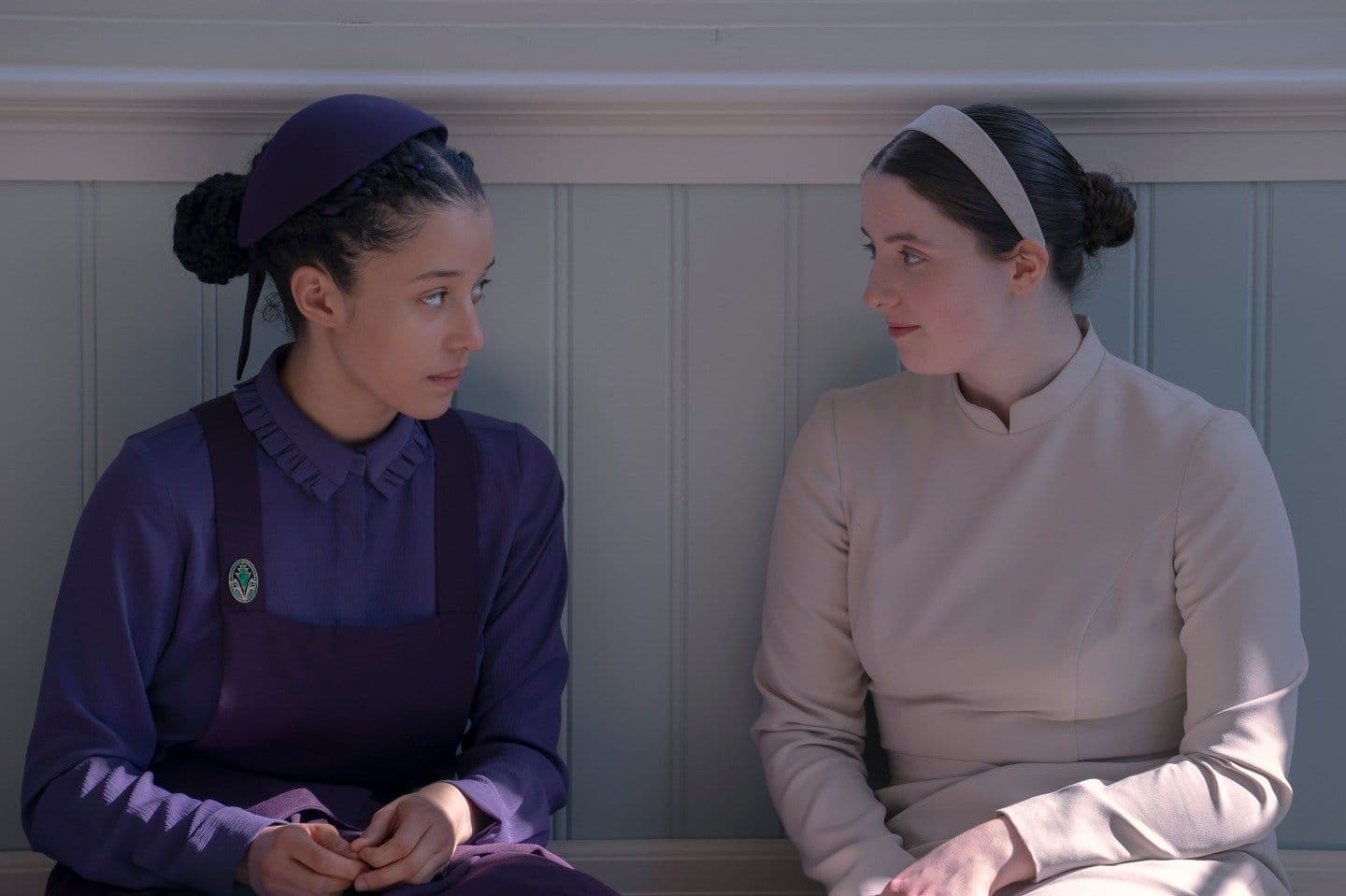
How 'The Testaments' Builds on 'The Handmaid's Tale' Legacy — Without a Single Red Cloak in Sight
The Hulu sequel series returns to Gilead with bold creative choices, a reimagined cast, and a deliberate decision to forge its own identity.

'The Testaments' Steps Out of 'The Handmaid's Tale' Shadow
Returning to the dystopian world of Gilead was never going to be a simple task. For the creative team behind Hulu's new sequel series The Testaments, the challenge wasn't just adapting Margaret Atwood's follow-up novel — it was proving that this new chapter could thrive without leaning entirely on what came before.
Warning: Major spoilers ahead for the three-episode premiere of The Testaments.
Executive producer Warren Littlefield recently sat down with The Hollywood Reporter to discuss the careful balancing act the show required. "I had déjà vu all over again with Chase Infiniti sitting at the window in The Testaments," he said, reflecting on the weight of audience expectations and confirming that the story will need at least three seasons to be told in full.
A New Vision for a Familiar Universe
At the heart of every creative decision was one guiding principle: The Testaments had to stand entirely on its own. That meant resisting the urge to simply pick up where The Handmaid's Tale left off, and it meant making some bold, deliberate departures.
Perhaps the most striking of those decisions? Not a single red cloak appears anywhere in the first season.
"As powerful as that symbol is, and as proud as we are of what it came to represent in the world, we had to move forward," Littlefield explained. The iconic crimson garment, synonymous with the oppressed handmaids of Gilead, has been completely absent from season one — a conscious creative choice to signal that this is a new story with its own visual language and identity.
Even the show's title went through a philosophical shift. Early in development, the team considered branding it as The Handmaid's Tale: The Testaments, but quickly abandoned that approach. "We were like, 'Nope, we have to let that go,'" Littlefield recalled.
Elisabeth Moss: Still There, Just Behind the Scenes
Few figures were more central to The Handmaid's Tale than Elisabeth Moss, who portrayed protagonist June Osborne across all six seasons, directed ten episodes, and served as an executive producer throughout. Her involvement in The Testaments continues behind the camera in that same producing role — but her on-screen presence has been deliberately scaled back.
Moss's return as June was kept completely under wraps until the series premiered, adding a genuine element of surprise for audiences. Rather than anchoring the new show, June now appears as a supporting character — specifically as a handler within the Mayday resistance movement. It's a meaningful but measured role, and one that Moss herself fully endorsed.
"No one knows better than Lizzie that for Testaments to work, there has to be a show without June," Littlefield said. "She's invaluable as a partner. But the show had to live on its own."
Littlefield also hinted that he's already deep in preparations for Moss's next project — describing it as "a very, very different show and a very different character."
The Road to 'The Testaments' Began in 2018
The groundwork for this series was laid years before cameras rolled. Back in 2018, while The Handmaid's Tale was still in its second season, the executive producers began quiet conversations with Atwood about the sequel novel she was developing. That book, The Testaments, was published in 2019, and Hulu and MGM moved quickly to secure the rights.
As THR previously revealed in an oral history, Atwood had provided showrunner Bruce Miller with a brief "no-kill list" — a handful of characters who needed to survive the original series because they would play pivotal roles in the sequel. Those protected characters included June, Aunt Lydia (reprised by Ann Dowd in The Testaments), and June's daughters: Hannah/Agnes, now portrayed by Chase Infiniti, and baby Nichole.
How the Timeline Changed Everything
While Atwood's novel is set 15 years after the conclusion of The Handmaid's Tale, the series jumps forward only four years. That condensed timeline required significant creative reimagining — particularly when it came to the character of Daisy.
In the book, Daisy is essentially Nichole, June's biological daughter, now a teenager. But in the series, since Nichole would only be about four years old at the time of the story, the writers reinvented Daisy entirely. Played by Lucy Halliday, this version of Daisy — referred to as a "Pearl Girl" — has no biological connection to June. Instead, she functions as June's surrogate daughter and is sent into Gilead as a spy by the Mayday resistance.
The twist that drives early tension in the series: June unknowingly dispatches Daisy to the same institution where her long-lost daughter Hannah/Agnes has been living since being taken from her years earlier.
According to Littlefield, Miller identified the Daisy reinvention as the single biggest creative hurdle in adapting the novel. However, the team was careful to preserve the essence of who Daisy is — a fierce outsider navigating an oppressive world, with a deep if unconventional bond with June.
A Multi-Perspective Story Set in a Darker Gilead
Like the source novel, The Testaments employs a multi-perspective narrative structure. The story unfolds through the viewpoints of Agnes/Hannah, Daisy, and Aunt Lydia — a trio of female perspectives that each offer a distinct window into how Gilead functions and fractures.
The series is also set in a geographically different corner of the Gilead universe — closer to the corridors of power in Maryland and Virginia, near Washington, D.C. That shift in location contributes to the show's different color palette and atmosphere, reinforcing its visual and tonal independence from its predecessor.
Looking Ahead: Season Two Is Already in Development
Despite the enormous pressure of following one of the most acclaimed drama series in recent television history, Littlefield says the team forged ahead with both clarity and conviction.
"We were scared to death," he admitted, acknowledging the cultural significance The Handmaid's Tale held — not least for establishing Hulu as a major player in prestige television. "But we have Margaret to guide us. We have Bruce reinventing a vision."
With three episodes now streaming on Hulu, the creative momentum shows no signs of slowing. "We're in the writers room for season two," Littlefield confirmed — signaling that the team is fully committed to the long game, with hopes of at least three seasons to complete this next chapter of the Gilead saga.

