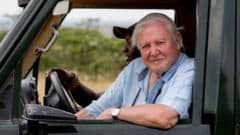
How Sir David Attenborough Turned Bristol Into the Wildlife Film Capital of the World
Bristol produces 80% of the world's natural history TV. Here's how one legendary naturalist built an entire industry from the ground up.

Bristol: The 'Green Hollywood' Behind Your Favorite Nature Documentaries
When people celebrate Sir David Attenborough's remarkable centenary, they tend to focus on his iconic voice, his awe-inspiring documentaries, and his lifelong dedication to the natural world. What rarely gets the spotlight, however, is an equally extraordinary achievement — his central role in building a thriving global industry, rooted in the city of Bristol, that now employs thousands of people and generates millions in revenue.
Today, Bristol is responsible for producing approximately 80% of the world's high-quality natural history television. That staggering figure has earned the city a striking nickname among industry insiders.
"Bristol is seen as the kind of 'Green Hollywood'," says Lucie Muir, CEO of the Wildscreen Awards and Festival.
The Man Who Made Wildlife Television a Global Business
Keith Scholey, a veteran filmmaker who has collaborated with Attenborough for four decades, puts it plainly: "Without Sir David, the wildlife film industry in Bristol would be a shadow of what it is."
Scholey's own story mirrors that of many Bristol-based filmmakers. He first crossed paths with Attenborough in 1981, fresh out of Bristol University with a zoology degree and ambitions to break into television. That connection proved career-defining. He went on to direct celebrated series including Planet Earth and The Private Life of Plants, before co-founding Silverback Films in 2012 alongside fellow Attenborough collaborator Alastair Fothergill.
"He made it famous, he made it internationally valuable," Scholey says of Attenborough. "All of us who went on to have careers in natural history in this city benefited from the genius of this man."
Today, Bristol's reputation is so firmly established that the biggest names in global broadcasting — Netflix, Apple TV+, Disney, National Geographic, and the BBC — consistently turn to the city for natural history content.
"We had the big players coming to us," Scholey recalls. "We have built a concentration of talent in Bristol that is quite unique."
From Behind the Desk to In Front of the Camera
Attenborough's influence on Bristol's wildlife industry didn't begin on screen. His earliest and perhaps most consequential contribution came from an executive role. As Controller of BBC2, he pioneered the concept of ambitious, large-scale landmark programming — a format that would define the genre for generations.
After stepping away from management, he transitioned into presenting, forging a close working relationship with the BBC's Natural History Unit (NHU), based in Bristol. The result of that partnership was nothing short of revolutionary.
Life on Earth: The Series That Changed Everything
Broadcast in 1979, Life on Earth was a landmark moment in television history. Filmed across more than 100 locations around the globe, the series cost over £1 million — a staggering budget for its era. It drew an audience of 15 million viewers in the UK alone, and an estimated 500 million people worldwide.
"It was extraordinary," says Scholey. "David would be in South America, then Australia, showing things people had never seen — underwater life, bats, reptiles, everything. He was the first person to make international wildlife popular."
Beyond its cultural impact, Life on Earth fundamentally transformed how wildlife television was financed. A landmark co-production deal with Warner Brothers introduced American investment into the genre for the first time.
"That was the first time money from America had been invested in a natural history series," Scholey recalls.
Prior to this, the NHU had largely confined itself to filming British wildlife on modest budgets. Attenborough's vision was unapologetically global — and it required serious financial backing to match. The series was ultimately sold to more than 100 territories, proving once and for all that wildlife filmmaking could compete as a global blockbuster genre.
Innovation as a Competitive Advantage
Attenborough didn't just expand the scope and scale of wildlife filmmaking — he pushed its technical boundaries as well. During the production of Life on Earth, his team employed cutting-edge film stock to deliver sharper, richer color imagery, and famously filmed bats inside a wind tunnel to capture footage that had never been seen before.
This spirit of technical ambition became embedded in Bristol's Natural History Unit, which built a reputation not just for using the latest camera technologies, but for actively developing and inventing new ones.
A Legacy Written in Industry
The Wildscreen Festival, held in Bristol every two years and widely regarded as the "Oscars of Wildlife filmmaking", draws the global natural history community to the very city Attenborough helped put on the map.
"Bristol is the beating heart of the wildlife film industry," says Muir.
For Scholey, the scale of what Attenborough built is still remarkable to reflect on.
"Filming wildlife is expensive. You have to go all over the world. International finance has been a huge part of it — but wow, we've had quite a ride."
As Sir David Attenborough reaches his hundredth year, his legacy extends far beyond the screen. He didn't just narrate the wonders of the natural world — he built an entire industry dedicated to sharing them.