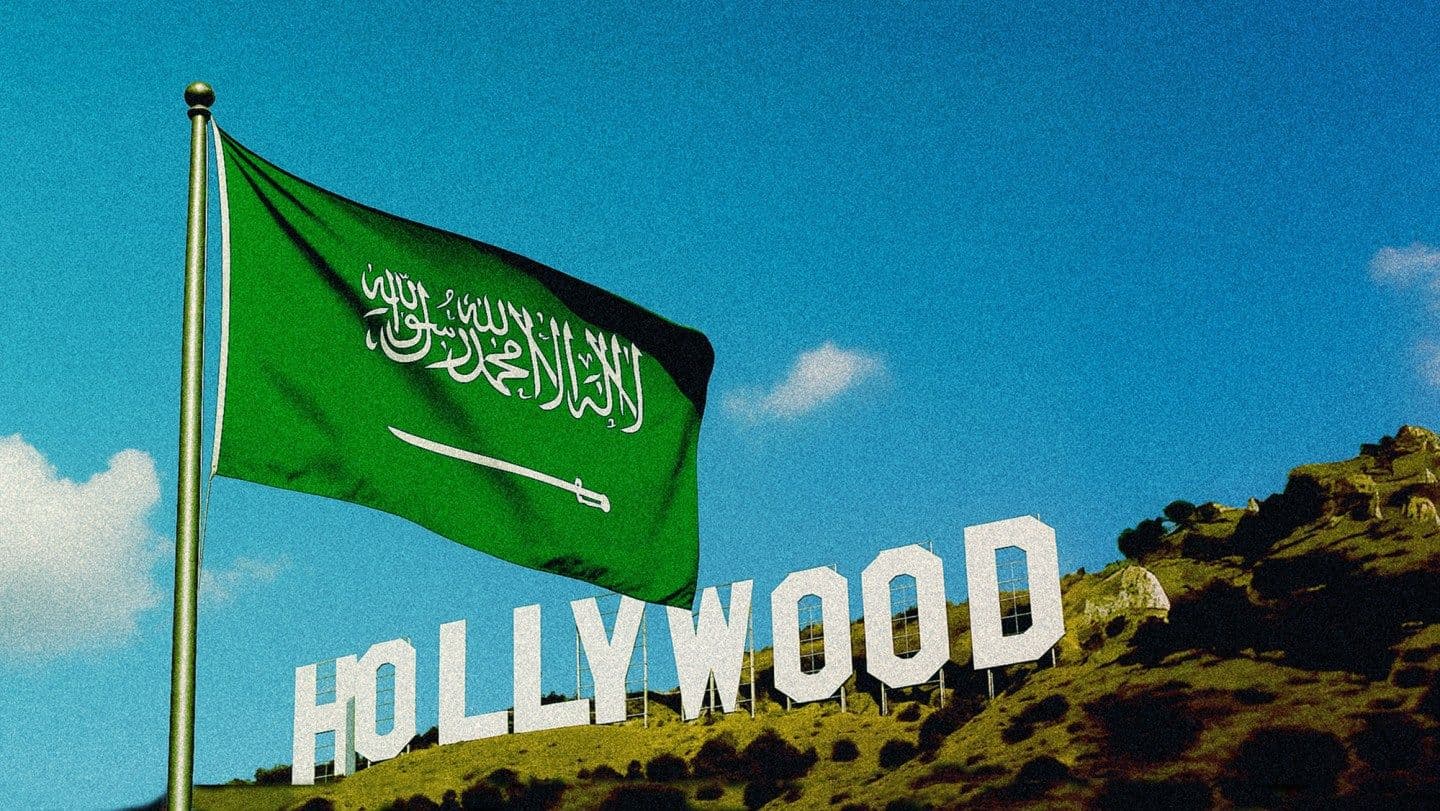
How Saudi Arabia Is Quietly Buying Its Way Into Hollywood's Future
With $24 billion flowing into a landmark Hollywood merger, Saudi Arabia's entertainment ambitions extend far beyond the multiplex. Here's what's really at stake.

Saudi Arabia's Hollywood Power Play Is Bigger Than Anyone Expected
Late on a weeknight in Riyadh, the lobby of a gleaming new multiplex buzzes with energy that feels nothing short of extraordinary given where this country stood less than a decade ago. Teenagers hover around snack counters, families glide up escalators, and showtimes roll well past midnight — some stretching to 1 a.m., 2 a.m. and beyond — calibrated for a society that lives most of its life after the brutal desert heat has faded.
Inside one of the theaters, a late-night audience watches 28 Years Later: The Bone Temple, a graphic, R-rated horror film laced with themes of satanism and references to a notorious British pedophile. A woman in a burka sits calmly in her seat, balancing popcorn and a drink beneath her garment, watching the carnage unfold without flinching. The only visible sign of censorship? A notably well-endowed zombie, nude in the original cut, has been digitally outfitted with a pair of cycling shorts.
For outsiders, the scene is disorienting. For locals, it's just another night out.
From Zero Cinemas to a Cultural Empire in Eight Years
Just eight years ago, Saudi Arabia had no commercial cinemas at all. Today, the Kingdom boasts multiplexes in every major city, comedy festivals drawing international headliners, esports arenas and a Red Sea International Film Festival that openly aspires to rival Cannes on the global stage.
Even the ongoing conflict with neighboring Iran — which has included drone strikes directed at Saudi soil — has done little to dampen the public's appetite for nighttime entertainment. Cinemas remain open and packed, and evening moviegoing has become a beloved ritual, particularly during Ramadan when crowds pour in after breaking their daily fasts.
This sweeping cultural transformation at home is not happening in isolation. It is the domestic face of a far more ambitious international strategy — one that is now reshaping the financial architecture of Hollywood itself.
(Disclosure: Saudi-based media conglomerate SRMG, a publicly traded firm in Saudi Arabia, holds a minority stake in PMC, co-owner of The Hollywood Reporter.)
A $24 Billion Bet on the Future of American Media
Thousands of miles from those Riyadh multiplexes, Saudi money is helping to power what may become the most consequential merger in entertainment history. The proposed $110 billion takeover of Warner Bros. Discovery by Paramount Skydance would fuse Paramount's century-deep intellectual property library with HBO, CNN and Warner Bros.' sprawling global television empire.
Fueling the deal is approximately $24 billion in capital from Gulf sovereign wealth funds. Saudi Arabia's Public Investment Fund (PIF) is contributing roughly $12 billion, while the Qatar Investment Authority and Abu Dhabi's L'imad Holding Co. are each putting up around $6 billion. The merger filing with the Securities and Exchange Commission did not specify individual contribution amounts, but sources familiar with the deal confirmed the figures. Paramount declined repeated requests for comment.
On paper, the Gulf investors are purely passive — the filing states they will hold no governance rights in the combined Paramount-Warner Bros. entity, a structure deliberately engineered to streamline regulatory approval and avoid triggering a formal review by the Committee on Foreign Investment in the United States. FCC Chairman Brendan Carr, speaking at Mobile World Congress in Barcelona in March, signaled he expected the deal to sail through approval "pretty quickly."
But in both Hollywood boardrooms and Washington corridors, few people believe that $24 billion — particularly in a deal encompassing CNN, HBO and the rights to Batman, Superman and Harry Potter — arrives without expectations.
Soft Power, Hard Cash and the Saudi Image Problem
For analysts who study Gulf state behavior, the Warner Bros. investment fits neatly into a broader, long-running campaign to reshape how Saudi Arabia is perceived on the world stage.
"It's very obvious that this is not only about entertainment in the U.S. — it's also about CNN. It's about soft power," says Stephan Roll, a political economist who leads the Africa and Middle East Division at the German Institute for International and Security Affairs in Berlin. "It's about rebranding the image of Saudi Arabia in the West."
Roll argues Saudi Arabia is executing a strategy already road-tested by Qatar and the United Arab Emirates. Qatar owns the international news network Al Jazeera, controls European soccer giant Paris Saint-Germain and holds a majority stake in Miramax. The UAE has made Premier League club Manchester City a global brand and owns a 50 percent share of Redbird IMI — the Jeff Zucker-run group that recently struck an $8 billion deal to merge Banijay (Peaky Blinders, MasterChef) and All3Media (The Traitors), creating the world's largest independent television production house.
Saudi Arabia has followed a similar playbook. In 2021, PIF acquired Premier League football club Newcastle United. Last year, the fund assumed full control of MBC Group — the Saudi-based broadcaster — and its regional news network Al Arabiya, a direct competitor to Al Jazeera.
"If anything, the Saudis are playing catch-up" in the soft power contest, notes Kristian Coates Ulrichsen of the Baker Institute for Public Policy in Texas.
Not everyone, however, is convinced that image management is the primary motivation. "The image-refurbishing is less important, largely because it doesn't work," argues F. Gregory Gause III of the Middle East Institute in Washington. Despite years of high-profile investment in sports, entertainment and media, Western public opinion toward Saudi Arabia has remained persistently negative — suggesting the real prizes are political influence in Washington and legitimacy on the home front, rather than a genuine shift in how ordinary Westerners view the Kingdom.
The Shadow of Khashoggi
The urgency behind Saudi Arabia's global rebranding effort sharpened dramatically after October 2018, when Washington Post journalist Jamal Khashoggi was murdered inside the Saudi consulate in Istanbul. Both the CIA and a subsequent 2021 U.S. intelligence report concluded that the killing was approved by Crown Prince Mohammed bin Salman — the Kingdom's de facto ruler, widely known as MBS.
Hollywood recoiled, if only briefly. Talent agency Endeavor returned a $400 million PIF investment. Legendary Entertainment walked away from acquisition talks. Top executives boycotted MBS's flagship Future Investment Initiative conference in Riyadh — a gathering often called "Davos in the Desert."
The chill, however, did not last. Hollywood's relationship with Saudi Arabia thawed rapidly, encouraged in part by Washington's own re-engagement with Riyadh during the Ukraine war as the Biden administration sought to stabilize global oil markets. "That normalized things for business leaders," notes Ulrichsen.
The rapprochement accelerated further under Donald Trump, whose administration cultivated unusually close ties with Saudi leadership and actively encouraged deeper economic cooperation. MBS's full rehabilitation in American political life was symbolically sealed on November 18 when he returned to the White House for the first time since Khashoggi's murder. With the U.S. and Israel leading operations against Iran, Saudi Arabia has re-emerged as a critical regional partner.
Hollywood's Moral Calculus
For an entertainment industry grappling with tight domestic financing, the Saudi government's capacity to write enormous checks has largely overridden whatever moral hesitation once existed about accepting money from a government accused of silencing dissidents and systematic human rights abuses.
"Saudi can make multibillion-dollar commitments that you just can't get in the United States," observes Andrew Leber, a Tulane University professor who specializes in the U.S.-Saudi relationship.
The financial pull is unmistakable across every corner of the entertainment world. In September, Kevin Hart, Bill Burr, Dave Chappelle and Pete Davidson headlined the inaugural Riyadh Comedy Festival before sold-out crowds. December's Soundstorm music festival outside Riyadh featured Cardi B, Post Malone and Pitbull. The Red Sea Film Festival in Jeddah drew acclaimed filmmakers and stars including Sean Baker, Ana de Armas and Dakota Johnson.
But celebrity appearances are only the most visible layer of a far deeper investment wave. In late September, a PIF-led consortium — which includes Jared Kushner's Affinity Partners and private equity firm Silver Lake — agreed to acquire video game powerhouse Electronic Arts for $55 billion, one of the largest transactions in gaming history. In October, former Lionsgate executive Erik Feig announced a $1 billion studio partnership with PIF, pairing his new independent label Arena SNK Studios with Saudi broadcaster MBC Group and Japanese gaming company SNK, itself controlled by MBS through the Misk Group.
For critics watching Saudi money flow through Hollywood's ecosystem, the industry's appetite for that capital reflects something more uncomfortable than simple pragmatism.
"Money is money and power is power," observes Bryan Fogel, the Oscar-winning filmmaker behind The Dissident, his 2020 documentary chronicling Khashoggi's murder — and the world that made it possible.

