How Robots Are Helping a San Francisco Nonprofit Feed People Who Need It Most
A Tenderloin-based nonprofit is turning to robotic arms to fill the volunteer gap and get medically tailored meals to vulnerable residents faster than ever.
Robots Step Into the Kitchen at a San Francisco Nonprofit
In the heart of San Francisco's Tenderloin district, a four-story building hums with quiet purpose. Inside, staff members, volunteers, and — increasingly — robots work side by side to prepare and package thousands of medically customized meals for people who depend on them. The organization making it all happen is Project Open Hand, a nonprofit with nearly four decades of history and a mission that has never been more relevant.
A Legacy Built on Compassion
Project Open Hand was established in 1985 by Ruth Brinker, a local grandmother and HIV-awareness advocate who recognized a growing crisis and decided to act. What began as a direct response to the AIDS epidemic has since grown into a comprehensive meal program serving individuals managing serious medical conditions including heart disease, diabetes, and chronic kidney disease.
The meals the organization produces are far from generic. Every box is tailored to meet specific nutritional requirements, accounting for individual allergies and health needs. It is a complex, detail-intensive process — one that demands both precision and a steady workforce.
The Volunteer Problem
For years, Project Open Hand leaned heavily on corporate volunteer groups, teams of employees sent by their companies to spend a few hours assembling meal kits as part of organized charity initiatives. That model worked well — until it didn't.
The COVID-19 pandemic effectively wiped out that pipeline. As workers left the city and corporate volunteer programs were suspended, Open Hand found itself short-handed at exactly the wrong moment. San Francisco has since experienced a degree of recovery, energized by an influx of artificial intelligence companies and biotech startups. But the renewed economic activity has not translated into the kind of community engagement the nonprofit once relied on.
"We used to have so many corporate groups come in here," says Paul Hepfer, CEO of Project Open Hand. "There are so many new businesses — AI businesses, biopharma businesses — that aren't engaged the way they were pre-pandemic, which is really unfortunate."
With volunteers harder to recruit, the organization began exploring unconventional solutions. The answer arrived, fittingly enough, during a casual conversation on the Bay Area Rapid Transit.
Enter Chef Robotics
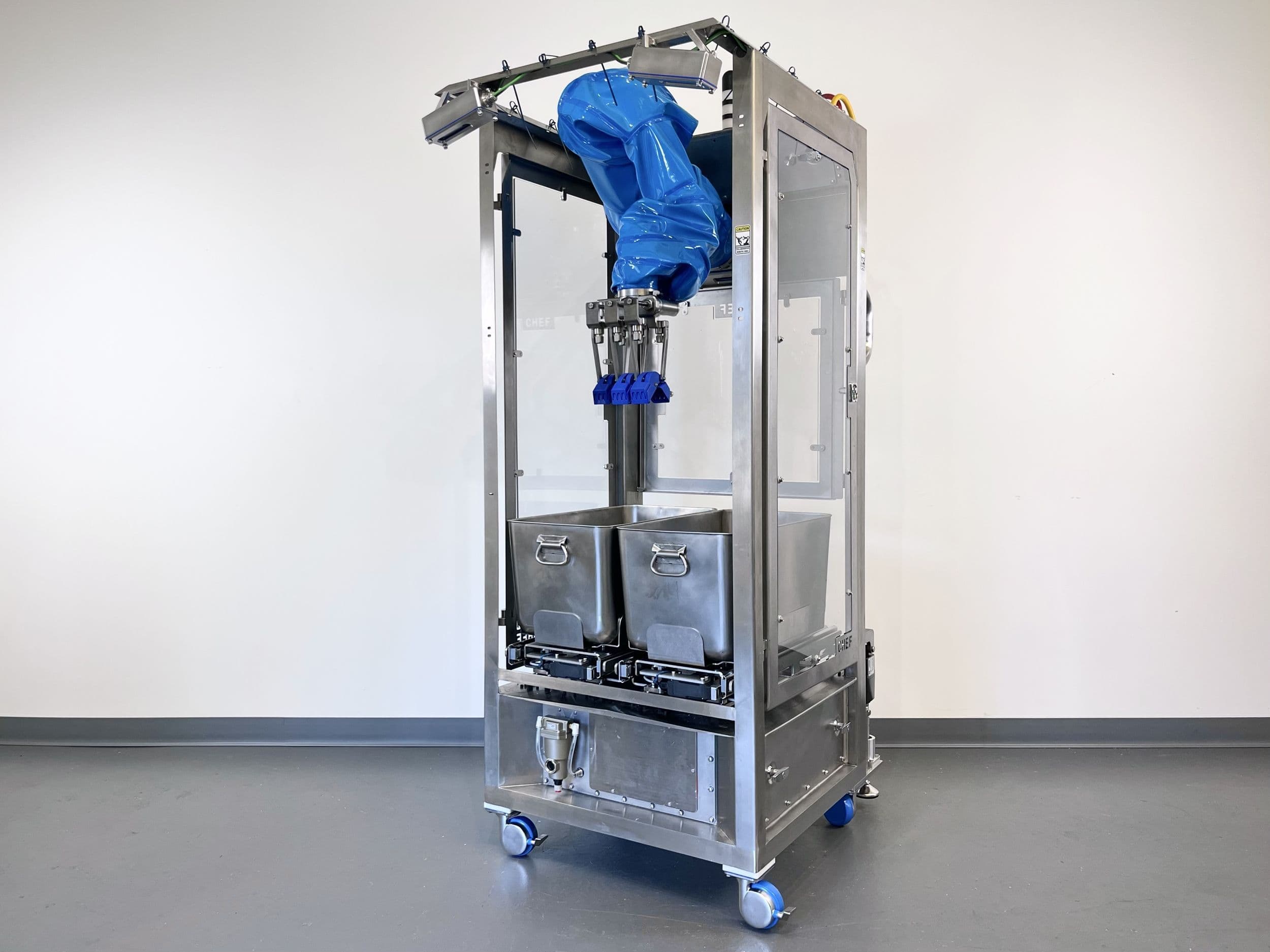
Chef Robotics is a San Francisco-based company that describes its work as building physical AI for the food industry. Its robotic systems are designed specifically for the plating stage of food preparation — not cooking, not chopping, but the mechanical act of portioning and placing food into trays at scale. The company counts established food brands like Amy's Kitchen and Factor among its clients and is currently training its robots to eventually tackle more complex assembly tasks.
When a chance encounter between employees from both organizations led to a conversation about a potential partnership, Hepfer did not hesitate. Despite the subscription cost involved in renting the robots, he saw the investment as worthwhile.
"Nonprofits often operate under a scarcity mindset, and I think that's a disservice to the people we serve, because then you're not looking for innovations or quality improvements," Hepfer says.
How the Robots Actually Work
If you visited Open Hand's facility today, you might not immediately notice the robots at all. There are just two of them, and they operate only a couple of hours each day as part of a conveyor-belt assembly line staffed by a small team of human volunteers.
The robotic arms function somewhat like oversized claw machines, reaching down into trays of portionable foods and depositing measured scoops — potato salad, corn, and other items — into the correct compartment of each meal tray. The arms can be fitted with different attachments to handle roughly 70 separate ingredients.
The system is not flawless. The robots occasionally miss their mark, leaving stray bits of food on the tray edges. A human volunteer is stationed nearby specifically to wipe down trays before they are sealed. Scattered frozen corn on the floor is a regular sight, swept up and discarded at the end of each session.
"Food is weird," acknowledges Rajat Bhageria, CEO of Chef Robotics. "It's sticky, it's malleable, it's wet. Even the best simulation doesn't completely get it."
But the imperfection is manageable — and notably, not much worse than what human hands sometimes produce.
Real Impact on the Assembly Line
Prior to the robots' arrival, Open Hand's volunteer teams were capable of completing around 500 meal kits per hour. The robotic systems add approximately 200 more on top of that during smooth operations. Perhaps more meaningfully, the robots free up human volunteers to focus on higher-skill kitchen tasks like vegetable prep and cooking batches of plant-based protein — work that is harder to automate and arguably more engaging.
"It's not even that they're faster," says Alma Caceres, a sous chef involved in the meal preparation process. "It's that we don't have the volunteers."
Bhageria frames the technological shift in practical terms. "Having an arm and a scooping motion turns a physics problem — like how cooked is your onion — into a software problem — like do you have the right motion path. So it's a lot more scalable."
A Community That Keeps Giving Back
Not everyone at Open Hand came through the front door as a volunteer. Joseph Sobiesiak first walked into the organization in the early 1990s as someone in need of its services. Decades later, he now helps manage the meal assembly line.
"I didn't die," he says simply. "And so now I'm here as a way to give back."
Asked about the robots, Sobiesiak admits he was initially skeptical. Over time, however, his position has softened.
"I'm old-school," he says. "It's working better than it did at first. Things are definitely much faster than before."
Looking Ahead
Hepfer is candid about the limits of the technology. The robots do not replace the need for volunteers — they supplement it. But he is hopeful that embracing innovation so visibly will send a signal to San Francisco's growing tech community that Open Hand is an organization worth engaging with.
"I'm hoping that maybe the gravy on top of all this — the low-salt gravy on top — might be that people from the tech world might see that we are open to innovating and using technology and AI to improve the product we're providing for people's health," he says.
In a neighborhood that has long been overlooked by the city's wealthier interests, a nonprofit is proving that cutting-edge technology and human compassion are not mutually exclusive — and that feeding people well is a problem worth solving with every tool available.