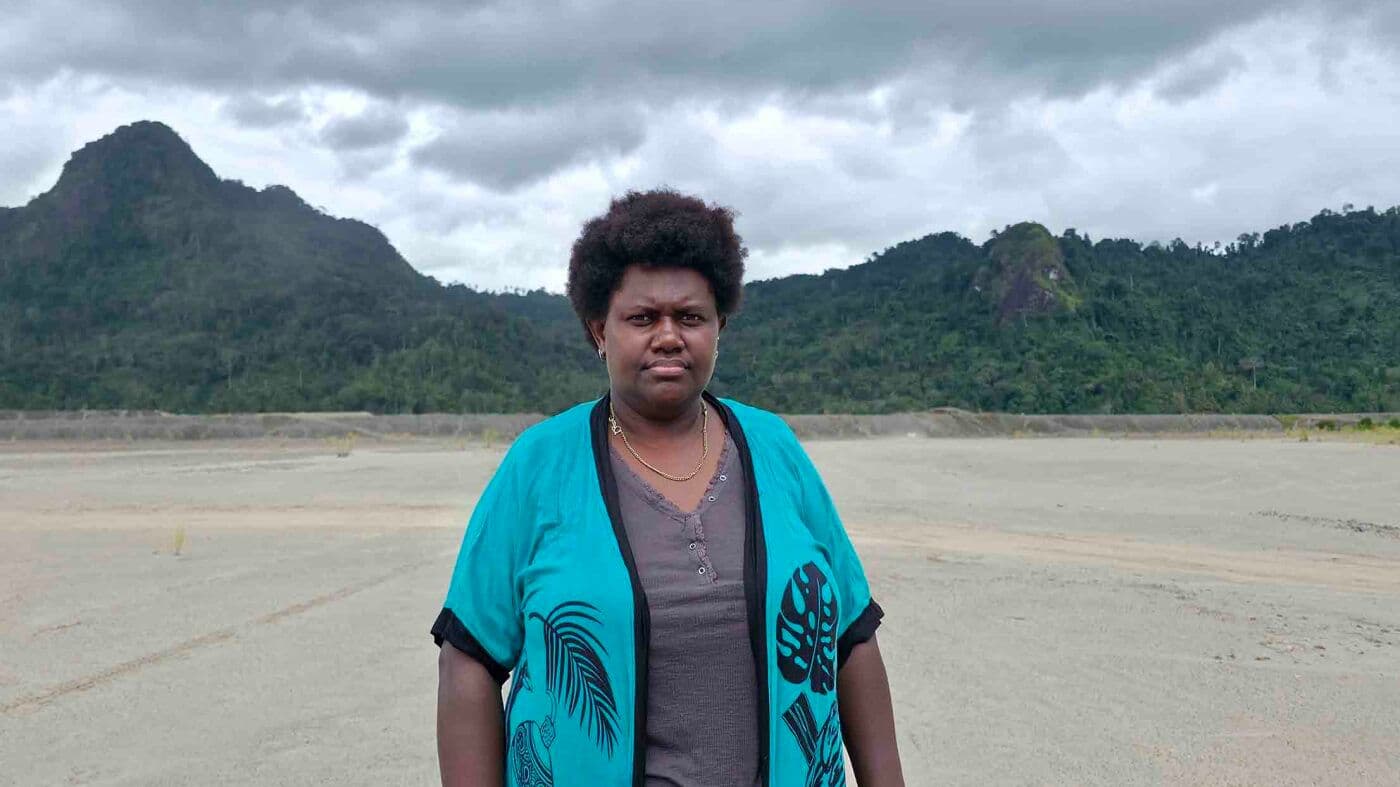
How One Woman from Papua New Guinea Took on a Mining Giant and Won
Theonila Roka Matbob grew up in a landscape scarred by mining. Now a Goldman Prize winner, she's forcing Rio Tinto to face the consequences.

Growing Up in the Shadow of a Destroyed Rainforest
For most people, Papua New Guinea conjures images of dense, thriving rainforest. But for Theonila Roka Matbob, the landscape of her childhood told a very different story. Born and raised near the heart of Bougainville — the largest island in Papua New Guinea's Autonomous Region — she grew up surrounded not by towering trees and rich biodiversity, but by barren rock and sand.
"You have to travel miles into another region and territory just to find the trees, the forest," says Roka Matbob, now 35.
From her earliest years, the warnings were constant. Elders in her community cautioned her never to drink from the rivers, never to eat anything that had fallen to the ground, and never to venture near the water. The reasons, however, were rarely explained. It was only when Roka Matbob began asking questions of her own that the full picture came into focus — and what she discovered would shape the entire course of her life.
The Mine That Scarred a Generation
At the center of Bougainville's environmental collapse sits the Panguna copper and gold mine, developed and operated by Bougainville Copper Ltd., a subsidiary of Rio Tinto — one of the world's most powerful mining corporations, headquartered across Australia and the United Kingdom.
Between 1972 and 1989, the Panguna mine extracted millions of tons of copper along with hundreds of tons of gold and silver. The economic rewards, however, came at a devastating cost. The mining operation brought in outside workers, displaced local communities, and channeled profits away from the island's Indigenous population. Tensions escalated into violence, eventually igniting a brutal civil war that lasted nearly a decade, claimed thousands of lives, and tore apart the social fabric of Bougainville.
Roka Matbob's own family was not spared. Just days before her third birthday, her father was seized by an armed group and subsequently killed. Her mother and siblings were left to survive as nomads, eventually seeking shelter in a government-controlled camp.
When the mine closed amid the unrest, there was no remediation plan, no environmental cleanup strategy, and no accountability for the lasting damage left behind.
"I was born into that broken environment," she says. "Growing up was a life on permanent survival mode."
From Protest to Legal Action
Roka Matbob's activism began during her high school years, when she started organizing community protests. But she quickly recognized that local demonstrations alone would not be enough to hold a global mining giant accountable.
In 2019, she helped bring the Human Rights Law Centre to Bougainville to listen directly to affected community members. The outcome was a landmark report titled After the Mine: Living with Rio Tinto's Deadly Legacy, which documented in stark detail the human and environmental toll of the Panguna operation. When Rio Tinto acknowledged that they had never fully understood the on-the-ground impact of their mine, Roka Matbob saw it as a turning point.
She went on to become the lead complainant in a formal human rights complaint filed against Rio Tinto. The company responded within 24 hours of the complaint being lodged — a moment Roka Matbob describes as profoundly meaningful.
"It was a dream come true — the opportunity to represent the people's voice and speak directly to the stakeholder who changed our lives," she says. "I shed tears. Finally, my grandmother didn't get to do this, but I'm going to do that now."
In 2021, Rio Tinto agreed to fund an independent environmental assessment. By 2024, the company had signed a memorandum of understanding committing to work alongside impacted communities to address and remediate the damage caused by decades of mining.
A Historic Recognition: The 2026 Goldman Environmental Prize
Roka Matbob's tireless campaign has earned her the 2026 Goldman Environmental Prize, one of the most prestigious honors in global environmental advocacy. The prize recognizes grassroots champions from each of the world's inhabited regions, and Roka Matbob was selected to represent the island nations.
"Theonila is leading a historic effort to obtain justice for decades of environmental and social devastation caused by the Panguna mine," said Ilan Kayatsky of the Goldman Environmental Prize. "Her efforts have brought together a coalition intent on improving the lives of Bougainvilleans, today and into the future."
Roka Matbob has indicated that she and her community will collectively decide how to use the prize money — a gesture consistent with the community-first philosophy that has defined her entire advocacy journey.
Rooted in Culture, Driven by Motherhood
What sustains Roka Matbob through years of uphill struggle is a combination of deep cultural identity and maternal determination. She belongs to the Indigenous Nasioi people and the Basikang clan, a matrilineal society in which women are considered the traditional guardians of the land.
"We women are the land guardians and keepers," she says, citing a proverb from her community: It takes a woman's tears to start a fight, and a woman's tears to broker peace.
She also draws strength from her two young children, aged 8 and 4. "No mother would want to pass a broken, contaminated environment on to her child," she says. The knowledge that countless other children in her community lack advocates who can speak for them only deepens her resolve.
Roka Matbob has also carried her fight into the political arena, serving as one of a small number of women elected to Bougainville's House of Representatives. While she acknowledges that the political culture remains largely patriarchal, she views her presence there as both a challenge and an opportunity — a chance to ensure that the voices of women and Indigenous communities are no longer ignored in decisions that directly affect their land, their health, and their future.
The Work Is Far From Over
Despite the hard-won progress, Roka Matbob is clear-eyed about what remains ahead. A memorandum of understanding is a beginning, not an ending. For communities still living in a contaminated environment, there is little room to pause and celebrate.
"When you are permanently in a broken environment, it does not give you space to stop and move on," she says. "The next question is: How soon can we fix it? How long is it going to take?"
Her story is a powerful testament to what sustained grassroots advocacy can achieve — even against some of the world's most powerful corporate interests. But for Roka Matbob, the Goldman Prize is not a finish line. It is simply more fuel for a fight she has no intention of walking away from.