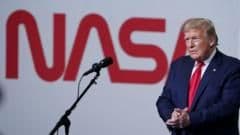
How NASA's Artemis II Mission Serves Trump's 'America First' Vision in the New Space Race
Four astronauts are headed to the Moon, and the stakes go far beyond science. From beating China to unlocking lunar resources, here's what's really driving Artemis II.
A Moon Mission With Much More Than Science at Stake
When four astronauts board their spacecraft this Wednesday for the first deep-space journey since 1972, the mission will carry far more weight than any rocket can measure. NASA's Artemis II represents a bold leap back into lunar territory — but behind the technical achievement lies a web of geopolitical strategy, economic ambition, and political opportunity that experts say could define Donald Trump's second term.
Timing Is Everything
The United States is navigating one of its most turbulent periods in recent memory. Ongoing military strikes in Iran, fierce immigration debates, and a rattled economy have left the country sharply divided. Against this backdrop, a successful crewed mission to the Moon offers the Trump administration something increasingly rare: a moment of genuine national pride.
The potential upside is enormous. A triumphant space mission could unite Americans across political lines, project strength on the world stage, and deliver a symbolic win at a time when the White House badly needs one.
Trump's Evolving Space Ambitions
America's renewed interest in the Moon didn't begin with Trump, but he has been a driving force behind its current shape. During his first term, Trump launched Space Force — a new military branch under the Pentagon — and set his sights on Mars, pledging to send American astronauts to plant the Stars and Stripes on the red planet.
His second-term priorities, however, have shifted closer to home — or rather, closer to the Moon. In December of last year, Trump signed an executive order directing NASA to return Americans to the lunar surface by 2028 and establish a permanent outpost there by 2030. The directive framed US dominance in space as a direct reflection of national strength, vision, and security.
The China Factor: A 21st Century Space Race
What the executive order notably left unmentioned was the nation fueling much of Washington's urgency: China. NASA Administrator Jared Isaacman has been far more direct on the subject.
"We find ourselves with a real geopolitical rival, challenging American leadership in the high ground of space," Isaacman stated at a NASA event in March. "This time, the goal is not flags and footprints. This time, the goal is to stay. America will never again give up the Moon."
China has accelerated its own lunar program and is working toward placing a crew on the Moon's surface within the next few years. The echoes of the Cold War-era space race with the Soviet Union are hard to ignore.
In 1962, President John F. Kennedy made his intentions crystal clear in a declassified White House recording with NASA Administrator James Webb. "This is important for political reasons," Kennedy said bluntly. "This is, whether we like it or not, a race." Six decades later, the race is on again — just with a different rival.
The Lunar Gold Rush: What's Really on the Moon
Beyond geopolitics, the Moon may hold staggering economic value — and that's where the competition gets even more intense.
Former NASA Administrator Sean O'Keefe told the BBC that whichever nation plants roots on the Moon first will hold a decisive advantage in accessing its resources. Chief among them is helium-3, a rare element with potential applications in compact, long-lasting nuclear fusion reactors. Currently trading at more than $20,000 per kilogram, helium-3 is among the most valuable substances on Earth — and the Moon is believed to hold it in significant quantities.
The lunar surface also contains water ice, which can be converted into rocket propellant, along with rare earth minerals including lithium and platinum — materials that are critical to modern electronics and clean energy technologies. On Earth, the mining of these resources is largely dominated by China, making lunar access a matter of both economic and strategic urgency for Washington.
A Frontier Without a Price Tag
Clayton Swope, a former CIA science and technology officer and Capitol Hill space policy adviser, likened the coming lunar resource rush to the Lewis and Clark expedition of the early 19th century.
"We didn't quite know the value of the western part of the US, or the Pacific Northwest, but we thought it was there," Swope explained. "Part of this mission is trying to figure out what that value is. We can't quite put a price tag on the Moon — but you can't get away from that competition and rivalry with China."
Space as a Unifying Force
History offers a compelling precedent for the cultural power of a Moon mission. When Neil Armstrong took his first steps on the lunar surface in July 1969, an estimated 125 to 150 million Americans watched live. The country was deeply fractured at the time — mired in the Vietnam War, reeling from the assassinations of Martin Luther King Jr. and Robert Kennedy, and polarized by Richard Nixon's presidency. Yet for one extraordinary moment, the nation came together.
Experts believe Artemis II could recreate that phenomenon in 2026.
"Space is one of the few areas that Americans with different political views can enjoy and watch together," said Esther Brimmer, a senior fellow and space policy specialist at the Council on Foreign Relations. "The space program is something that most Americans have grown up with and see as a point of pride. It's by and large unifying, in terms of the social impact."
The White House has leaned into this narrative. Spokeswoman Liz Huston framed the mission within the broader 'America First' agenda: "With President Trump's America-First policies, the United States will lead humanity into space and enter a new era of groundbreaking achievements in space technology and exploration."
More Than a Mission — A Statement
Officially, Artemis II is described as a stepping stone — a foundation for a permanent lunar base and, eventually, a crewed mission to Mars. But in practice, it is something far more layered: a geopolitical signal to Beijing, a potential gateway to trillions in untapped resources, and a rare opportunity to remind a divided nation of what it's capable of achieving when it looks upward together.