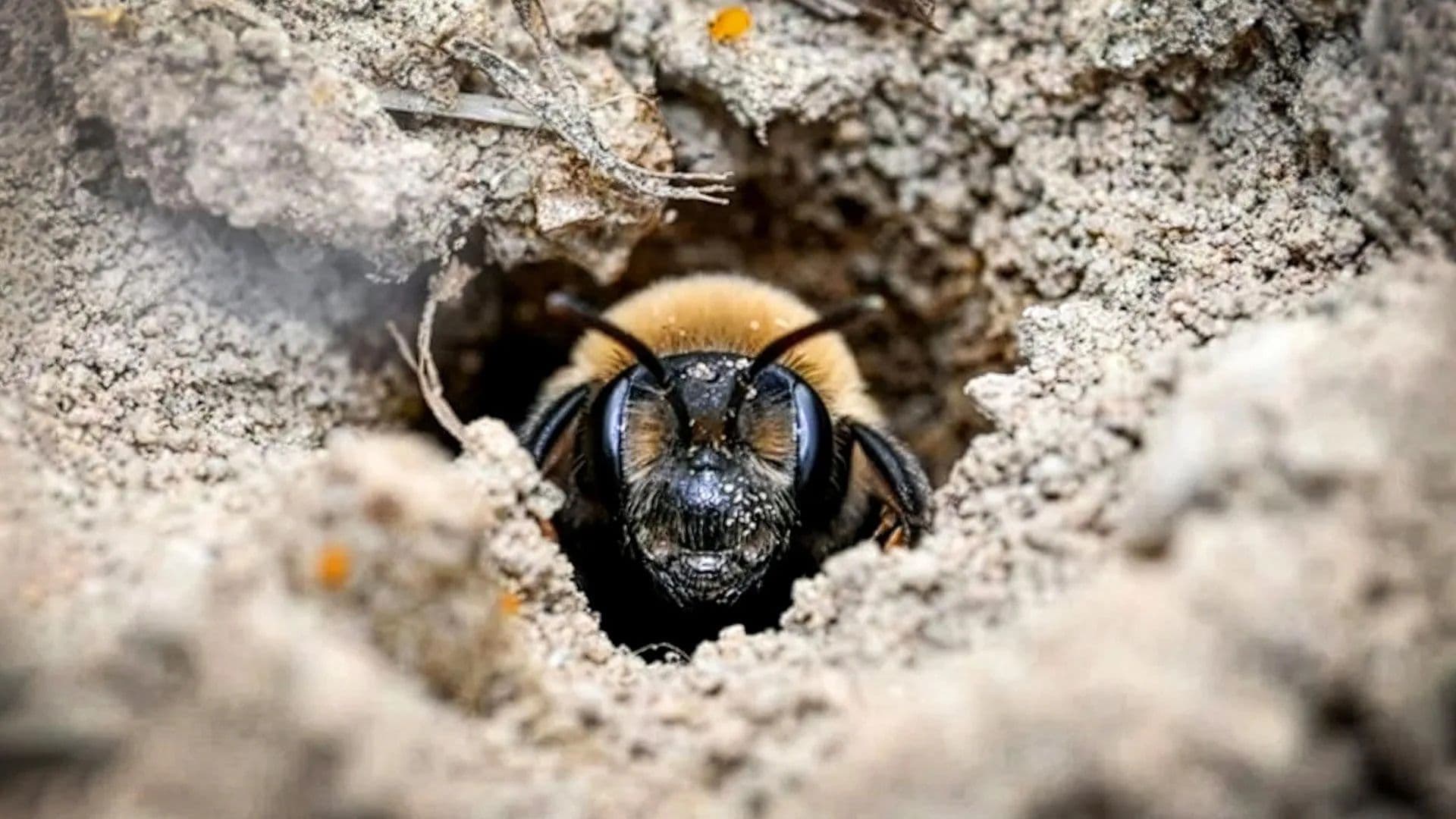
How Millions of Wild Bees Built a Secret Underground Empire Beneath a New York Cemetery
A routine walk to work led to one of entomology's most surprising urban discoveries — a thriving colony of up to 8 million wild bees living beneath a historic New York cemetery for over a century.

A Chance Encounter That Changed Everything
Some of science's most remarkable discoveries begin not in a laboratory, but on an ordinary morning commute. In the spring of 2022, Rachel Fordyce — at the time a laboratory technician in Cornell University's entomology department — noticed an unusual concentration of insects during her walk to work. Intrigued, she collected several specimens and brought them to Bryan Danforth, a seasoned entomologist at the same institution.
The results of the subsequent analysis were extraordinary. The insects were identified as Andrena regularis, a species commonly known as the mining bee or miner bee. Unlike the familiar honeybee, this wild species leads a solitary existence and reproduces by excavating tunnels beneath the soil's surface. Perhaps even more striking was the historical context: records suggest these bees have been living beneath the cemetery — which was established in 1878 — since at least the early twentieth century.
Counting the Uncountable: Inside the Scientific Census
Estimating the size of such a hidden population required creative methodology. Between late March and mid-May of 2023, researchers deployed 10 specialized traps across the cemetery grounds. Each trap consisted of a small net enclosure covering less than one square meter of soil, designed to intercept insects as they emerged from the earth and guide them into a glass collection chamber.
The results surpassed all expectations. Over 3,000 individual insects were captured, representing 16 distinct species — including bees, beetles, and various fly species. Andrena regularis dominated the sample by a significant margin. By extrapolating from the average density observed across all trap locations, scientists estimated the total population to fall somewhere between 3 million and 8 million individuals, with a midpoint estimate of approximately 5.5 million. To put that figure in perspective, it is the biological equivalent of more than 200 domestic honeybee hives occupying a single cemetery.
Remarkable Biology of a Little-Known Species
Beyond sheer population numbers, the study produced a wealth of new biological data on a species that had previously received little scientific attention. The traps revealed a fascinating behavioral pattern: male bees emerge from the ground several days before females during the first warm spell of April — a reproductive strategy that maximizes their chances of successful mating.
Once above ground, females take on the labor-intensive task of digging individual nests and stocking underground cells with pollen and nectar to nourish their offspring. What makes Andrena regularis particularly unusual among bee species is its ability to overwinter in adult form beneath the soil. This adaptation allows the colony to become active extremely early in the spring season, placing its emergence in near-perfect synchrony with the flowering of apple trees in Cornell University's neighboring orchards — a relationship that underscores the species' ecological importance as a pollinator.
The monitoring effort also uncovered a darker layer of ecological complexity. Researchers documented active parasitism by Nomada imbricata, a cleptoparasitic bee species that infiltrates the nests of Andrena regularis and deposits its own eggs inside — ultimately at the expense of the host's larvae. This kind of ecological interplay adds further depth to what initially appeared to be a simple bee aggregation.
Why Urban Cemeteries May Be Wildlife's Best-Kept Secret
The findings carry significant implications for urban conservation. Approximately 75 percent of wild bee species worldwide are solitary ground-nesters, making suitable undisturbed soil a critical and increasingly scarce resource. Old city cemeteries, it turns out, may represent some of the last ideal habitats available to these insects in densely developed urban environments.
The conditions found in such locations — sandy, easily excavated soil, a complete absence of pesticides, and protection from the land-use changes that define intensive agriculture and residential development — create a sanctuary that wild bees have quietly exploited for generations. The danger lies precisely in this invisibility. A population of millions of bees living underground can be entirely wiped out by a single concrete pour or an unplanned road project, with no one the wiser.
A Global Call to Action
To address this threat, the research team has launched an international citizen science initiative aimed at identifying and protecting underground bee aggregations before they are inadvertently destroyed. The project invites members of the public to report suspected nesting sites, helping scientists build a comprehensive map of these hidden colonies around the world.
The ultimate goal is to establish protections for these vital pollinator habitats before ongoing habitat fragmentation makes preservation impossible. What began as one woman noticing something unusual on her morning walk has evolved into a global effort to safeguard an ecological treasure hiding just beneath our feet.