How Magnetic Fields Could Be the Hidden Force Behind Binary Star Systems
New supercomputer simulations reveal that magnetic fields may act as a cosmic brake, pulling newborn star pairs together and solving a long-standing mystery in astronomy.

The Mystery of Binary Stars May Finally Have an Answer
For decades, astronomers have wrestled with a puzzling question: how do two young, still-forming stars manage to draw close enough together to become a gravitationally bound pair — and do so remarkably fast? New research powered by cutting-edge supercomputer simulations may have finally cracked the case, pointing to magnetic fields as the unexpected driving force behind binary star formation.
Stars Are Born in Cosmic Clouds
Most stars originate deep within enormous clouds of gas and dust scattered throughout the galaxy. When gravity causes portions of these clouds to collapse inward, they form dense concentrations known as molecular cloud cores — the birthplaces of new stars.
Star formation rarely happens in isolation. Quite often, two protostars emerge in close proximity and become gravitationally linked, producing what scientists call a binary star system. Observations have consistently shown that many of these paired systems take shape at a very early stage, long before either star has fully matured. What remained unclear, however, was the precise mechanism allowing two growing protostars to converge so rapidly.
Supercomputer Simulations Point to Magnetic Forces
Running the Numbers
To probe this longstanding puzzle, a team of researchers conducted highly detailed simulations on multiple supercomputing platforms, including the National Astronomical Observatory of Japan's powerful ATERUI III system and its predecessor, ATERUI II.
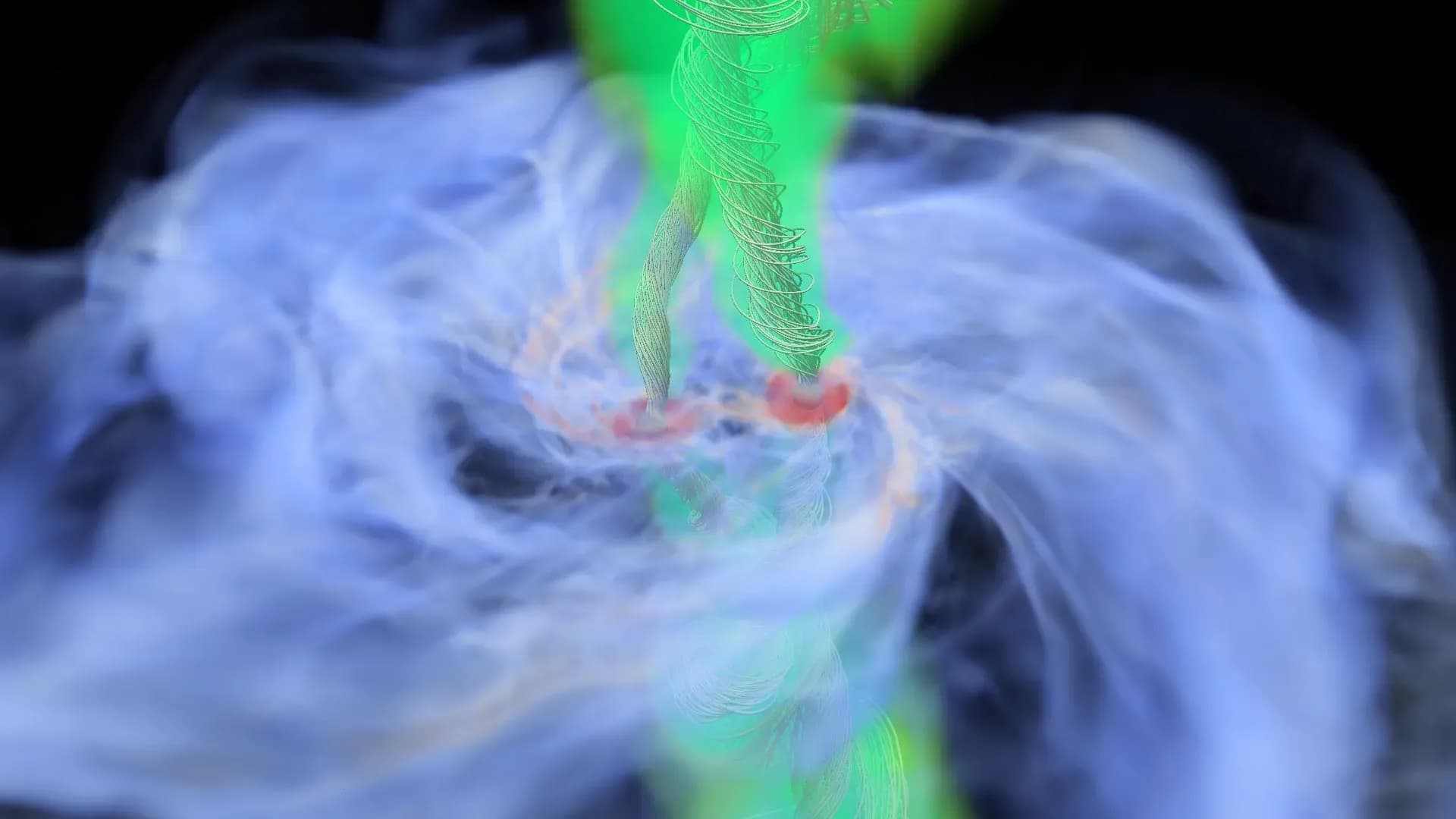
The findings were striking. Magnetic fields woven through the surrounding gas were shown to function like a natural braking system, steadily removing angular momentum — the rotational energy that would otherwise keep the two protostars drifting apart. As this momentum was sapped away, the pair spiraled progressively inward, eventually settling into a binary configuration within a timeframe consistent with what astronomers actually observe.
What Happens Without Magnetic Fields
To confirm the significance of this mechanism, the team ran a separate simulation with magnetic fields stripped out entirely. The outcome told a clear story: without magnetic influence, the two protostars moved away from each other rather than drawing closer together. This control test strongly underscored just how essential magnetic fields are to the binary formation process.
Broader Implications: Could This Apply to Black Holes?
The research team didn't stop at star systems. They propose that a strikingly similar process may unfold on a far grander scale — one involving massive binary black holes residing in the gas-rich cores of young galaxies.
Just as magnetic fields help protostars lose angular momentum and spiral together, the same type of interaction could theoretically bring pairs of colossal black holes close enough to eventually merge. These mergers are widely believed to play a critical role in the creation of supermassive black holes, particularly in the turbulent aftermath of galaxy collisions.
However, the researchers are careful to note that directly modeling the full long-term evolution of binary black holes remains an extraordinary computational challenge due to the immense timescales involved. They emphasize that additional studies will be necessary before the full extent of magnetic field influence on black hole mergers can be established with confidence.
A New Chapter in Understanding Cosmic Structure
This research adds a compelling new layer to our understanding of how the universe organizes itself — from the birth of paired stars to the formation of the most massive objects in existence. Magnetic fields, long known to shape plasma and influence stellar winds, may now earn recognition as a fundamental architect of cosmic structure itself.