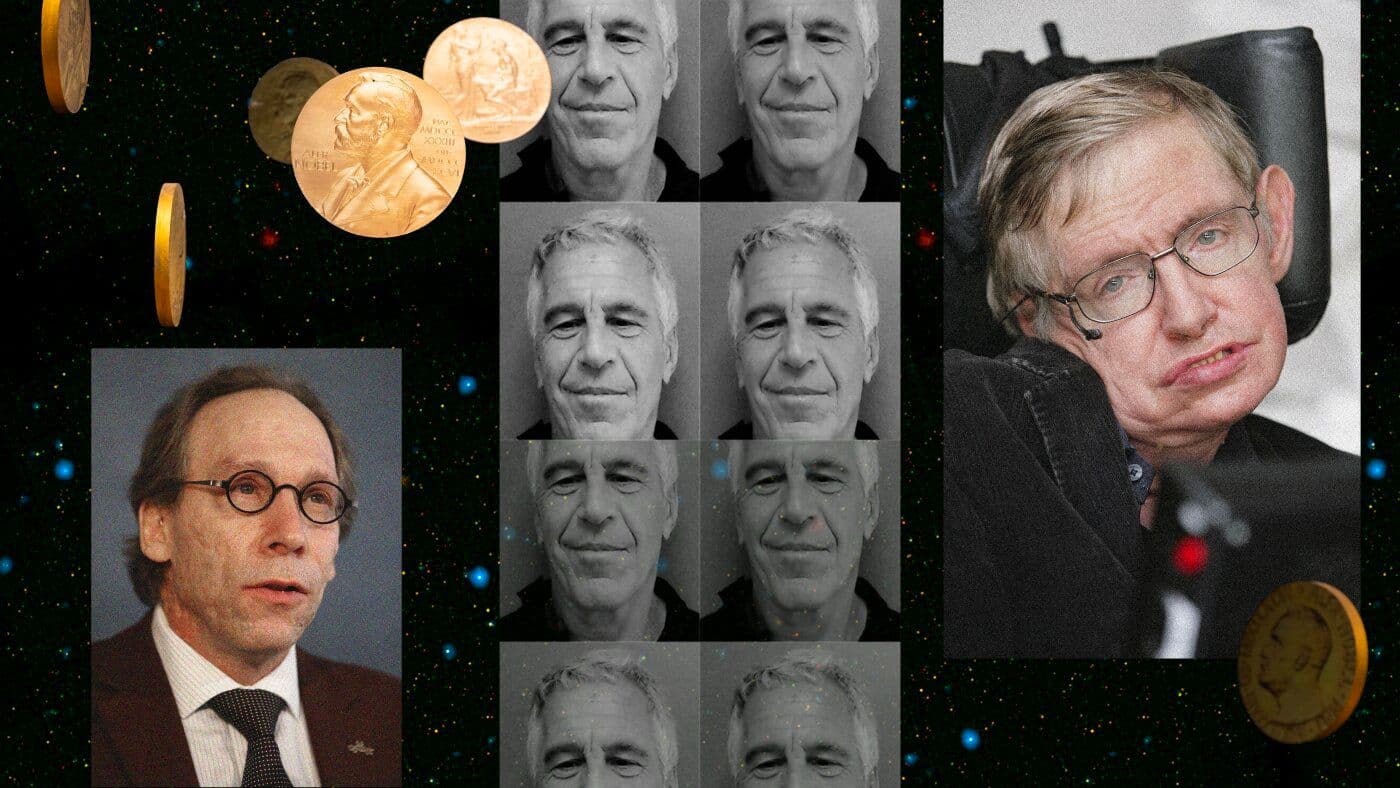
How Jeffrey Epstein Leveraged Nobel-Winning Scientists to Rehabilitate His Reputation
Jeffrey Epstein used lavish funding and exclusive conferences to forge deep ties with the world's most prominent scientists, including Stephen Hawking.

How Jeffrey Epstein Used Elite Scientists to Rebuild His Public Image
A 2006 gathering of elite physicists in the U.S. Virgin Islands offers a revealing window into how convicted sex offender Jeffrey Epstein systematically cultivated relationships with some of the world's most celebrated scientific minds — using his wealth as the ultimate calling card.
A Submarine Ride and a Star-Studded Conference
Nearly 100 feet beneath the turquoise Caribbean waters, the late Stephen Hawking peered through a submarine porthole at coral reefs and tropical fish in March 2006. Strapped securely in his wheelchair and accompanied by a nurse, the legendary astrophysicist was experiencing his first-ever underwater journey — made possible entirely through Epstein's financing.
The submarine excursion served as the grand finale to an invitation-only week-long conference that Epstein funded, drawing approximately 20 of the planet's foremost physicists to the Virgin Islands. Among the attendees were three sitting Nobel laureates and three additional scientists who would later claim the prestigious honor.
Getting Hawking aboard the submarine — chartered from a private tour company — was no small feat. A winch system was carefully deployed to lower him in his wheelchair through the vessel's main hatch. Theoretical physicist Lawrence Krauss, who organized the event, even donned scuba gear and dove underwater just to wave at Hawking through the porthole. "I was just so happy because he'd never been underwater," Krauss later recalled.
In a 2017 text message exchange, Epstein reflected on the moment with characteristic irreverence, claiming he had improvised a solution to secure Hawking in the submarine for what he described as "great fun."
The "Confronting Gravity" Conference
The event, titled "Confronting Gravity," was officially promoted as a forum for exploring fundamental questions in physics and cosmology. Marketing materials described it as an opportunity for participants to engage in serious scientific discourse while also relaxing on the beach and visiting Epstein's nearby private island.
Krauss, who was then affiliated with Case Western Reserve University, organized the gathering and pitched it in advance emails as a small, exclusive, all-expenses-paid workshop. To attract top-tier talent, he strategically name-dropped high-profile invitees, including Hawking, Nobel Prize-winning physicists David Gross and Frank Wilczek, 1999 Nobel laureate Gerard 't Hooft, and Kip Thorne, who would later claim the Nobel Prize in 2017.
"To get good people, you've got to have a hook," Krauss acknowledged.
The strategy paid off. MIT physicist Alan Guth, who first proposed the groundbreaking theory of cosmic inflation, attended and described it as a legitimate and impressive gathering. "It included many of the big names in cosmology and gravitational theory at the time," he told NPR.
Attendees stayed at the upscale Ritz-Carlton in St. Thomas, where daily sessions explored cutting-edge topics such as gravitational wave physics — a subject that would later become central to the field. Several scientists also participated in a public lecture at a nearby college.
Epstein himself viewed the conference as a personal milestone, reportedly listing it among his top five professional achievements. Speaking to a local publication at the time, he took full credit for assembling the group. "They say Newton discovered it but no one knows what it is," he said of gravity, adding, "There is no agenda except fun and physics, and that's fun with a capital 'F'."
Building a Scientific Network Through Philanthropy
The Virgin Islands conference was far from an isolated event. It was part of a broader, calculated strategy by Epstein to embed himself in elite scientific circles through generous funding. His interests ranged widely — from theoretical physics and evolutionary biology to computer science — and he bankrolled conferences, research initiatives, and individual scientists across multiple disciplines.
"Jeffrey was interested in interesting people," Krauss told NPR, describing Epstein's motivations.
Krauss himself maintained a relationship with Epstein spanning nearly 15 years. He later led the Origins Project at Arizona State University, which received partial funding from Epstein, before retiring from ASU in 2019 following multiple sexual misconduct allegations. Krauss has consistently denied those allegations.
The Fallout Reaches Science's Upper Echelons
The revelations surrounding Epstein's connections have sent shockwaves through the scientific community, much as they have through politics and the arts. At Harvard University alone, genomics pioneer George Church, physicist Lisa Randall, and mathematics and biology professor Martin Nowak have all faced intense public scrutiny over their associations with Epstein. NPR reached out to all three for comment but received no response.
The repercussions have extended well beyond Cambridge. Nobel Prize-winning molecular biologist Richard Axel stepped down as co-director of Columbia University's Zuckerman Mind Brain Behavior Institute, while Yale computer science professor David Gelernter was suspended from teaching duties pending a university review of his conduct.
Perhaps most strikingly, even after Epstein entered a guilty plea in 2008 for soliciting prostitution and procuring a minor for prostitution, a number of scientists and academics continued to accept his support or maintain communication with him — in some cases right up until his 2019 arrest on federal sex-trafficking charges.
Scientists Recall Epstein's Low Profile
Interestingly, several attendees of the 2006 conference recall Epstein as a largely invisible presence during the event itself. MIT's Alan Guth and Princeton University's Jim Peebles — who would receive the Nobel Prize in physics in 2019 — both noted that Epstein barely registered on their radar during the week.
"As far as I'm aware, although I was never thinking of it, Epstein was never in my eyesight at any time during the conference," Peebles recalled.
For the scientists involved, the conference appeared to be a legitimate and intellectually stimulating event set against an unusually scenic backdrop. "It was a little more exotic, a little more colorful, a little more natural beauty than just sitting in a restaurant in a hotel," Guth reflected — an assessment that, in hindsight, takes on a far more troubling dimension.

