How Falling Rainwater Was Secretly Controlling Airflow Nearly a Mile Underground
Engineers at a South Dakota underground lab cracked a puzzling ventilation mystery — and the culprit was rushing rainwater acting like a giant underground piston.
A Strange Discovery Nearly a Mile Below the Surface
Deep beneath the Black Hills of South Dakota, engineers responsible for maintaining one of the world's most extraordinary underground laboratories noticed something they couldn't immediately explain. During heavy rainstorms, the airflow inside their tunnel network would behave erratically — sometimes weakening dramatically, and in certain areas, reversing direction altogether.
It wasn't a minor fluctuation. It was a measurable, repeatable phenomenon that nobody had a solid explanation for. That mystery would ultimately lead to a scientific breakthrough with implications for underground operations across the globe.
Inside the Sanford Underground Research Facility
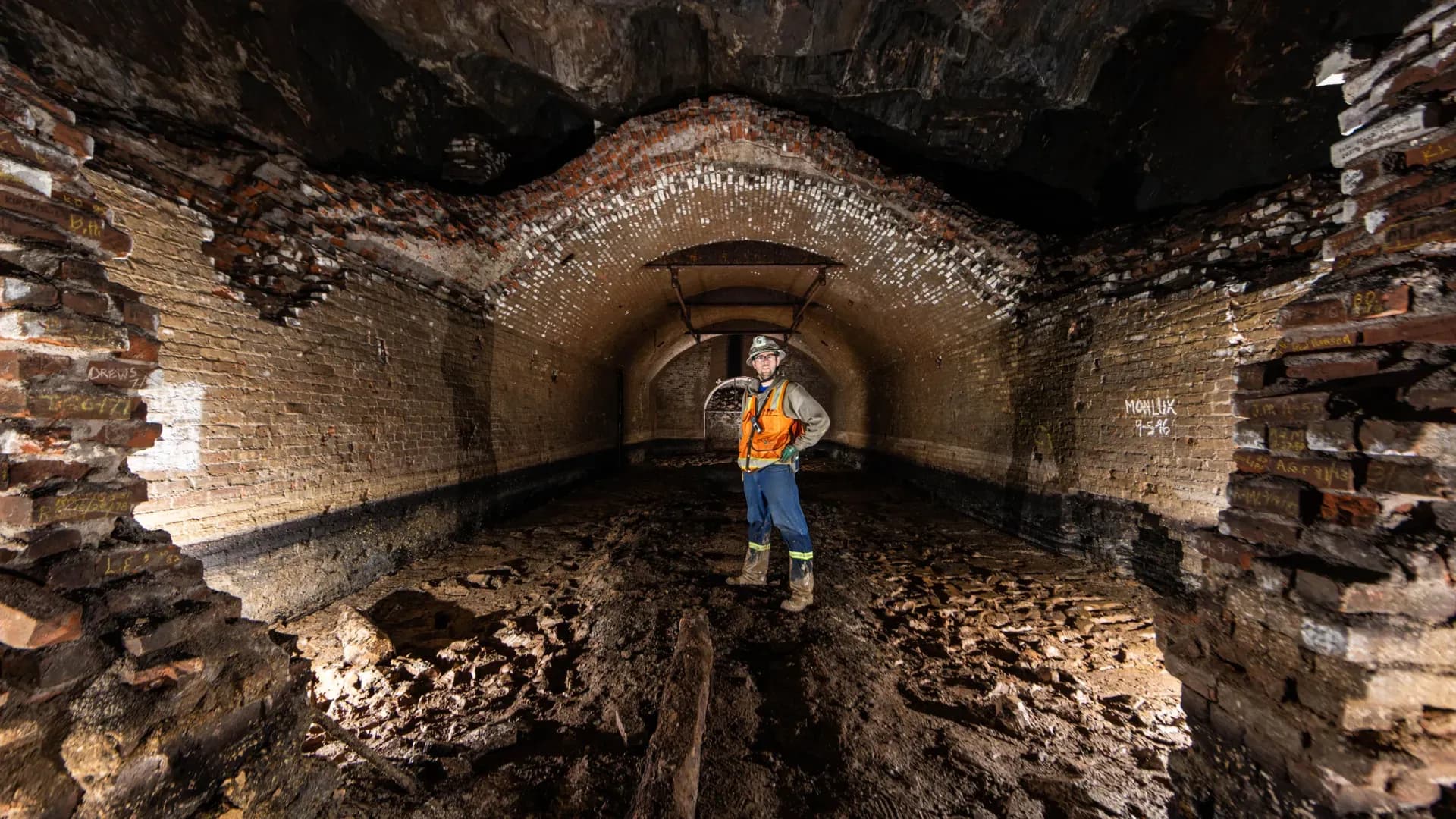
The Sanford Underground Research Facility, known as SURF, sits nearly a mile beneath the earth in Lead, South Dakota. Originally a gold mine, the site was converted into a cutting-edge science laboratory where researchers conduct experiments that require the natural shielding only deep underground environments can provide.
While mining operations have long since ceased, a dedicated team of mining engineers still manages the facility's vast network of tunnels and shafts. Their responsibilities cover two fundamental systems: ventilation and water management. Both are non-negotiable when it comes to worker safety and operational integrity.
Under normal conditions, fresh air flows into the facility through two primary intake shafts and exits through two separate exhaust shafts. One of those exhaust routes — known as 5 Shaft — plays a secondary but critical role during storms: it serves as an overflow channel, routing excess rainwater down into a deep underground reservoir where it can later be pumped back to the surface.
The Moment Engineers Noticed Something Was Wrong
Jason Connot joined SURF as a mining engineer in 2019 and quickly took charge of overseeing its ventilation systems. It didn't take long before he and his team began observing irregular airflow patterns during periods of intense rainfall.
"We noticed our fan would go haywire at 5 Shaft. Some areas would show reduced or even reversed airflow during large rain events," Connot said.
The team could see the changes happening in real time, but the cause remained elusive.
"At first, we didn't know what was going on with the airflow in large rain events. We could all see these airflow changes occurring throughout the underground, and we were like, why is this happening?" Connot recalled.
A Key Clue Emerges
The first real breakthrough came during a routine test of the shaft deluge system. Airflow sensors located on the 4850 Level — instruments built and installed by local high school science teacher Steve Gabriel and his students — recorded an unexpected spike in air movement. Gabriel would later join SURF full-time as a ventilation technician.
That observation planted a seed. The installation of Maestro airflow sensors on the 2000 Level as part of an upgraded automated ventilation control system provided even sharper data, giving the engineering team a far more detailed picture of what was actually happening underground.
"We felt that airflow increase on the 4850 Level during that test. That's what made the correlation and triggered everything," Connot said.
The Piston Theory: Water as an Airflow Driver
The team began to form a hypothesis. When rainfall exceeded the underground pumping system's capacity, engineers redirected surplus water down 5 Shaft into the deep pool below — essentially using the shaft as an overflow spillway. Their theory was that this cascading column of water was behaving like a syringe or a piston, physically displacing air as it plunged downward through the confined shaft.
It was a compelling idea, but scientific confirmation was needed.
Connot dove into the existing research literature and discovered something encouraging: similar phenomena had been documented in large municipal sewer systems. Those studies contained fluid dynamics equations that described how moving water in enclosed spaces could exert significant force on surrounding air.
Working alongside colleagues at South Dakota Mines, Connot adapted those equations to reflect the specific dimensions and conditions at SURF. The results were striking.
"When we added our numbers and parameters to the model, everything came out spot on," Connot said. "You would not think the weight of water droplets could move so much air."
Why This Discovery Matters Far Beyond SURF
The implications of this research reach well beyond one laboratory in South Dakota. Underground mines around the world deal with both water infiltration and emergency ventilation scenarios — and the two are more connected than previously understood.
A Critical Safety Consideration
Connot pointed to a particularly important real-world scenario: fire response. In the event of an underground fire, engineers may deliberately flood a shaft with water from the surface to help control the situation. If that influx of water simultaneously alters airflow patterns — potentially pushing smoke in unexpected directions — the consequences could be severe.
"If there's ever a fire, mining engineers will sometimes turn a valve on up top and just dump water down the shaft. Knowing this can change the airflow is critical information for everyone. We tested this, we've seen it occur," Connot said.
Bryce Pietzyk, Director of Underground Operations at SURF, emphasized how this research transforms the team's ability to anticipate and manage ventilation behavior.
"Thanks to this work, we're able to be way ahead of airflow issues, predict what will happen, and configure ventilation controls in the right manner," Pietzyk said. "No one had previously taken the time to grasp this issue — but it's absolutely critical."
From Curiosity to Published Science
Connot's findings were formally published in the journal Mining, Metallurgy & Exploration under the title Effects of Water Inflows on a Mine Ventilation System: A Case Study. The research represents a rare opportunity — made possible by SURF's dual identity as both an operational facility and a research environment — to thoroughly investigate a phenomenon that active mining operations rarely have the time or resources to study in depth.
Dr. Andrea Brickey, a professor of Mining Engineering and Management at South Dakota Mines and Connot's academic advisor, praised both the quality of the work and the determination behind it.
"He identified a phenomenon impacting ventilation systems and his curiosity drove him to want to determine how to predict that behavior. He succeeded, and his work is helping SURF and an entire industry," Brickey said.
What began as an unexplained anomaly during a rainstorm has become a meaningful contribution to underground safety science — proof that even in environments humans have worked in for centuries, nature still has secrets worth uncovering.