How Big Tech Conquered the TV Upfronts and Left Legacy Media Behind
YouTube, Netflix, and Amazon didn't just show up to this year's upfronts — they took over. Here's how Silicon Valley rewrote Hollywood's oldest advertising ritual.

Big Tech Didn't Just Attend the Upfronts — It Took Them Over
For years, the major tech platforms lurked on the fringes of the television upfronts, eager to claim their seat at the table. In 2026, they didn't just pull up a chair — they bought the whole restaurant.
On the evening of May 13, shortly after pop sensation Chappell Roan wrapped her performance at YouTube's upfront showcase inside Lincoln Center's David Geffen Hall, thousands of media buyers and brand advertisers spilled out into a purpose-built pavilion erected over the venue's Josie Robertson Plaza. The iconic fountain anchored the center of the space, surrounded by towering candy installations, small bites crafted by celebrated culinary creators, and the kind of open-bar energy that only serious ad dollars can fund.
Amid the spectacle, a veteran advertising executive leaned over to remark that the upfronts — that annual multi-day ritual of wining, dining, and dazzling brands into committing roughly $30 billion in linear TV and streaming ad spend — still carry the DNA of the Mad Men era. He wasn't wrong. But the people throwing the best parties have changed entirely.
A Tradition Born in Broadcast, Now Owned by Tech
The upfronts were originally a broadcast television invention. ABC hosted the very first one back in 1962. For decades, the major networks used the event to flex their programming muscles and lock in advertiser commitments for the coming season. That model worked beautifully — until it didn't.
This year made the power shift impossible to ignore. Paramount skipped the week altogether, while established players like NBCUniversal, Fox Corporation, and Warner Bros. Discovery leaned into measured, focused pitches rather than grand spectacle.
Fox CEO Lachlan Murdoch framed his company's strategy in deliberately modest terms at the New York City Center. "We don't try to do everything, and we don't pursue scale just for scale's sake," he said. "Instead, we focus where it matters most — live sports, live news, bold entertainment, and ad-supported streaming."
NBCUniversal's ad sales chief Mark Marshall, meanwhile, highlighted NBC's approaching 100th anniversary as a badge of distinction. "Legacy is not a word we shy away from," he told the audience. "It's our superpower."
Both statements, however sincere, carried the unmistakable tone of companies defining their lanes — not setting the pace.
The Party Scene Said Everything
Nothing illustrated the upfronts' new power structure more vividly than where the best afterparties were held. Two of New York City's most prestigious cultural landmarks — the New York Public Library at Bryant Park and Lincoln Center on the Upper West Side — played host to the week's most talked-about events. Both were thrown by tech companies: Amazon and YouTube, respectively.
YouTube's celebration featured Chappell Roan, podcast queen Alex Cooper, and comedian-turned-creator Trevor Noah. Amazon went even bigger, landing Oprah Winfrey, DJ Diplo, and actor Michael B. Jordan.
Netflix, not to be outdone, corralled Jennifer Lopez, Florence Pugh, Tina Fey, and John Cena to a Hudson River film studio, where media buyers were treated to an evening of burgers, cocktails, and grain bowls inside one of the company's vacant soundstages. It was unorthodox, memorable, and entirely on-brand for a company that plays by its own rules.
A Decade of Disruption Comes to a Head
The dominance on display this upfront season didn't happen overnight. Over the past ten years, tech giants including Apple, Amazon, Google, and Netflix systematically redirected enormous resources into entertainment and sports content, acquiring legacy properties like MGM and steadily eroding the audience base that traditional Hollywood had spent generations building.
The result is a media landscape where legacy companies — with the notable exception of Disney — are largely playing defense. NBCUniversal has spun off the majority of its cable TV assets into a new entity called Versant. Fox shed its entertainment division to Disney years ago. And Warner Bros. Discovery is currently in the process of being acquired by Paramount in a deal backed by tech billionaire Larry Ellison — making this year's WBD upfront presentation feel noticeably subdued, quite possibly its final solo appearance on the stage.
"Traditional media is still trying to preserve legacy economics while others are creating new ones," observed Laura Molen, a former NBCUniversal ad sales president, in a widely circulated LinkedIn post.
YouTube's Bottom-Up Empire
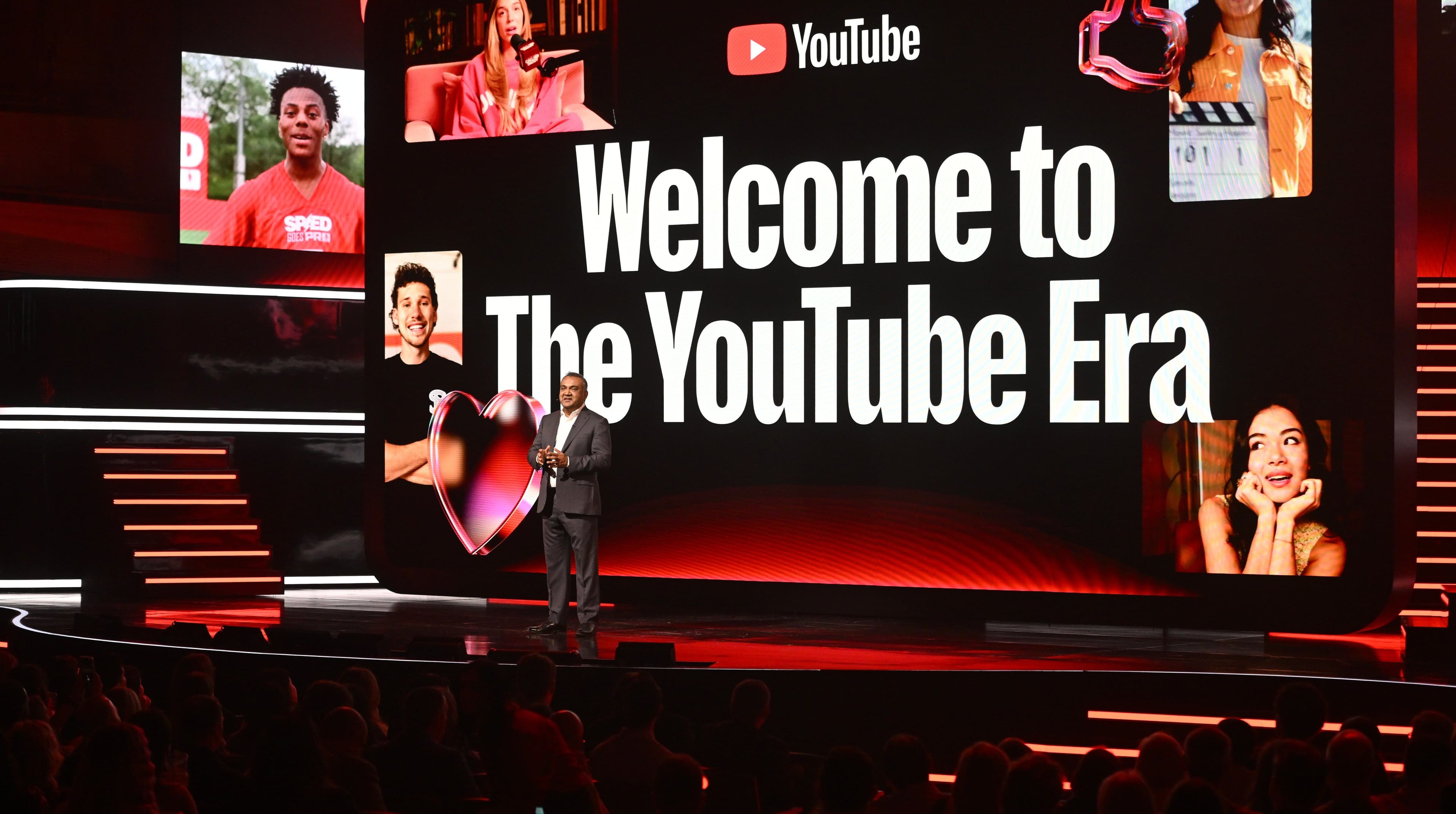
At his upfront presentation, YouTube CEO Neal Mohan drew a pointed contrast between his platform's origins and those of the old guard. "For decades, the entertainment industry was built on a series of bets — programming shows based on formulas and focus groups, guessing what would make an audience show up," he said. "At YouTube, we didn't wait for a focus group. We built a stage and empowered anyone with a story to find an audience."
The democratic framing is compelling, though it tells only part of the story. YouTube's unparalleled data collection and its market-leading recommendation algorithms mean the platform has never really needed to guess at audience preferences. It already knows them with remarkable precision. Rather than programming to tastes, YouTube generates enough content volume that its technology can reliably surface the right material for the right viewer at the right moment.
Google's Americas ad chief Sean Downey drove this point home at the presentation, describing how the company's tools can already identify viewer "intent" — predicting what content someone wants to watch or what ad they're likely to engage with, often in real time. With AI-powered predictive tools on the immediate horizon, that capability is only set to deepen.
Amazon's Shopping Mall Approach to TV
Amazon's upfront on May 11 took a more traditional presentational format — Michael B. Jordan appeared alongside Lonnie Ali to discuss their new series, for instance — but the subtext was unmistakably different from anything a legacy broadcaster could offer.
When Amazon executives stepped onstage to discuss their proprietary advertising tools, or simply mentioned that viewers could purchase advertised products without ever leaving the platform, the message was clear: Amazon isn't really competing in the television business. It's competing in the commerce business, and television just happens to be one of its most effective storefronts.
Netflix's Four-Year Advertising Glow-Up
Perhaps the most striking transformation in the upfront landscape belongs to Netflix. Just four years ago, the streaming giant had no advertising business whatsoever. This year, Netflix ads president Amy Reinhard stood before a room full of media buyers and announced 250 million monthly active viewers — with plans to more than double the number of countries where the company operates an ad-supported tier in the coming year.
"If the last couple of years were about proving we're a durable player, this year is about establishing ourselves as a more formidable one," Reinhard told the crowd. "We've got cutting-edge tech, we've got great entertainment across shows, movies, podcasts, and live events, and we've got the most engaged and attentive audience. We're ready to compete with anyone."
Disney Fights to Stay in the Conversation
Among the legacy media players, only Disney mounted a presentation that attempted to match Big Tech's scale and showmanship. The company closed its upfront with a live performance by Olivia Rodrigo and rolled out an impressive parade of talent — Anne Hathaway, Robert Downey Jr., Robert Irwin, Shaquille O'Neal, and Rosario Dawson all took the stage. Jimmy Kimmel, William H. Macy, and the viral phenomenon the Savannah Bananas worked the afterparty crowd.
The strategy was unmistakable: Disney was pitching itself not just as a content company, but as a tech company — leaning heavily into Disney+ and Hulu as evidence of its digital evolution.
Still, the contrast became apparent the very same evening, when YouTube hosted a buzzy creator event that ran simultaneously — unintentionally, perhaps, but tellingly — opposite Disney's presentation. The atmosphere was electric, informal, and alive in a way that polished broadcast affairs rarely manage.
Trevor Noah moderated panels and worked the room effortlessly. Alex Cooper and science communicator Cleo Abram chatted freely with anyone who approached them. These weren't celebrities being escorted to a branded backdrop for a photo op. They were regular people who had built massive audiences from their bedrooms, and they behaved accordingly.
Noah, when pressed by reporters about whether he felt creatively liberated compared to his time hosting The Daily Show, pushed back on the framing while still capturing the distinction perfectly. "I wouldn't say that, because it's not like I didn't feel free before. But that was a train track and this is a road."
Legacy Media's Tech Envy Is Showing
Perhaps the clearest signal of tech's dominance at this year's upfronts came not from the tech companies themselves, but from the legacy players scrambling to sound like them. Traditional entertainment executives devoted significant portions of their presentations to discussing advanced audience data, agentic ad-buying tools, and AI-powered targeting capabilities — the language of Silicon Valley, not Hollywood.
Senior buy-side sources were candid about the gap. "I don't know that they're ever going to catch up to an Amazon or a Google," one told The Hollywood Reporter. "YouTube, Google, and Amazon have entire ecosystems built on automation and constant updating. They're looking at live sales data and can make creative decisions in real time. Disney and NBC are trying to get there, but their ecosystems are fundamentally different."
Google's Performance Max was singled out as the gold standard for AI-powered advertising infrastructure, with Amazon cited as running a close second.
The upfronts were invented to give broadcasters a structured moment to sell their vision of the future. In 2026, that future belongs to the platforms — and the legacy players are working very hard just to stay in the frame.