How Amazon Quietly Revolutionized Data Center Networking With a Breakthrough No One Saw Coming
Amazon has cracked a decades-old networking problem, deploying faster, greener data center technology that uses 69% fewer routers and cuts power consumption by 40%.
Amazon's Secret Networking Revolution Is Already Running Inside Its Data Centers
Amazon has announced a significant breakthrough in data center networking technology — and the company has already been rolling it out quietly since late 2024. The innovation promises to dramatically accelerate data speeds while cutting energy consumption, potentially positioning Amazon Web Services ahead of competitors in the increasingly fierce race to power the cloud.
The Problem With How Data Centers Have Always Been Built
Since the mid-1980s, communications networks — spanning everything from telecommunications infrastructure to modern data centers — have relied on what engineers call a "fat-tree" topology. Picture a hierarchical structure with two or three vertical layers of switches and routers, with wider, more powerful connections at the top narrowing toward the bottom. Data travels up and down this layered stack, with the heavier bandwidth at the top helping to prevent bottlenecks.
While fat-tree architecture has proven reliable over the decades, it comes with significant drawbacks. The design is inherently rigid, operationally inefficient, and demands increasingly complex physical cabling systems. Anyone who has ever stepped inside a data center has likely seen the tangled nests of colorful fiber-optic cables snaking out of metal server racks. According to Matt Rehder, Vice President of AWS Network Engineering, cabling represents one of the largest costs in networking. Amazon's global data center infrastructure alone is currently threaded together with approximately 20 million kilometers of fiber-optic cable — enough to travel between Earth and the moon and back roughly 25 times.
A Decades-Old Idea That Nobody Could Scale
Researchers have long theorized that random network architectures could outperform the structured fat-tree model. In 2012, a team at the University of Illinois Urbana-Champaign introduced a concept called Jellyfish — a randomly connected network topology designed to scale naturally with growing demand. The idea was elegant: by connecting routers and switches in a fluid, randomized pool, the network could be more efficient and adaptable than any fixed design.
"We named it Jellyfish because it's fluid," explains Brighten Godfrey, a computer science professor at the University of Illinois Urbana-Champaign who co-authored the original 2012 paper. "You can connect the routers and switches randomly and it becomes this flexible pool of network capacity, which is very efficient."
However, random networks introduced their own complications. Routing data becomes significantly more complex when there are countless possible paths between any two points. Physical cabling also becomes harder to manage when cable endpoints are selected randomly rather than following a predictable pattern. Despite theoretical promise, nobody had managed to deploy random network architecture at a meaningful real-world scale — until now.
Around the same time, Google began experimenting with optical circuit switching, which uses microscopic mirrors to redirect light signals and reconfigure optical connections in real time. While innovative, this approach added considerable engineering complexity and cost.
How Amazon Finally Cracked the Code
A dedicated team of engineers and researchers at Amazon Web Services — including several recruited directly from academia — began tackling the random networking challenge in 2023. Their goal was ambitious: design a data network that was flat, highly efficient, resilient to hardware failures, and capable of scaling without becoming unmanageable, all while simplifying the cabling nightmare that has long plagued traditional architectures.
Giacomo Bernardi, one of the lead researchers on the project, initially drew inspiration from an unexpected source: Penrose tiling, a mathematically complex, non-repeating geometric pattern named after British physicist Roger Penrose. Bernardi wondered whether a similar structured-yet-irregular pattern could serve as the blueprint for a new kind of network mesh.
Simulations, however, told a different story. The Penrose-inspired design proved unreliable and failed to deliver the efficiency improvements the team was hoping for. The breakthrough came when researchers leaned into randomness rather than fighting it.
"We embraced the chaos and adopted a quasi-random approach," Bernardi explains.
The result is what Amazon calls Resilient Network Graphs, or RNG — a hybrid architecture that blends the organizational benefits of structured networks with the performance advantages of random topology. The team published their findings in a paper titled RNG: Flat Datacenter Networks at Scale.
Meet the ShuffleBox: Amazon's Custom-Built Networking Hardware
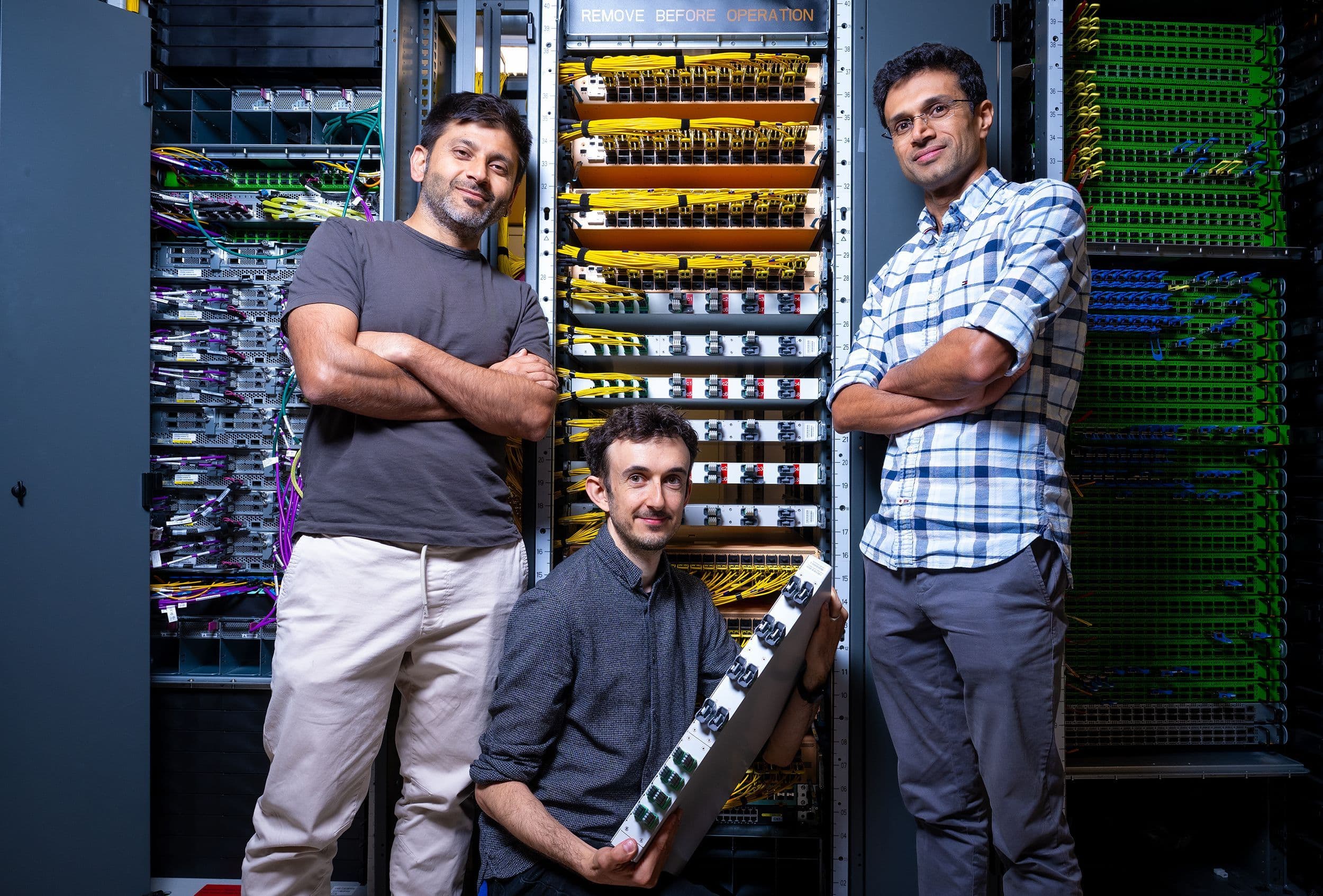
A critical piece of the RNG puzzle is a new optical device Amazon engineered specifically for this purpose: the ShuffleBox. This compact piece of hardware automatically shuffles and manages the cable connections between routers internally, bringing order to what would otherwise be an unruly web of random connections.
During a demonstration at one of Amazon's networking labs in Cupertino, engineers showed side-by-side comparisons of traditional fat-tree cabling — a chaotic tangle of wires — versus the clean, organized cable runs flowing through ShuffleBoxes in the new RNG design. The visual difference alone was striking.
The Results Speak for Themselves
According to Rehder, the performance gains delivered by RNG are substantial. Compared to conventional network architectures, the new design:
- Uses 69% fewer routers and switches
- Delivers 33% higher data throughput
- Cuts network power consumption by 40%
- Reduces operating costs by 27%
"By essentially flattening the network, we eliminated the bottlenecks that come with traditional networking designs," Rehder told WIRED in an exclusive interview. "We think we're the only ones who have done this at scale."
Outside experts are equally impressed. Godfrey, who was not involved in Amazon's research, called the real-world deployment of this technology "remarkable," noting that random network graphs represent a "mind-bending problem to solve, in general."
Where RNG Is Being Deployed — And What It's Not For
Amazon first activated RNG technology in a Dublin data center in 2024, subsequently expanding the rollout to facilities in Germany and Spain. The company reports that most newly constructed data centers are now being built with RNG networking as the standard.
Interestingly, Amazon is not positioning RNG as an AI training solution. Rehder is clear on this point: generative AI workloads involve highly coordinated, centrally orchestrated data patterns that don't align well with random graph architectures. Instead, RNG is designed to make Amazon's core, everyday data center operations faster, cheaper, and more resilient.
This distinction matters. While much of the tech industry's attention is currently focused on AI infrastructure, Amazon's networking breakthrough targets the foundational efficiency of cloud computing itself — the backbone upon which virtually everything else depends.
A New Era for Data Center Design
Amazon's RNG achievement represents more than an incremental improvement in networking technology. It signals a potential paradigm shift in how large-scale data centers are architected — moving away from decades-old hierarchical designs toward flatter, smarter, and more adaptable systems. As demand for cloud services continues to grow, the ability to do more with less power and fewer components could prove to be one of the most consequential engineering advances in modern infrastructure.
