How AI Is Exposing the Hidden Magnetic Energy Waste Killing Electric Motor Efficiency
Japanese researchers have built an AI-powered physics model that peers inside the chaotic magnetic structures of electric motors to uncover where energy silently disappears.
The Silent Energy Thief Inside Every Electric Motor
As electric vehicles become increasingly central to the global push for cleaner transportation, engineers and scientists are hunting down every hidden source of energy inefficiency. One of the most elusive culprits lies deep within the materials of electric motors themselves — invisible magnetic structures that quietly bleed energy as heat. Now, a team of researchers in Japan has developed a groundbreaking AI-powered physics model capable of decoding these chaotic patterns and exposing the mechanisms behind wasted energy.
Understanding the Problem: Iron Loss and Magnetic Chaos
When an electric motor operates, the magnetic fields within its core constantly reverse direction. Every time this happens, a portion of energy escapes as heat rather than contributing to motion. This phenomenon, known as iron loss or magnetic hysteresis loss, represents a significant and often underestimated drain on motor efficiency.
The situation grows more complex at high operating temperatures. Heat can partially strip these materials of their magnetic strength — a process called thermal demagnetization — compounding the energy loss problem further. At the heart of this behavior are magnetic domains: microscopic regions within a material where magnetic forces are locally aligned. The way these domains are arranged and how they respond to heat plays a decisive role in determining how much energy a motor ultimately wastes.
The Mystery of Maze Domains
Certain soft magnetic materials contain particularly intricate domain structures known as maze domains — named for their winding, labyrinth-like appearance under a microscope. These structures are especially sensitive to temperature changes, shifting abruptly as materials heat up or cool down, and directly influencing energy loss in the process.
Despite their importance, maze domains have remained poorly understood. Their behavior involves a tangle of interacting variables — microscopic material structure, thermal fluctuations, and energy stability — that conventional simulations and experimental methods have struggled to untangle simultaneously.
Japan's Research Breakthrough: The eX-GL Model
To crack this problem, a research team led by Professor Masato Kotsugi and Dr. Ken Masuzawa from the Department of Material Science and Technology at Tokyo University of Science (TUS), in collaboration with researchers from the University of Tsukuba, Okayama University, and Kyoto University, developed a novel computational framework called the entropy-feature-eXtended Ginzburg-Landau (eX-GL) model.
This model was applied to study the energy landscape of maze domains within a rare-earth iron garnet (RIG) — a material with particularly complex magnetic behavior. Their findings were published in the peer-reviewed journal Scientific Reports.
"Conventional simulations oversimplify real materials, while experiments reveal complexity without a clear way to quantify cause and effect," said Prof. Kotsugi. "Our physics-based explainable artificial intelligence framework addresses these limitations and is designed to mechanistically explain the temperature-dependent magnetization reversal process."
How the AI-Physics Hybrid Works
The research team began by capturing detailed microscopic images of magnetic domains within the RIG sample across a range of temperatures. These images were then fed into the eX-GL model, which operates in three interconnected stages.
Stage One: Mapping Topological Features
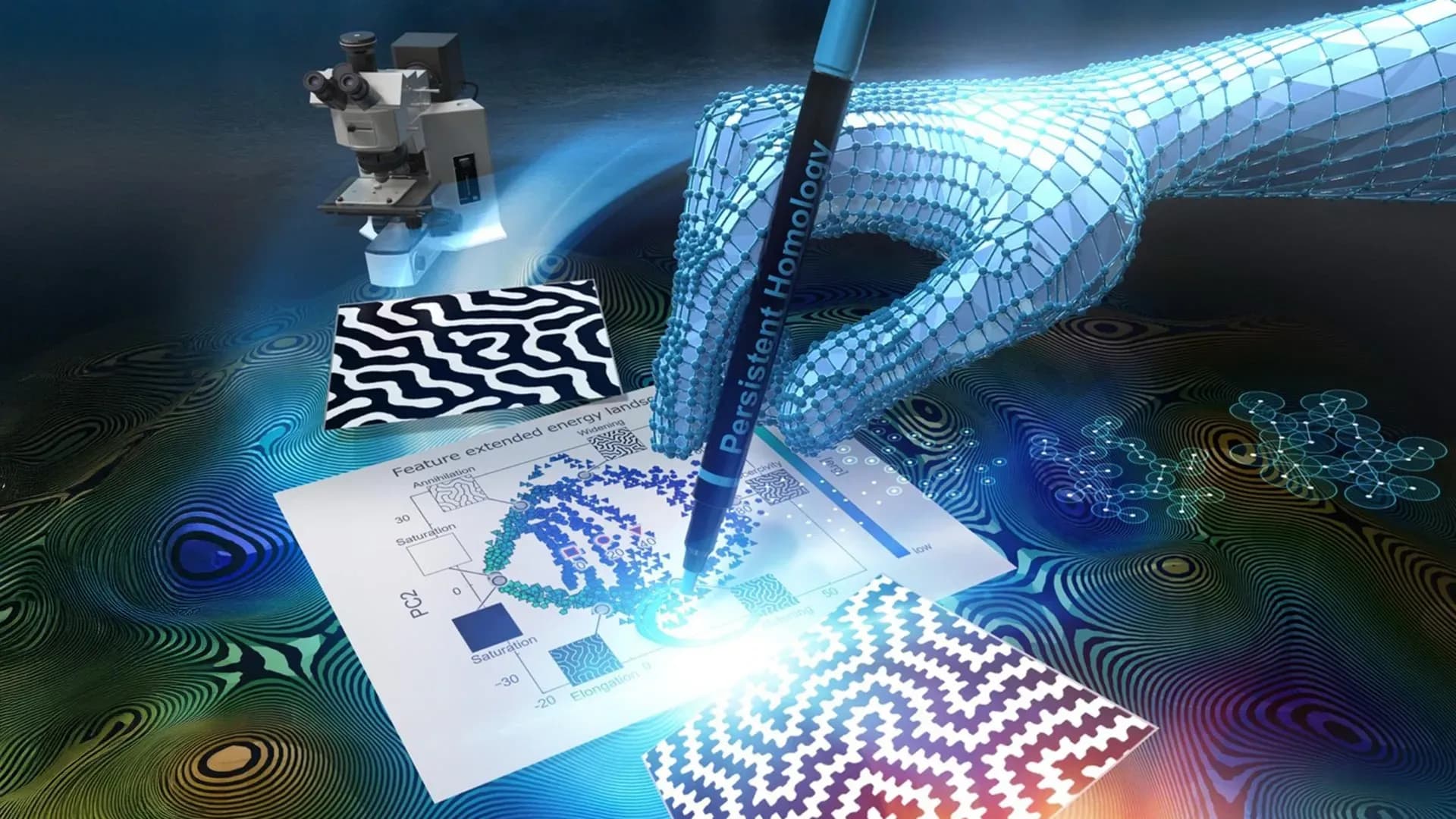
The first stage employs persistent homology (PH), an advanced mathematical technique used to identify structural and topological features within complex datasets. This allowed researchers to detect subtle irregularities and patterns within the magnetic domain images that would otherwise go unnoticed.
Stage Two: Machine Learning Pattern Recognition
Next, machine learning algorithms sifted through the topological data to identify the most significant structural features. This process generated a digital free-energy landscape — essentially a map showing how magnetic microstructures evolve as energy conditions change within the material.
Stage Three: Linking Micro to Macro
Finally, mathematical analysis bridged the gap between these microscopic domain structures and the broader magnetization reversal process, allowing the team to connect what happens at the atomic scale to observable energy behavior in the material as a whole.
Four Hidden Energy Barriers Uncovered
Using this multi-stage approach, the team identified a dominant analytical feature called PC1, which effectively captured the magnetization reversal process across different temperatures. By linking PC1 to physical properties of the material, the researchers were able to visualize four major energy barriers that govern how magnetization reversal unfolds.
A deeper analysis of these barriers revealed how different forms of energy — including exchange interactions, demagnetizing fields, and entropy — contribute to the reversal process. The researchers also found that maze domains become increasingly complex as the total length of magnetic domain walls grows, driven by a dynamic interplay between entropy and exchange energy forces.
"Our eX-GL approach effectively automates the interpretation of complex magnetization reversal processes and enables identification of hidden mechanisms that are difficult to discern using conventional methods," Prof. Kotsugi explained. "Since free energy is a universal thermodynamic metric, our model can be extended to other systems with similar characteristics."
Why This Matters for the Future of Electric Vehicles
The implications of this research extend well beyond academic interest. As demand for high-performance, energy-efficient electric motors grows alongside EV adoption, understanding and minimizing iron loss becomes a critical engineering challenge. By revealing the precise mechanisms through which energy is wasted inside magnetic materials, this AI-physics framework opens new pathways for designing better motor materials and improving overall energy efficiency.
Beyond electric vehicles, the eX-GL model's ability to analyze complex energy landscapes makes it a potentially valuable tool across multiple fields — from advanced manufacturing materials to next-generation electronic devices.
This research was supported by a Japan Society for the Promotion of Science (KAKENHI) Grant-in-Aid for Scientific Research (21H04656) and JST-CREST (Grant No. JPMJCR21O1).