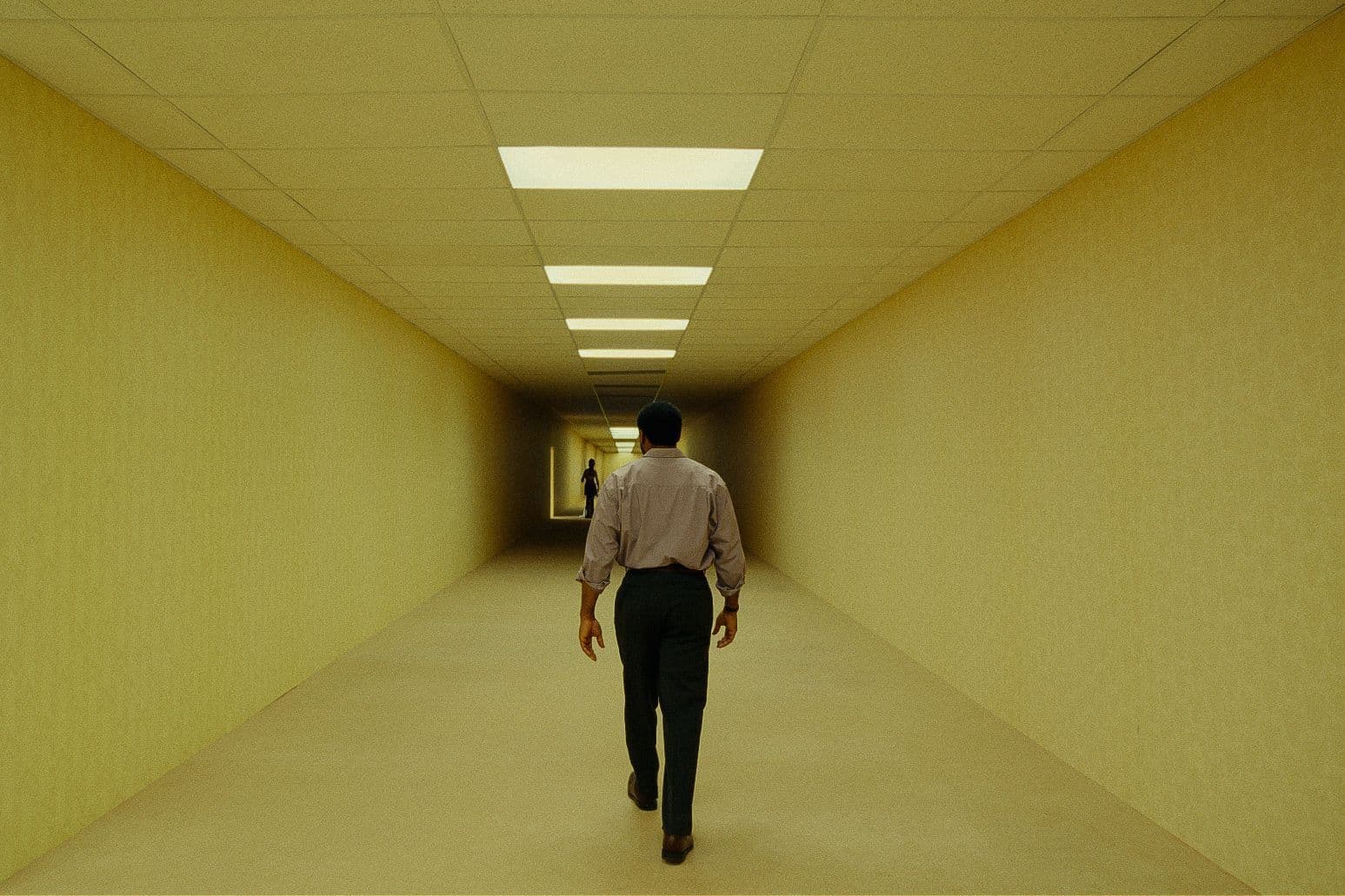
How a Teenage Filmmaker Turned a Creepy Internet Myth Into A24's Next Big Horror Hit
Director Kane Parsons transformed a viral 4chan meme into a full-length A24 horror feature starring Chiwetel Ejiofor and Renate Reinsve.

From Viral YouTube Clip to Hollywood Feature Film
Kane Parsons hasn't had a moment to breathe. "It's been go, go, go," he recently told WIRED, acknowledging that even a brief pause would help him process the whirlwind of the past few years. For now, though, he's embracing the spotlight — and expects it'll be at least another month before he can truly step back and take stock of how dramatically his life has changed.
His debut feature, Backrooms, is a brooding, cerebral horror film starring Chiwetel Ejiofor and Renate Reinsve. An ambitious expansion of his atmospheric YouTube web series of the same name, the movie marks Parsons' arrival as A24's youngest-ever director — a remarkable milestone for a filmmaker whose career began not in film school, but in the comment sections and creative communities of the internet. With its release perfectly timed for summer blockbuster season, the anticipation surrounding the film has been enormous.
Yet Parsons is remarkably modest about how it all came together. "I never went into making that first short or making the series with the intention of proving to Hollywood that this concept could carry a film," he says. "It wasn't a calculated move."
The Creepy 4Chan Post That Started It All
The story behind Backrooms stretches back to 2019, when an anonymous user posted on 4chan's /x/ paranormal forum. Alongside a deeply unsettling photograph of a bare, fluorescent-lit hallway, the post described a place called "the Backrooms" — an infinite, disorienting maze characterized by "the stink of old, moist carpet, the madness of mono-yellow, the endless background noise of fluorescent lights at maximum hum-buzz, and approximately six hundred million square miles of randomly segmented empty rooms." The warning that closed the post was equally chilling: "God save you if you hear something wandering around nearby, because it sure as hell has heard you."
The concept quickly spread across social media platforms, spawning a wave of fan-created stories, artwork, and lore. It became part of a broader cultural fascination with liminal spaces — eerie, transitional environments that feel simultaneously familiar and deeply wrong. Parsons stumbled upon this growing mythology and felt an immediate pull toward it.
"It was clearly scratching something that I didn't really see much other media scratching," he explains. "I found myself wishing there was simply more of it to engage with."
A Teenager With a Vision and the Right Software
Determined to fill that creative void, Parsons set to work using Blender 3D animation software and Adobe After Effects to craft his own interpretation of the Backrooms. The result — a nine-minute found-footage short titled The Backrooms (Found Footage), uploaded in 2022 — depicted a lone figure being pursued through those endless, sickly corridors by something deeply threatening. The video exploded online, earning widespread praise for both its technical sophistication and its suffocating atmosphere. Fans immediately began dissecting the mythology, and within a month, Hollywood studios were calling.
Despite still being a teenager at the time, Parsons approached these overtures with a healthy dose of skepticism. "I was distrustful of pretty much everything that was happening," he admits. "It's a very common experience for that kind of buzz to turn into nothing — or something even worse than nothing."
His caution paid off. He eventually secured a deal that allowed him to preserve his creative vision, collaborating with screenwriter Will Soodik — known for his work on Homeland and Westworld — while being backed by producers Osgood Perkins and James Wan, two of horror's most respected names.
What the Film Is Actually About
Backrooms is a visually rich, psychologically layered experience drenched in fluorescent unease. Ejiofor plays Clark, a hard-drinking divorcé barely keeping his San Jose furniture store afloat and carrying a deep-seated anger he struggles to acknowledge. In therapy sessions with Dr. Mary (Reinsve), he attempts to unravel the behavioral cycles that have derailed his life — the collapse of his marriage, the abandonment of his dream to become an architect. Mary, meanwhile, carries her own hidden wounds: as a child, her agoraphobic mother kept her confined indoors, windows sealed with yellowing newspaper.
The story shifts into supernatural territory one evening when Clark, investigating a malfunctioning circuit breaker in his darkened showroom, notices a faintly glowing seam in the wall. Inexplicably, the plaster gives way to reveal a passage into a vast, seemingly infinite labyrinth — an otherworldly maze of connected rooms filled with objects and architecture that feel almost recognizable, yet fundamentally wrong. Drawn back repeatedly, Clark attempts to map the sprawl and discover whether he is truly alone in there.
Balancing Fan Expectations With Mainstream Appeal
One of Parsons' central challenges was crafting a narrative that would reward the Backrooms' devoted online fanbase without alienating newcomers. "You have to be careful not to lean too hard into the existing community," he says, noting that deeply invested fans — the "problem-solvers" and "puzzle-oriented people" — can develop such elaborate theories that they end up limiting rather than expanding a story's potential.
His solution was restraint. Backrooms deliberately withholds definitive answers, leaving viewers sitting with discomfort rather than resolution. The film is also set in the 1990s, a choice that adds an interesting layer of irony: a mythology born from internet culture is explored through a character who has no access to the internet, no search engine to consult, no platform to share his discovery. As Parsons wryly notes, "He can't even fly a drone down there."
The film's impossible spatial logic draws comparisons to the Overlook Hotel in The Shining, creating an architecture of dread that lingers in the mind long after the credits roll.
A Landmark Moment for Horror and Hollywood
Industry trackers are projecting a massive opening weekend for Backrooms — one that could shatter A24's existing box office record. Beyond the numbers, many are viewing the film as a signal of a broader shift in how Hollywood identifies emerging talent, with YouTube increasingly serving as a proving ground for the next generation of horror directors.
But perhaps the most compelling aspect of the film's cultural moment is simpler than any industry trend: Backrooms is a genuinely original story. As I walked to my car after a screening — through a silent, underground parking garage — I caught myself glancing over my shoulder, half-expecting to hear footsteps that weren't there.
For Parsons, growing up immersed in overlapping online creative communities gave him a finely tuned sense of what audiences are hungry for but rarely receive. "What people are looking for, it feels like they're usually ignored or neglected," he says. "There's a real power in feeling tapped into that conversation — in actually having it with everyone else."