How a Sleeping Welsh Town Was Torn Apart When a River Surged to 18 Times Its Normal Level
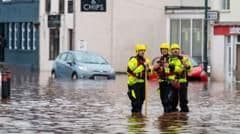
Storm Claudia struck Monmouth in the dead of night, sending floodwaters raging through homes and businesses and leaving a community shattered.

A Town Caught Off Guard in the Early Hours
At one o'clock on a Saturday morning in November 2025, the market town of Monmouth in south Wales was plunged into chaos. While most residents slept, Storm Claudia was unleashing catastrophic flooding that would go on to be described as the worst the town had seen in living memory.
The culprit was not the River Wye — the larger waterway that borders the eastern side of Monmouth and the one most residents had their eyes on — but rather its tributary, the River Monnow. According to Jeremy Parr, Head of Flood and Incident Risk Management at Natural Resources Wales, the Monnow rose to a staggering 18 times its normal level during the storm. To put that in perspective, Parr described it as the equivalent of "371 small cars passing your eyes every second."
Hundreds of residents were forced from their homes. Businesses lost millions. And for some who had spent their entire lives in Monmouth, the flood took absolutely everything.
'It Was Carnage' — A Retirement Home Manager's Harrowing Night
Among those who witnessed the full horror of that night was Gillian Haycock, manager of Chippenham Court, a retirement living complex in the town. She described the scene as "carnage" as she worked frantically to protect her elderly residents from the rising water.
One moment she will never forget involved a 102-year-old resident who had to be rescued by raft boat, still dressed in their nightgown. Speaking on BBC Radio Wales' After the Cameras podcast, Haycock painted a vivid picture of the destruction.
"It was like a sinking ship, and it still looks like that now," she said. "I would never believe that water could do that much damage — that it could take a kitchen off its wall. The severity of that water was so strong that day, and it kept flowing."
Nearly four months after the disaster, some residents of Chippenham Court remain homeless. Among those displaced is Haycock's own 87-year-old father-in-law, who is battling terminal cancer.
"Even now, 11 or 12 weeks later, they're all in not the best place," she said. "Mentally, they're distraught and I don't know whether some will even come back."
The cost of repairing the building has been estimated at over £750,000. Haycock has described it as "pretty scary" to consider that she may be forced to permanently close Chippenham Court if she is unable to afford to renew the building's insurance policy at the end of March.
A Restaurant Dream Nearly Destroyed After Just Eight Days
Andrea Shull and her husband had only opened their restaurant, Bar 125, eight days before Storm Claudia struck. They were still on the premises when the street outside began filling with rushing water in the early hours of the morning.
"Because there were a lot of us still there, we started lifting furniture and fridges up into the kitchen area, thinking about the electricals," Shull recalled. "Then before we knew it, it just all came through like a river and we were fighting a losing battle."
What made the situation even more devastating was that Shull had not thoroughly read the small print of her insurance policy. As a result, she received nothing to cover her losses or to help fund the restaurant's reopening. She estimates total losses at around £250,000, encompassing destroyed food, equipment, and unpaid wages. To stay afloat, she emptied her savings, cashed in her pension, and relied on multiple credit cards.
Despite the overwhelming setbacks, the local community rallied around Bar 125, and the restaurant managed to reopen just ten days after the flood.
"You kind of feel like you're in somebody else's nightmare — that it's not really happening to you," Shull said.
Yet the recovery has been slow and painful. Speaking earlier this month, she revealed: "Yesterday, we didn't even take enough money to cover our staff wages."
Flood Defences Are No Guarantee, Experts Warn
The scale of the flooding caught many in Monmouth off guard, partly because the town does have flood defences in place. Jeremy Parr acknowledged that the event was unexpected given how long it had been since flooding of this magnitude had occurred in the area.
"What it shows is that a lot of places, like Monmouth, are next to rivers with defences — and those defences aren't a guarantee that there will never be any flooding," Parr said. "I've spoken to people who are scared every time it rains because of their memory of what happened last time."
The broader picture for Wales is equally concerning. Natural Resources Wales estimates that one in seven homes across the country is currently at risk of flooding — a figure projected to rise by 28% over the next hundred years as climate patterns continue to shift.
Investigation Underway as Community Tries to Rebuild
Monmouthshire County Council has launched a formal investigation into the causes and full impact of last November's flooding, with findings expected to be published during the summer.
For many residents and business owners, however, the damage is already done. The road to recovery is long, financially crippling, and — for some — deeply uncertain. What Storm Claudia revealed is that no community situated near a river can afford to feel entirely safe, no matter what protections may be in place.