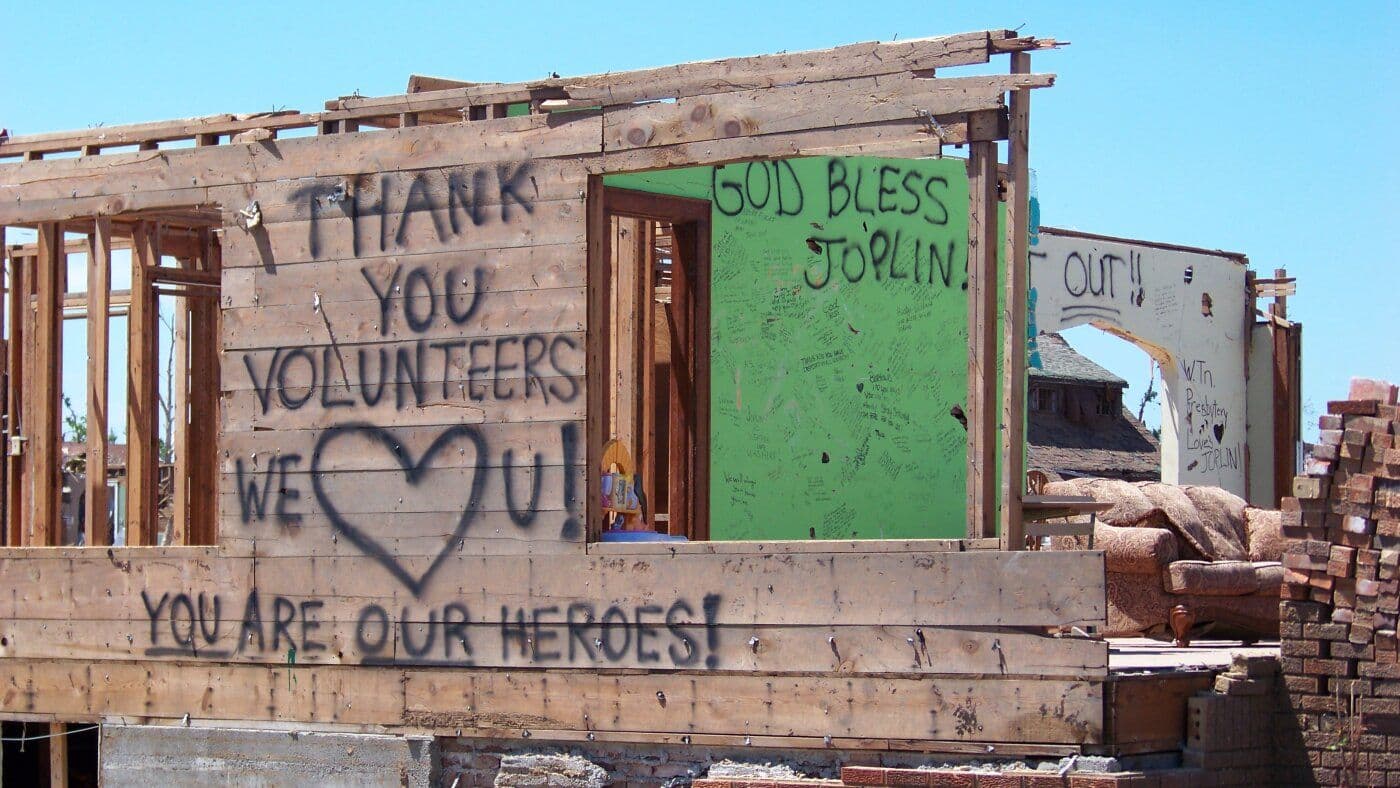
How a Devastating Tornado United Joplin, Missouri — and Sparked a Legacy of Kindness That Endures 15 Years Later
When a deadly tornado tore through Joplin in 2011, something remarkable emerged from the rubble: an outpouring of compassion that researchers still study today.

A City Brought to Its Knees — Then Lifted by Humanity
When Nanda Nunnelly returned home from a weekend trip on May 22, 2011, the sky above Joplin, Missouri had turned an unsettling shade of green. Moments later, tornado sirens pierced the air. She grabbed her husband and dog and dove into the nearest closet.
"Within just seconds, it was so loud that it was quiet," she recalls. As winds roared past at nearly 200 mph, she whispered a quiet prayer: "If I'm dying, dear God, please don't let it hurt."
Nunnelly survived. Her house did not.
The massive multi-vortex tornado that tore through Joplin that afternoon stretched three-quarters of a mile wide and claimed nearly 160 lives — making it one of the deadliest tornadoes in American history. In a single afternoon, roughly one-third of the city's population was left displaced, homes reduced to splinters, neighborhoods unrecognizable.
Yet within months, Joplin would become famous not for its destruction, but for the extraordinary human response that followed.
Nearly 100,000 Volunteers and the Power of Collective Action
In the weeks immediately following the disaster, close to 100,000 volunteers poured into Joplin from virtually every state in the country. They hauled away millions of cubic yards of debris, rebuilt homes, and helped a shattered community find its footing again. Government agencies, private businesses, faith-based organizations, and ordinary citizens all worked side by side.
Researchers from Columbia University who studied the recovery noted something striking: just six months after the tornado, there was "barely any polarization or political conflict" surrounding the rebuilding effort. Schools reopened on schedule that fall — a milestone that spoke volumes about how purposefully and cooperatively the community moved forward.
Darren Fullerton, who managed a Red Cross emergency shelter at Missouri Southern State University during those chaotic first weeks, witnessed generosity in its most unfiltered form.
"People came out of the woodwork," he says.
Ranchers fired up grills and cooked steaks for exhausted volunteers. A university dean who had lost his own home quietly set up cots at a shelter so others would have somewhere to sleep. Someone dressed as a clown, wandering through the chaos, twisted balloon animals to make children smile.
Breaking Down Barriers: What Disaster Does to Human Identity
Melodee Colbert-Kean, who served as Joplin's vice-mayor at the time, says the crisis had a peculiar equalizing effect on the community.
"It didn't matter what color you were, whether you were a Republican, Democrat, independent, whatever," she says. "You saw a need, and you tried to fill that need the best you could."
Social psychologists have a name for this phenomenon: catastrophe compassion. According to Dr. Jamil Zaki, director of Stanford's Social Neuroscience Lab and author of two books on empathy and kindness, disasters have a unique ability to dissolve the social walls people normally build around themselves.
"After something terrible happens, people, instead of falling apart and focusing on themselves, come together and try to do for one another," Zaki explains.
He pushes back against the popular misconception that disasters trigger looting, selfishness, and social breakdown. In reality, the opposite tends to be true.
Under normal circumstances, humans are what Zaki calls a "group-ish" species — we sort ourselves into identity categories like political affiliation, religion, or ideology, and those labels can quietly divide us. But when catastrophe strikes, a new and more powerful identity emerges: survivor.
"If you're on a bus that gets bombed or you're in a street that gets hit by a tornado, you suddenly have a lot in common with the people right next to you," says Zaki. "You're part of a tribe you might not have chosen to join, but one that unites you really powerfully."
A Face From the Past: One Woman's Path to Redemption
For Nanda Nunnelly, the tornado did more than reshape her home — it reshaped her conscience.
As she crouched in her daughter's closet watching shards of broken glass swirl through the air like, in her words, "fairy dust," her mind flashed to an unexpected face. Not a family member. Not a close friend. It was a girl she had bullied in 8th grade.
"I'm like, 'Oh my God, I never got to tell her I'm sorry,'" Nunnelly recalls.
After relocating to a nearby town in the storm's aftermath, the memory continued to haunt her. Eventually, she tracked the woman down and sent her a lengthy, heartfelt apology on Facebook.
"When you truly think you're going to die, it's really strange the things that come into your head," she reflects.
When Nunnelly returned to Joplin five years later, she joined the board of a local community center that now provides shelter for unhoused individuals during extreme weather events. The drive to give back, she says, felt almost instinctive.
"I don't know how anyone could go through that and not think about how they can help the next person."
Altruism Born From Suffering: The Science Behind Giving Back
Psychologists suggest that Nunnelly's transformation is far from unique. Personal trauma, particularly when the individual received meaningful support during their darkest moments, can plant the seeds of future altruistic behavior.
Zaki describes this as altruism born of suffering — a concept that helps explain why people who have battled addiction often become addiction counselors, or why veterans dedicate themselves to supporting fellow veterans.
"When we experience some type of pain, it's almost like we have an easier time accessing that suffering in other people and a stronger desire to do something about it," he says.
Fifteen years after the tornado leveled a third of Joplin, the spirit it unexpectedly ignited lives on — in community boards, volunteer hours, and quiet acts of grace between neighbors. The storm took nearly 160 lives. But in its wake, it also revealed something profound and enduring about human nature: that even in our worst moments, kindness has a way of finding the cracks.

