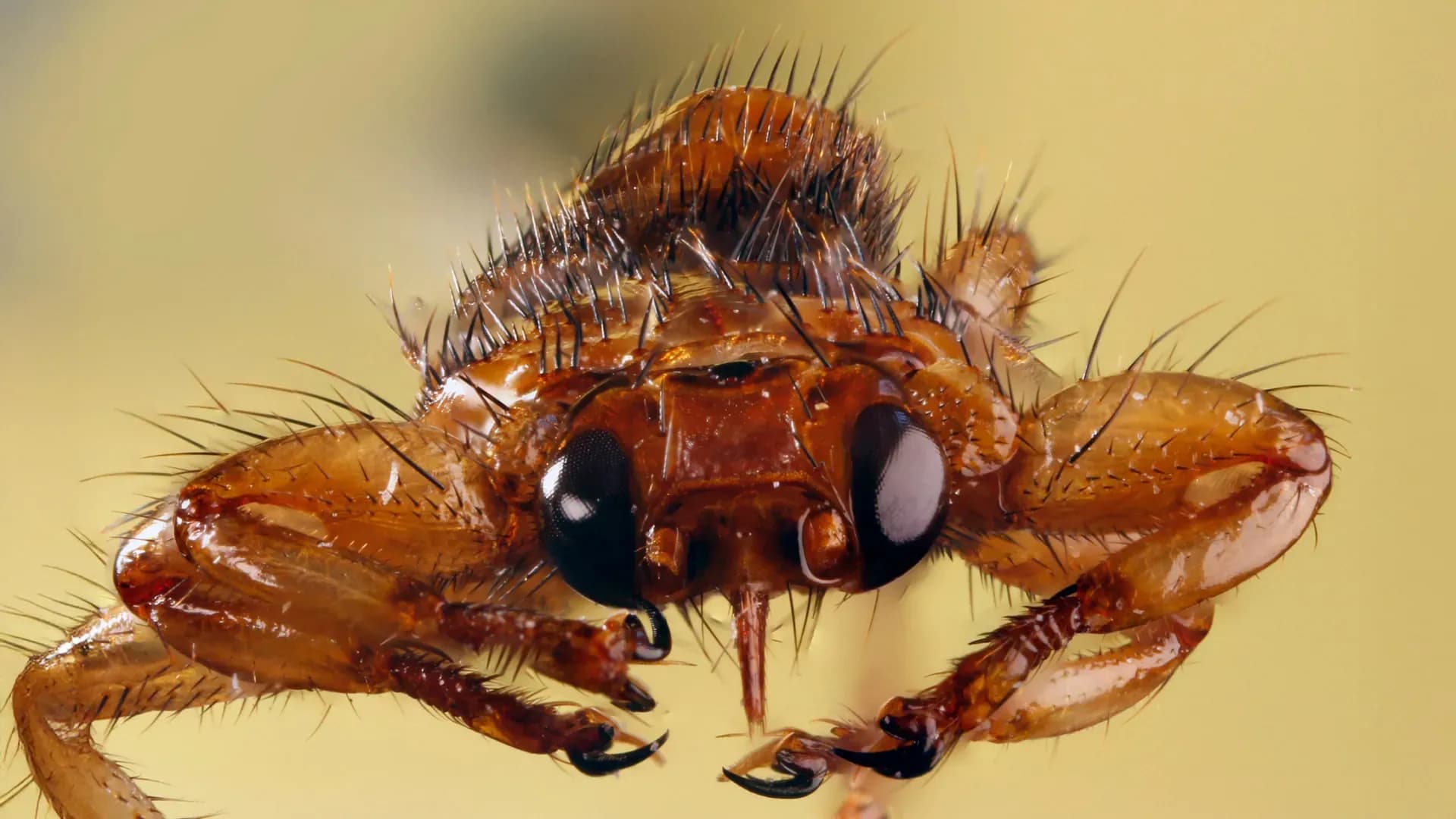
How a Blood-Sucking Fly Trades Its Vision for a Permanent Home on a Host
Deer keds use sharp eyesight to hunt hosts, then deliberately dial back their vision once settled. Scientists now know why.
A Fly That Gives Up Both Its Wings and Its Sight
Most creatures do everything possible to protect their senses. For one unusual blood-feeding fly, however, dimming its own vision appears to be a surprisingly smart survival strategy.
New research has revealed that deer keds — biting flies found across Europe, Asia, Africa, and the Americas — dramatically reduce the activity of key vision-related genes once they locate a host and permanently shed their wings. Scientists believe this is a deliberate biological trade-off: sacrifice sharp eyesight to conserve energy for feeding and reproduction.
What Are Deer Keds?
Deer keds are parasitic flies that live a double life. In their winged adult stage, they behave much like any airborne predator, using both flight and keen vision to track down a suitable host — most commonly deer, though humans and other mammals are occasionally targeted.
Once a deer ked successfully lands on a host, however, everything changes. The insect sheds its wings permanently and transitions into a full-time ectoparasite, spending the rest of its life burrowing through fur and feeding on blood. It never flies again.
The Science Behind the Sensory Shift
Researchers from Aberystwyth University and the University of Florence set out to understand how deer keds adapt biologically to this extreme lifestyle change. Their study, published in the Journal of Experimental Biology, compared winged deer keds actively hunting for hosts against wingless individuals already established on deer.
The team focused specifically on opsins — the proteins encoded by genes that govern visual sensitivity. By measuring opsin gene activity at both stages of the fly's life, scientists could track exactly how the insect's visual system responds to its new circumstances.
Vision Reduced by Half
The findings were striking. After a deer ked sheds its wings and settles onto a host, the activity of its opsin genes drops to roughly half the level recorded in flying individuals.
Dr. Roger Santer, who led the study from the Department of Life Sciences at Aberystwyth University, explained the significance of this discovery:
"Vision plays a vital role in animal behavior, but it is also energetically expensive. Evolution favors sensory systems that are efficiently matched to an animal's way of life. We found that a flying deer ked's visual system closely resembles that of a tsetse fly, which famously hunts mammal hosts across Africa. However, after a deer ked loses its wings and becomes an ectoparasite, activity of its opsin genes reduces to around half the previous level."
Importantly, this does not mean the flies go completely blind. Rather, their visual capabilities appear to scale back in proportion to what is actually needed for life on a host, where aerial navigation is no longer relevant.
Energy Is the Real Currency
The underlying logic is straightforward: maintaining a high-performance visual system requires significant energy. Once a deer ked no longer needs to search for hosts from the air, investing heavily in sharp eyesight becomes wasteful.
By dialing down opsin gene activity, the fly appears to redirect that saved energy toward biological functions that matter far more in its new environment — primarily digesting blood meals and reproducing.
Dr. Santer added: "We think the fly might be sacrificing sight to conserve energy for functions such as digestion and reproduction. Evolution has essentially fine-tuned the fly's sensory investment to match each phase of its life."
Why This Research Matters
Beyond satisfying scientific curiosity, this research offers practical implications. A deeper understanding of how deer keds and other biting flies use their senses throughout their life cycles could inform the development of more effective monitoring and control strategies for parasitic fly populations.
As parasites continue to pose challenges for wildlife, livestock, and human health alike, insights into their biology — including how they perceive and adapt to their environment — become increasingly valuable tools for those working to manage them.

