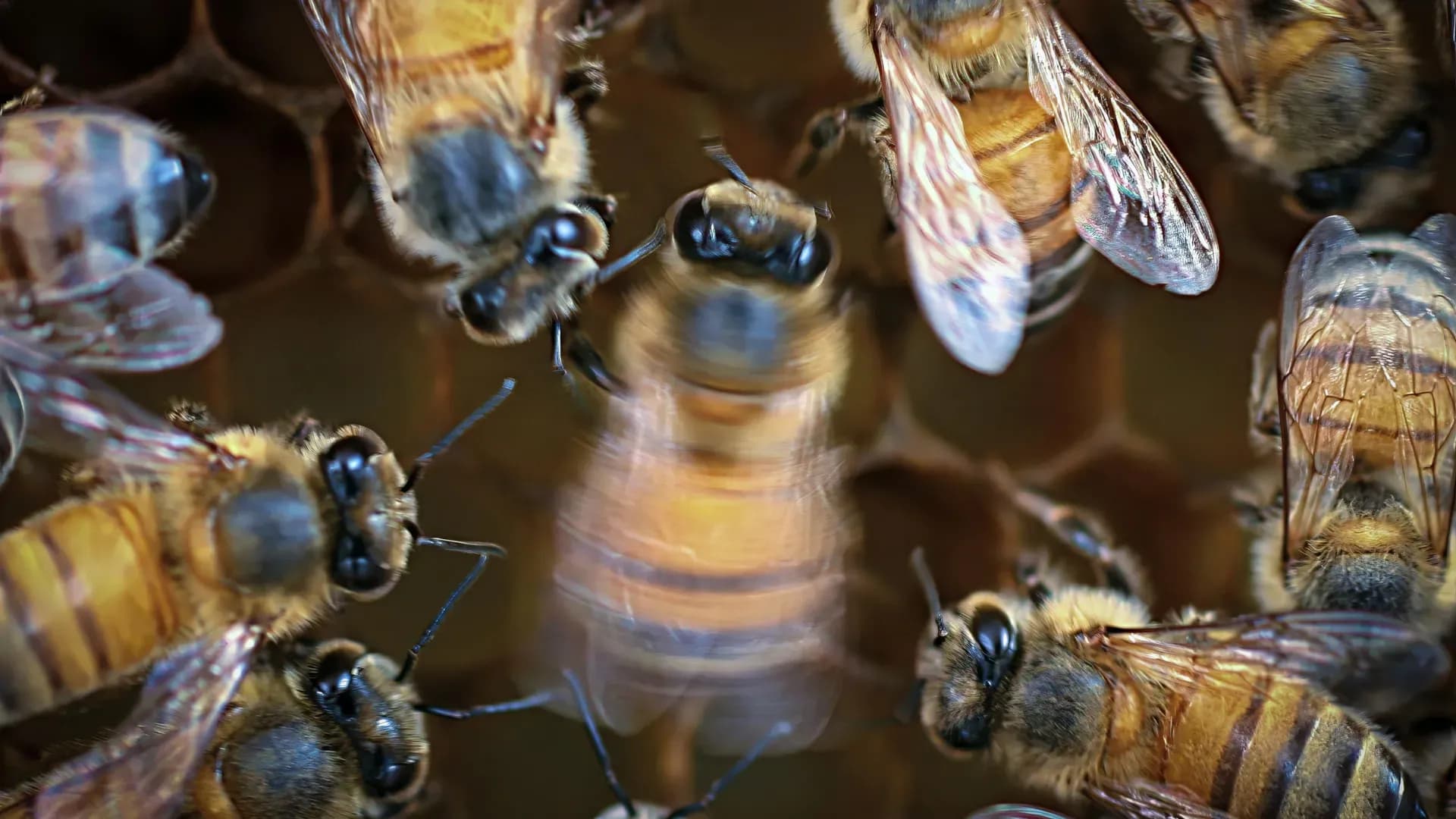
Honey Bees Perform Better When the Crowd Is Watching, Scientists Reveal
New research shows honey bees fine-tune their famous waggle dance based on audience size, proving this ancient communication system is far more dynamic than once thought.

The Waggle Dance Is More Than a Simple Message
For decades, scientists have marveled at the honey bee's waggle dance — a remarkably precise form of communication used to guide fellow foragers toward food sources. But groundbreaking new research reveals there is much more happening on the hive's dance floor than previously understood. It turns out, bees are not simply broadcasting a fixed signal. They are actively adapting their performance based on who is paying attention.
A study published in the Proceedings of the National Academy of Sciences, led by researchers from the University of California San Diego in collaboration with the Chinese Academy of Sciences and Queen Mary University of London, demonstrates that the accuracy of a bee's waggle dance rises and falls depending on audience size and engagement.
How the Waggle Dance Actually Works
When a foraging bee returns to the hive after locating a quality food source, it launches into a rapid, repetitive routine on the hive's communal dance floor. The bee moves forward while vigorously shaking its abdomen, then loops back and repeats the sequence within seconds.
This seemingly simple motion carries a wealth of encoded information. The direction of the dance relative to the sun indicates where other bees should fly, while the duration of each forward movement communicates how far away the food is. Together, these cues allow the colony to efficiently mobilize foragers toward the best available resources.
Audience Size Changes Everything
What makes this new research so compelling is the discovery that the dance is not a static transmission. According to Professor James Nieh of UC San Diego's School of Biological Sciences, the performance is deeply social — shaped in real time by the reactions of those watching.
Nieh draws a vivid comparison to street performers. A musician playing to a full crowd can stay focused and deliver a polished, consistent act. When the audience dwindles, however, the performer instinctively shifts attention toward attracting new listeners, often at the expense of the performance itself.
Honey bees follow exactly this pattern. When fewer hive mates are present or engaged, the dancing bee moves around more in an attempt to recruit followers. That additional movement disrupts the precision required to communicate an accurate food location.
"Everyone has seen a street musician or a performer adjust to a changing crowd," said Nieh, a faculty member in UC San Diego's Department of Ecology, Behavior and Evolution. "In the hive, we see a comparable tradeoff. When fewer bees follow, dancers move more as they search for their audience, and the dance becomes less precise."
Inside the Experiments
To test this dynamic, Nieh and his international team set up controlled hives designed to replicate natural colony conditions. The researchers carefully monitored the hive's dance floor, observing how bee dancers responded under different social circumstances.
In one experiment, the team deliberately varied the number of bees present during a dance to measure the direct effect of audience size on performance quality. In a separate test, they kept overall bee numbers constant but introduced young worker bees — individuals that do not typically follow or respond to waggle dances — effectively reducing the engaged portion of the audience. In both scenarios, dancers produced less accurate signals when their active audience was small or unresponsive.
Physical Touch as Social Feedback
The study also explored how bees actually sense their audience. Observing bees closely revealed that follower bees regularly make physical contact with the dancer, touching it with their antennae and bodies throughout the performance. Researchers believe these tactile interactions serve as real-time feedback, helping the dancer gauge how many bees are nearby and how attentive they are.
A Signal Shaped by Social Conditions
Ken Tan, senior author of the study and a researcher at the Xishuangbanna Tropical Botanical Garden of the Chinese Academy of Sciences, emphasized that this research fundamentally reframes how scientists understand bee communication.
"The waggle dance is often presented as a one-way information transfer," Tan explained. "Our data show that feedback from the audience shapes the signal itself. In that sense, the dancer is not only sending information, but also responding to social conditions on the dance floor."
Lars Chittka of Queen Mary University of London echoed that sentiment, noting the broader implications of the findings. "Humans aren't the only ones who perform differently depending on their audience," he said. "Our study shows that honey bees quite literally dance better when they know someone is watching. When followers are scarce, dancers wander around searching for listeners — and in doing so, their signals become fuzzier. It's a lovely reminder that even in the miniature world of insects, communication is a deeply social affair."
What This Means for Animal Communication
The implications of this research extend well beyond the beehive. The study offers a new framework for understanding how collective animal groups exchange and act on information. In many distributed systems — whether biological or engineered — the quality of a signal depends not only on the sender's intent but also on whether there is an attentive audience ready to receive it.
"The new findings show that the accuracy of a signal can depend on the availability of receivers, not only on the motivation of the sender," said Nieh. "That kind of feedback may be important in animal societies, engineered swarms and other distributed systems where the quality of information can rise or fall with audience dynamics."
This research was funded by the 14th Five-Year Plan of Xishuangbanna Tropical Botanical Garden, the Chinese Academy of Sciences, the Yunnan Revitalization Talents Support Plan, and the National Natural Science Foundation of China.

