Homer's Iliad Fragment Discovered Inside a 1,600-Year-Old Egyptian Mummy
Archaeologists uncovered a papyrus passage from Homer's Iliad inside a Roman-era Egyptian mummy — the first literary text ever found used in mummification.

A Groundbreaking Find Beneath Ancient Wrappings
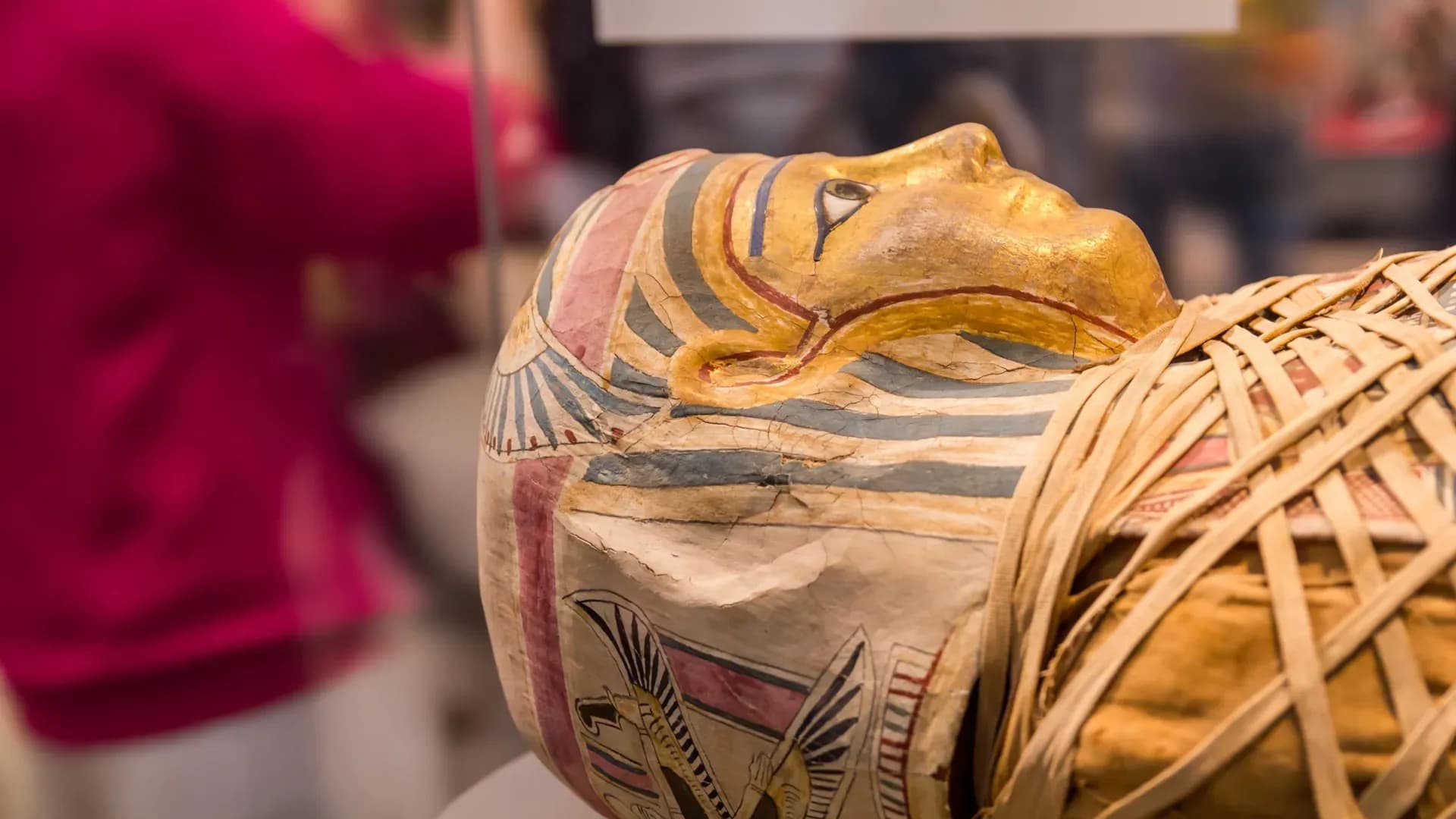
Archaeologists working in Egypt have made a discovery that is rewriting what we know about ancient burial practices and the cultural reach of Greek literature. Hidden inside a 1,600-year-old Roman-era mummy, researchers found a fragment of papyrus containing verses from Homer's Iliad — marking the very first time a Greek literary text has been deliberately incorporated into the mummification process.
The find emerged from excavations at Al Bahnasa, the modern Egyptian town built atop the ruins of ancient Oxyrhynchus, one of the most archaeologically rich cities of the Greco-Roman world. Located roughly 190 kilometers south of Cairo along the Bahr Yussef branch of the Nile, Oxyrhynchus has long been celebrated for yielding vast quantities of ancient papyri.
The Discovery at Tomb 65
During a field season conducted between November and December 2025, a team led by researcher Núria Castellano uncovered a mummy inside Tomb 65 of Sector 22. What made this burial immediately stand out was a papyrus scroll resting deliberately on the mummy's abdomen — placed there as an intentional part of the embalming ritual.
The excavation falls under the broader Oxyrhynchus Archaeological Mission, directed by Maite Mascort and Esther Pons through the Institute of Ancient Near East Studies (IPOA) at the University of Barcelona — a project that has been operating continuously since 1992.
From Ritual Magic to Literary Epic
Previous excavations at the same site had turned up Greek papyri bundled and sealed within mummies in a similar fashion. However, those earlier texts were exclusively magical or ritual in content. The discovery of a passage from Homer's Iliad placed in an identical funerary context is entirely without precedent in the archaeological record.
Identifying the 'Catalogue of Ships'
Following the initial discovery, a dedicated research campaign conducted between January and February 2026 brought together a team of specialists to analyze the fragile document. Conservator Margalida Munar carefully preserved the papyrus, while papyrologist Leah Mascia carried out a detailed reading of the text.
Using Mascia's transcription, Professor Ignasi-Xavier Adiego — a classical philologist and director of the Oxyrhynchus project within the Department of Classical, Romance and Semitic Languages at the University of Barcelona — confirmed that the fragment belongs to the famous "Catalogue of Ships" found in Book II of the Iliad. This celebrated section enumerates the Greek forces assembled before the walls of Troy and is widely regarded as one of the most iconic passages in all of Western literature.
As Professor Adiego noted: "This is not the first time we have found Greek papyri bundled, sealed, and incorporated into the mummification process, but until now, their content was mainly magical. The real novelty is finding a literary papyrus in a funerary context."
A Window Into Greco-Roman Funerary Culture
The broader excavation revealed a funerary complex built from limestone, housing several burial chambers that contained Roman-era mummies alongside decorated wooden sarcophagi. Unfortunately, many of the tombs showed evidence of historical looting, leaving a number of artifacts in degraded condition.
Despite this, the site continues to yield discoveries of remarkable historical significance. The mission's most recent season produced findings that researchers describe as pivotal to understanding the intersection of Greek literary culture and Egyptian burial traditions during the Roman period.
Decades of Research Behind the Discovery
The University of Barcelona's Oxyrhynchus Archaeological Mission has operated for over three decades, making it one of Spain's longest-running archaeological endeavors in Egypt. The project receives funding and support from Spain's Ministry of Culture, the University of Barcelona, the Palarq Foundation, the Catalan Egyptology Society, and AIXA Serveis Arqueològics. It operates in formal cooperation with Egypt's Supreme Council of Antiquities and Cairo University.
The team recently presented their latest findings during a public lecture series hosted at the University of Barcelona's Faculty of Philology and Communication, featuring presentations covering archaeology, physical anthropology, and conservation work.
Why This Discovery Matters
For historians and classicists alike, this find opens new questions about how Homer's works were perceived and used in everyday life — and in death — during the Roman era in Egypt. That a passage from the Iliad would be chosen as a funerary offering suggests the text carried not just literary prestige but perhaps a deeper spiritual or protective significance for those who placed it there.
As researchers continue to analyze the mummy and its contents, this remarkable papyrus stands as a testament to the enduring power of Homer's words — words that, even in death, someone chose to keep close.