Hidden in Plain Sight: DNA Uncovers Brand-New Pitviper Species in China's Mountains
A brilliantly green snake lurking in Sichuan's misty peaks has been confirmed as an entirely new species—one scientists had overlooked for decades.

A Green Serpent With a Secret
Tucked away in the fog-draped mountains of western Sichuan, China, a vividly colored snake had been deceiving scientists for decades. With its lush grass-green scales blending effortlessly into the surrounding forest, the snake was repeatedly mistaken for a well-known species—until cutting-edge DNA analysis exposed the truth. What researchers once dismissed as a common pitviper is, in fact, a species never before recorded by science.
The discovery was made by a team of researchers from the Chengdu Institute of Biology and the Giant Panda National Park, who were conducting wildlife surveys across the West China Rain Zone—a region globally recognized for its extraordinary biological richness. Their findings have since been published in the open-access journal Zoosystematics and Evolution.
Meet the Huaxi Green Pitviper
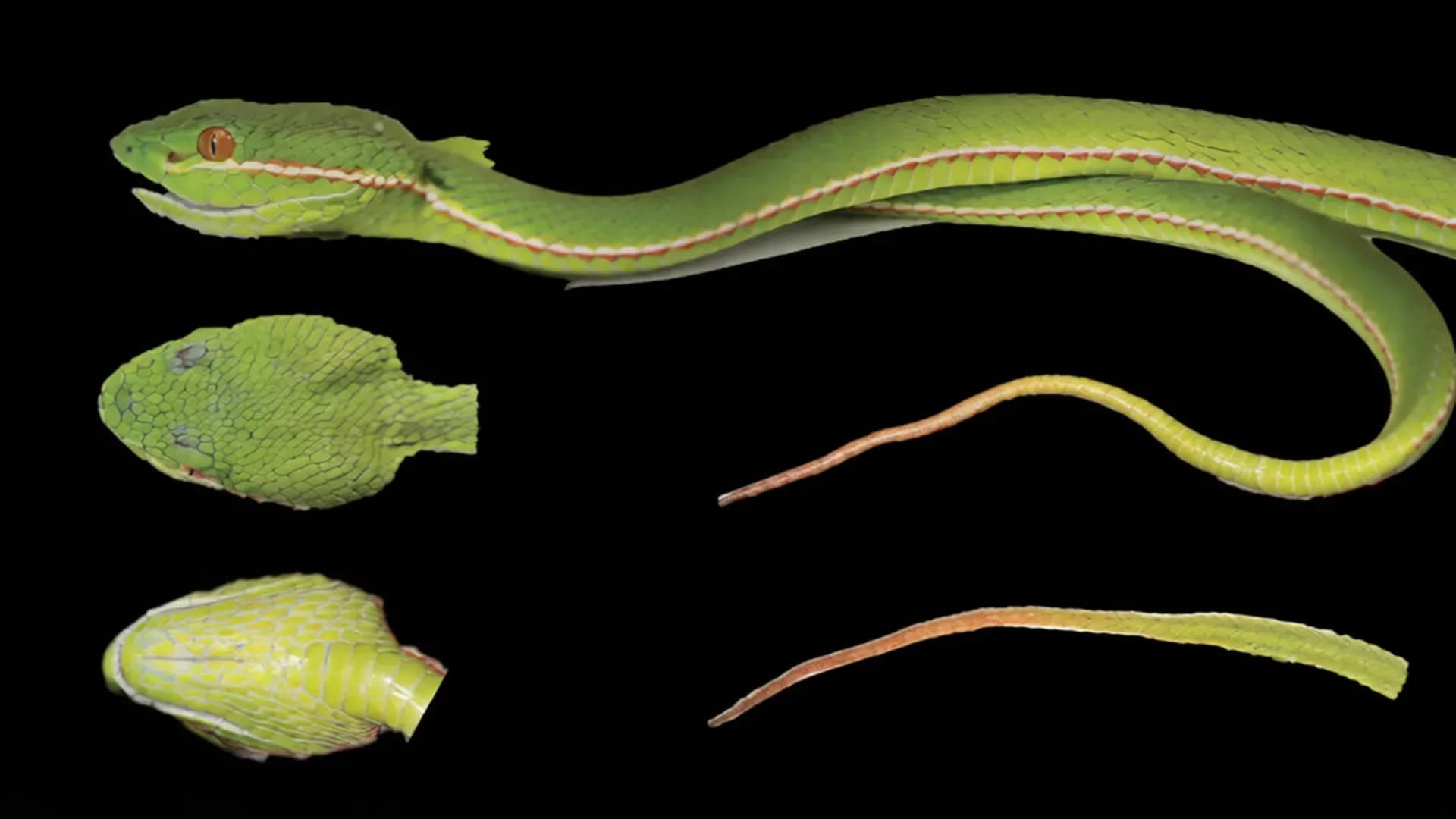
The newly identified snake has been formally named Trimeresurus lii, though it carries the more evocative common name: the Huaxi Green Pitviper. The species name pays tribute to Li Er, the revered ancient Chinese philosopher widely known as Laozi, whose foundational teachings celebrate the harmony between humanity and the natural world.
"His teachings emphasize the harmonious coexistence between humans and nature," explained lead researcher Bo Cai, "a principle that perfectly aligns with the conservation mission of the Giant Panda National Park where this species was discovered."
With this addition, Trimeresurus lii becomes the 58th recognized species within the Trimeresurus genus and only the second member of its subgenus ever documented in Sichuan Province.
How Scientists Cracked the Case
For years, these snakes were grouped alongside the bamboo pitviper (T. stejnegeri), a widespread species that shares nearly the same vivid green coloration. The resemblance was close enough to fool even trained eyes in the field.
It was only through rigorous genetic testing and careful physical examination that the distinction became undeniable. DNA sequencing confirmed that this snake population represents its own independent evolutionary lineage. Supporting evidence also emerged from physical characteristics—most notably, the Huaxi Green Pitviper possesses distinctly smooth head scales that set it apart from its closest relatives.
Striking Differences Between Males and Females
While both sexes share the species' signature bright green body, the Huaxi Green Pitviper displays notable differences depending on gender. Males are adorned with a bold red and white lateral stripe running along their sides, paired with striking amber-colored eyes. Females, by contrast, carry a more subtle yellow stripe and eyes tinged with orange-yellow hues—a distinction that makes gender identification surprisingly straightforward in the field.
A Species With Real-World Implications
Beautiful as it is, the Huaxi Green Pitviper is not without risk. Like all members of its genus, it is venomous and capable of causing serious snakebite envenoming. Given that its mountain habitat overlaps with areas frequented by local communities and tourists, health authorities and visitors alike should be aware of its presence.
Adults can reach lengths of nearly 80 centimeters (approximately 32 inches). The species inhabits the humid, densely forested slopes of Mt. Emei and Xiling Snow Mountain—two iconic landmarks within the West China Rain Zone biodiversity hotspot.
Why This Discovery Matters
The identification of an entirely new vertebrate species in a region as heavily studied as Sichuan Province sends a compelling message to the scientific community: even well-explored corners of the world still harbor biological secrets waiting to be uncovered.
"This discovery highlights the importance of continued field surveys in biodiversity hotspots," the research team emphasized.
In an era of accelerating habitat loss and species decline, findings like this reinforce the urgent need for sustained investment in field biology, genetic research, and protected natural areas. The Huaxi Green Pitviper is a vivid reminder that nature's catalog is far from complete—and that the next unknown species may be hiding in a forest we thought we already knew.