Gray Whales Are Invading San Francisco Bay — And a Smart Camera System May Save Their Lives
Climate change is pushing hungry gray whales into San Francisco Bay, where deadly ship collisions threaten their survival. A new AI-powered camera system aims to change that.

Gray Whales Are Turning Up in San Francisco Bay in Alarming Numbers
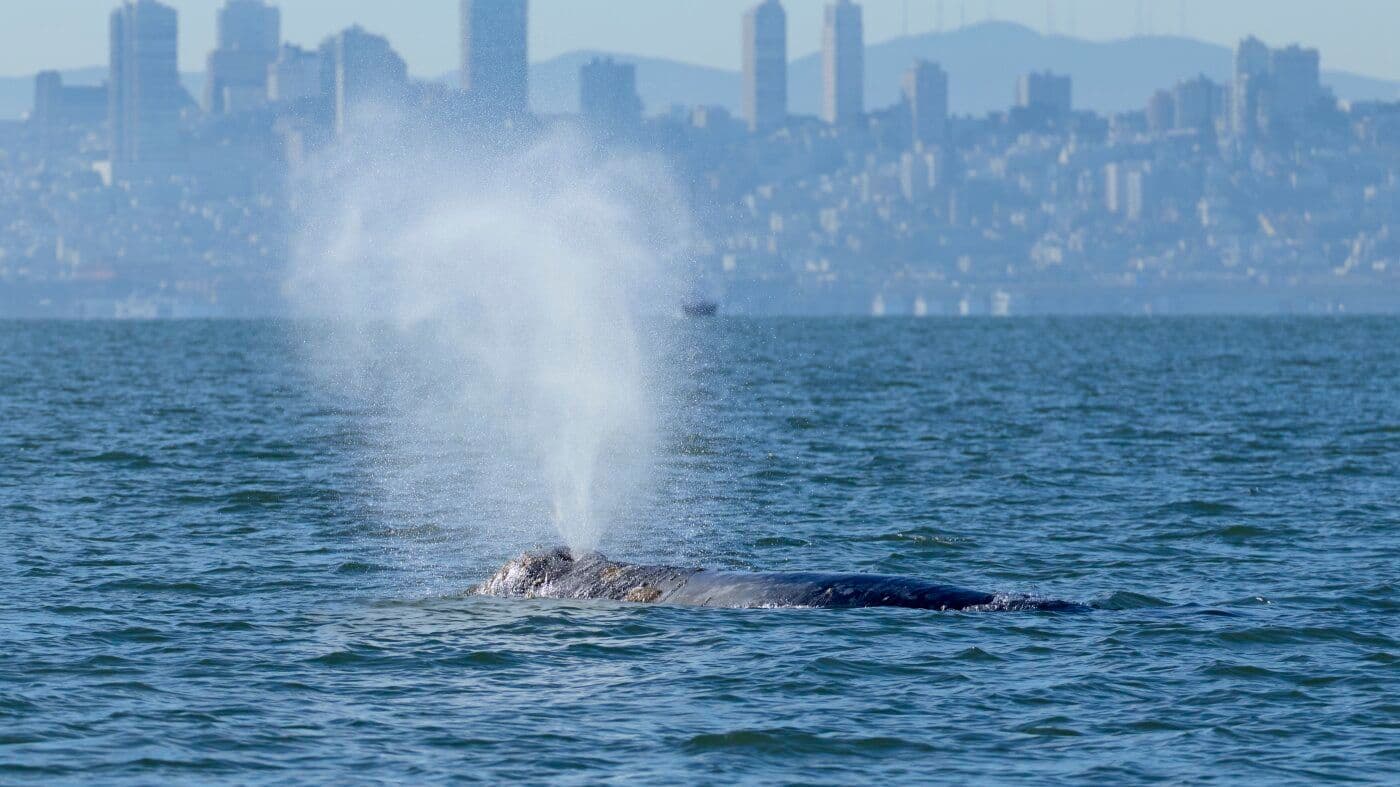
Not long ago, spotting a gray whale in San Francisco Bay was a remarkable event. Today, it has become almost routine. Spouts are breaking the surface near Alcatraz Island, one of the most trafficked waterways in the United States, as gray whales make unexpected pit stops on their annual migration between Mexico and Alaska.
Scientists believe the whales are not wandering in by accident. They are hungry — driven into the bay by the far-reaching consequences of climate change, which is stripping away their traditional food sources in Arctic waters.
But in adapting to one human-caused threat, these whales are walking directly into another: the relentless traffic of container ships, ferries, and cargo vessels that crisscross the bay every day.
A Population Already Under Pressure
Gray whales in the North Pacific are in serious trouble. The current population sits at roughly 13,000 — approximately half of what it was just a decade ago. Last year alone, 22 gray whales were found dead across the greater San Francisco Bay Area, the highest annual toll in 25 years. Similar die-offs are being recorded up and down the entire West Coast.
Of the 16 gray whales documented in San Francisco Bay this year, seven have died. Necropsies — animal autopsies — performed by the Marine Mammal Center and the California Academy of Sciences confirmed that several of those deaths were caused by ship strikes.
On a beach at Angel Island, the skeletal remains of three whales lie in a solemn row. One of them, a female, told a particularly grim story.
"She died from injuries due to blunt force trauma from vessel strike," says Kathi George, Director of Cetacean Conservation Biology at the Marine Mammal Center. Broken bones and damaged tissue, she explains, are the telltale signs of a fatal collision with a ship's hull.
Why Climate Change Is Sending Whales Into the Bay
To understand why gray whales are appearing in San Francisco Bay, you need to follow them to the Arctic — and witness what is disappearing there.
Gray whales are extraordinary long-distance travelers, completing a round-trip migration of roughly 12,000 miles every year. Each summer, they journey to the Arctic to gorge on tiny, shrimp-like crustaceans, consuming more than a ton of them daily to build the fat reserves needed to fuel the entire migration cycle.
But Arctic sea ice is retreating at a dramatic pace, fundamentally reshaping the ecosystem beneath it. The prey that gray whales depend on is becoming harder to find. As a result, many whales are arriving at critical waypoints severely undernourished, running low on energy before they can complete their journey.
"These whales are hungry," George says. "We think they're stopping at different areas along their route to find sources of food, and San Francisco Bay has become one of those hotspots."
With some individual whales now lingering in the bay for weeks at a time, the risk of a deadly encounter with vessel traffic has grown considerably.
The New Technology Designed to Protect Them
In response to the mounting crisis, a coalition of marine scientists, technology companies, and local officials has deployed an innovative early-warning system aimed at preventing whale-vessel collisions.
How the Thermal Camera System Works
At the heart of the project is a thermal imaging camera, installed on a tower in the middle of San Francisco Bay by a company called WhaleSpotter. The camera detects the faint heat signature of a whale's exhalation — its spout — as it rises above the cooler surrounding water and air.
"That blow is a little bit warmer than the water and the air around, so it provides a very good thermal signature," says Shawn Henry, CEO of WhaleSpotter.
Once a potential sighting is captured, artificial intelligence screens the image, and human operators then verify the alert. Confirmed whale locations are published in real time on the WhaleSafe website, operated by the Benioff Ocean Science Laboratory at the University of California, Santa Barbara. The U.S. Coast Guard then broadcasts the whale's position over the radio to vessels operating in the area.
Critically, the system works around the clock. Before its installation, Coast Guard alerts depended entirely on visual sightings reported by ships during daylight hours.
"Now with this new technology, it'll show us whales at night, so we can identify them and notify traffic," says Gary Reed, Director of Vessel Traffic Service San Francisco for the U.S. Coast Guard.
Ferries, Container Ships, and the Limits of Maneuverability
A second thermal camera is being mounted aboard a local ferry to extend coverage across a broader area of the bay. Both of the Bay Area's ferry operators say their crews are already responding — either slowing down or rerouting when whale alerts come in.
Large container ships present a more complicated challenge. Massive and slow to respond, they are largely confined to fixed shipping lanes and cannot easily change course at short notice. For now, participation in the whale-avoidance program remains voluntary for all vessels.
Researchers point out, however, that voluntary speed restrictions on other parts of the California coastline have achieved meaningful levels of compliance from commercial shipping fleets — offering reason for cautious optimism.
Every Whale Counts
"We're looking at a moment for gray whales where every whale that comes in and goes out of the bay matters for population," says Douglas McCauley, Director of the Benioff Ocean Science Laboratory at UC Santa Barbara. "So even though this is just one piece of the problem, it's a piece that we want to solve, can solve."
McCauley acknowledges that conditions for gray whales are likely to become even more difficult as climate change accelerates. The whales are demonstrating a capacity to adapt — venturing into new feeding grounds, adjusting their migration behavior — but there are limits to how far biological flexibility can stretch against an ecosystem in rapid transformation.
"I'm really optimistic that this is one of those solutions where the community comes together and the community solves it," he says. "But we'll see."
For now, the stakes could not be higher. With a population already cut in half over a single decade, San Francisco Bay has become both a refuge and a danger zone for one of the ocean's most iconic long-distance travelers.