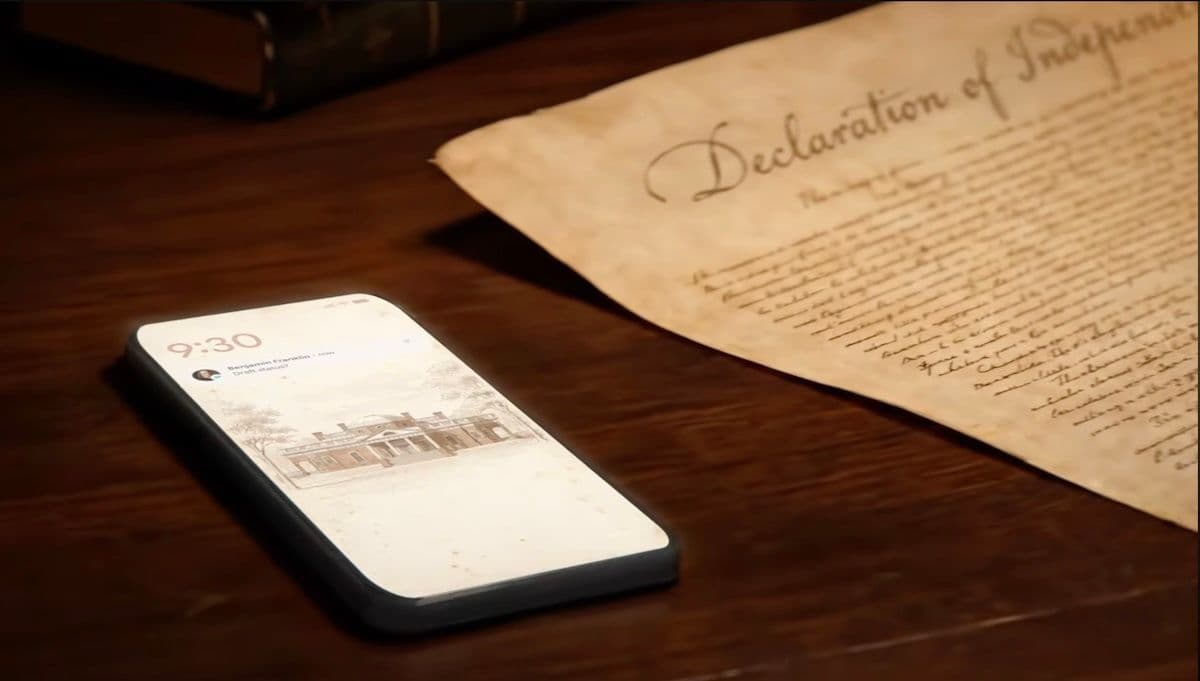
Google's Bold New Ad Imagines the Founding Fathers Using AI to Draft the Declaration of Independence
Google's latest commercial places AI tools in the hands of America's Founding Fathers. Here's what viewers think about it.

Google Asks: What If the Founding Fathers Had AI?
As the United States approaches its 250th anniversary, Google has released a clever new commercial that poses a fascinating historical "what if": Could America's Founding Fathers have drafted the Declaration of Independence faster — and better — with the help of Google Workspace and AI?
The ad, cheekily branded with the tagline "Group project, but make it 1776," blends colonial-era history with modern productivity tools in a way that is equal parts humorous and promotional.
How the Ad Plays Out
The commercial centers on a fictionalized Thomas Jefferson, caught mid-draft when he receives a nudging text message from none other than Benjamin Franklin. What follows is a surprisingly relatable depiction of modern workplace collaboration — just set two and a half centuries in the past.
Edits appear in Google Docs, a group meeting is scheduled through Google Calendar, and the session itself is conducted remotely via Google Meet — complete with virtually every attendee keeping their camera switched off, a nod that many remote workers will find painfully familiar. The process wraps up with electronic signatures, followed by a burst of celebratory fireworks.
AI Takes a Supporting Role
Given that this is a tech company advertisement in 2026, artificial intelligence is naturally woven into the storyline — though perhaps more subtly than expected. The fictional founders use Google's "help me visualize" AI feature to experiment with different animals for the national seal. Google's Gemini AI steps in to take meeting notes, and the founders consult the chatbot before ultimately rejecting King George III's request for document access.
Notably, the ad stops well short of implying that AI could have improved the actual prose of the Declaration of Independence — a wise creative decision given the backlash that followed an earlier Google commercial in which a father used Gemini to ghostwrite a fan letter on behalf of his daughter.
Tongue-in-Cheek Humor Keeps It Light
The commercial leans heavily into self-aware comedy. At one point, Sam Adams quips, "Can we settle this over beers?" — a wink to his famous brewing legacy. The AI integration is handled with a relatively light touch compared to many recent technology advertisements, which have faced criticism for overselling artificial intelligence as a solution to deeply human problems.
One additional detail worth noting: some viewers have observed that portions of the footage carry the distinctive, slightly uncanny visual quality often associated with AI-generated video — adding an unintentional layer of meta-commentary to the whole production.
Audience Reactions Are Divided
Public response to the ad has been decidedly mixed, and the divide appears to break along platform lines. Comments on YouTube and Instagram skew broadly positive, with many viewers appreciating the humor and historical creativity.
However, on Bluesky, the reception has been considerably more hostile. Critics have called the commercial "cringey" and "stunningly tone deaf," with the AI elements drawing the sharpest criticism. Ironically, several users — including historian Angus Johnston — pointed out that very little of the ad's content actually involves AI in any meaningful way.
"Even in a corny fantasy joke, it's impossible to make the case that AI is a useful tool for political organizing, writing, or human collaboration," Johnston remarked.
The Bigger Picture
Google's commercial arrives at a moment when tech companies are under increasing scrutiny for how they market AI to the general public. While the ad's comedic framing gives it some insulation from criticism, the debate it has sparked reflects a broader cultural tension: as AI becomes more embedded in everyday tools, consumers are growing more discerning — and more skeptical — about what these technologies can genuinely offer.

