Global Leaders Want American AI — But Fear Washington Could Pull the Plug Anytime
World leaders at the G7 raised urgent concerns about U.S. control over AI access after the Anthropic export ban made their worst fears a reality.
Global AI Dependence Meets a Hard Political Reality
The question that has quietly haunted international technology policy finally broke into the open at the G7 Summit this week: What happens when the country that builds the world's most powerful AI decides to shut the door?
French President Emmanuel Macron and Indian Prime Minister Narendra Modi both raised pointed concerns during the summit, warning fellow G7 leaders and top American AI executives that Washington holds an uncomfortable amount of leverage over the rest of the world's digital future. Their fears were not hypothetical — they were rooted in something that had just happened.
The Anthropic Ban That Changed the Conversation
Days before the summit, the Trump administration moved to block Anthropic from exporting its latest Mythos 5 and Fable 5 AI models, citing national security concerns. The decision followed a tip from Amazon to the White House suggesting that certain safety guardrails built into the models could be circumvented.
Cybersecurity professionals have since pushed back on that rationale, pointing out that comparable capabilities exist in other AI systems — including models from OpenAI — that remain freely available internationally. Despite those objections, Anthropic's models remain under restriction with no clear timeline for resolution.
The episode crystallized a risk that international businesses and governments have long tried to avoid confronting directly: any organization that builds its operations on American AI infrastructure is now exposed to the possibility that access could be revoked without warning, and potentially without explanation.
Macron's Warning to Washington
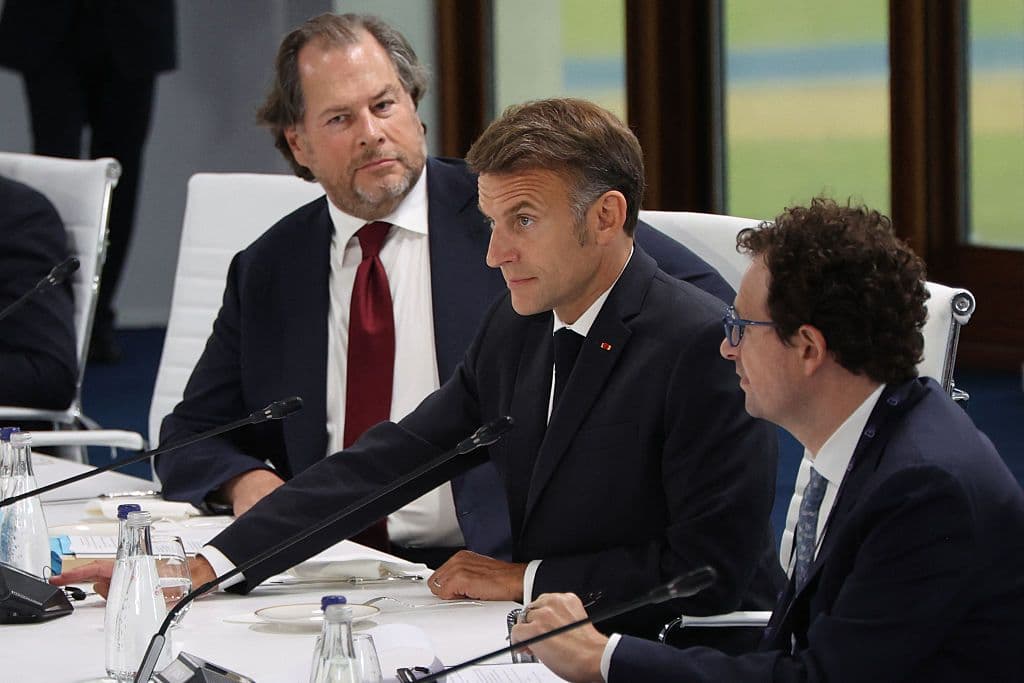
Speaking over lunch with G7 leaders and AI executives — a group that included Anthropic CEO Dario Amodei, OpenAI CEO Sam Altman, and President Donald Trump — Macron delivered a blunt message. If the United States can "from one day to the next turn off the switch," he warned, the damage would extend far beyond the customers left stranded. It would ultimately hurt the American AI companies themselves, undermining the global trust they depend on to grow.
The argument was as much commercial as it was political. No government, no enterprise, and no startup will build critical systems on a foundation they cannot rely on.
Modi Calls for Unfettered Access Among Democracies
Prime Minister Modi echoed those concerns, according to reporting from the Financial Times. He argued that democratic nations must have guaranteed, uninterrupted access to leading AI models, particularly when it comes to protecting critical national infrastructure. The Anthropic export restriction, in his view, set a troubling precedent for allied nations.
The Case for Digital Sovereignty Grows Louder
The reaction from the broader technology industry was equally pointed. Aidan Gomez, co-founder and CEO of Cohere — a Canadian enterprise AI company — released a statement that framed the issue in stark terms.
"The recent restriction on access to Anthropic's models confirms what we at Cohere have known all along: that companies and democratic nations remaining dependent on a small handful of big tech companies is dangerous to resilience," Gomez said. "Digital sovereignty is not just about market competition or any one company or nation. It's about who controls the foundational technology that will shape our economic security and national sovereignty for decades to come."
A 'Trusted Partners' Framework Takes Shape
In response to the growing unease, G7 leaders discussed the outlines of a potential "trusted partners" arrangement — a mechanism that would grant non-U.S. nations access to advanced AI systems from companies like Anthropic and OpenAI, even in cases where broader export restrictions apply.
Under the proposed framework, both countries and companies could qualify as trusted partners, provided they use the technology to strengthen their defenses against adversarial actors, with China named as the primary concern. The goal would be to maintain an open AI trade network that operates within — but is not entirely subject to — U.S. export controls.
Macron suggested that Washington itself has a strong incentive to support such a scheme. Broad adoption of American AI is only possible if buyers believe their access is secure. The moment that confidence erodes, the market for U.S. AI shrinks.
The Limits of Sovereignty in a U.S.-Dominated Market
Yet significant questions remain about how far any trusted partner framework would actually reach. It is unclear whether such protections would extend to a small startup in Paris or Bangalore that woke up one morning to find its AI-powered product no longer functional — with no official explanation provided.
The tension is compounded by the fact that American AI models continue to outpace their international competitors. European and other non-U.S. governments have been pushing for AI sovereignty for years, but that argument becomes harder to sustain when opting out of American AI means falling behind. The world wants what the U.S. is building — it just wants assurances that what it buys cannot be taken back.
