Frozen in Time: How a Tyrannosaurus Tooth Lodged in a Dinosaur's Skull Reveals a 66-Million-Year-Old Attack
A tyrannosaur tooth still embedded in an Edmontosaurus skull is giving scientists an extraordinary window into how T. rex hunted its prey.

A Single Fossil, A Terrifying Story
Some fossils preserve bones. Others preserve entire skeletons. But every once in a while, a discovery comes along that preserves something far more extraordinary — a moment in time. A fossilized skull housed at Montana State University's Museum of the Rockies is doing exactly that, capturing what appears to be the final, violent seconds of a prehistoric predator-prey encounter that unfolded roughly 66 million years ago.
The specimen belongs to an Edmontosaurus — a large, duck-billed herbivore that once roamed the ancient floodplains of what is now Montana. What makes it exceptional is a single, broken Tyrannosaurus tooth still lodged firmly in the animal's facial bones, offering researchers a direct physical record of a deadly bite delivered long before humans ever walked the Earth.
The findings, the result of a collaboration between Montana State University and the University of Alberta in Canada, have been published in the peer-reviewed scientific journal PeerJ.
Unearthed in Montana's Hell Creek Formation
The skull was first excavated in 2005 from the Hell Creek Formation in eastern Montana, a region managed by the Bureau of Land Management and widely regarded as one of the world's most productive Late Cretaceous fossil sites. The specimen is nearly complete, but one detail immediately set it apart from other finds in the Museum of the Rockies' paleontology collection — a tyrannosaur tooth, broken at the root, permanently embedded in the Edmontosaurus's snout.
The fossil is now on public display in the museum's Hall of Horns and Teeth, where it became the centerpiece of a detailed forensic-style investigation led by University of Alberta doctoral student Taia Wyenberg-Henzler and Museum of the Rockies Curator of Paleontology John Scannella.
Identifying the Attacker
To determine which predator delivered the fatal — or near-fatal — blow, researchers systematically compared the embedded tooth against the dental records of every known carnivorous dinosaur species documented from the Hell Creek Formation. The evidence pointed unambiguously to Tyrannosaurus.
To go even further, the team used CT scanning technology at Advanced Medical Imaging at Bozeman Health Deaconess Hospital. The scans provided a highly detailed three-dimensional view of how the tooth had become trapped within the bone, revealing the mechanics of the bite in remarkable clarity.
"Although bite marks on bones are relatively common, finding an embedded tooth is extremely rare," said Wyenberg-Henzler. "The great thing about an embedded tooth, particularly in a skull, is it gives you the identity of not only who was bitten but also who did the biting. This allowed us to paint a picture of what happened to this Edmontosaurus — kind of like Cretaceous crime scene investigators."
Face-to-Face With a Tyrannosaurus
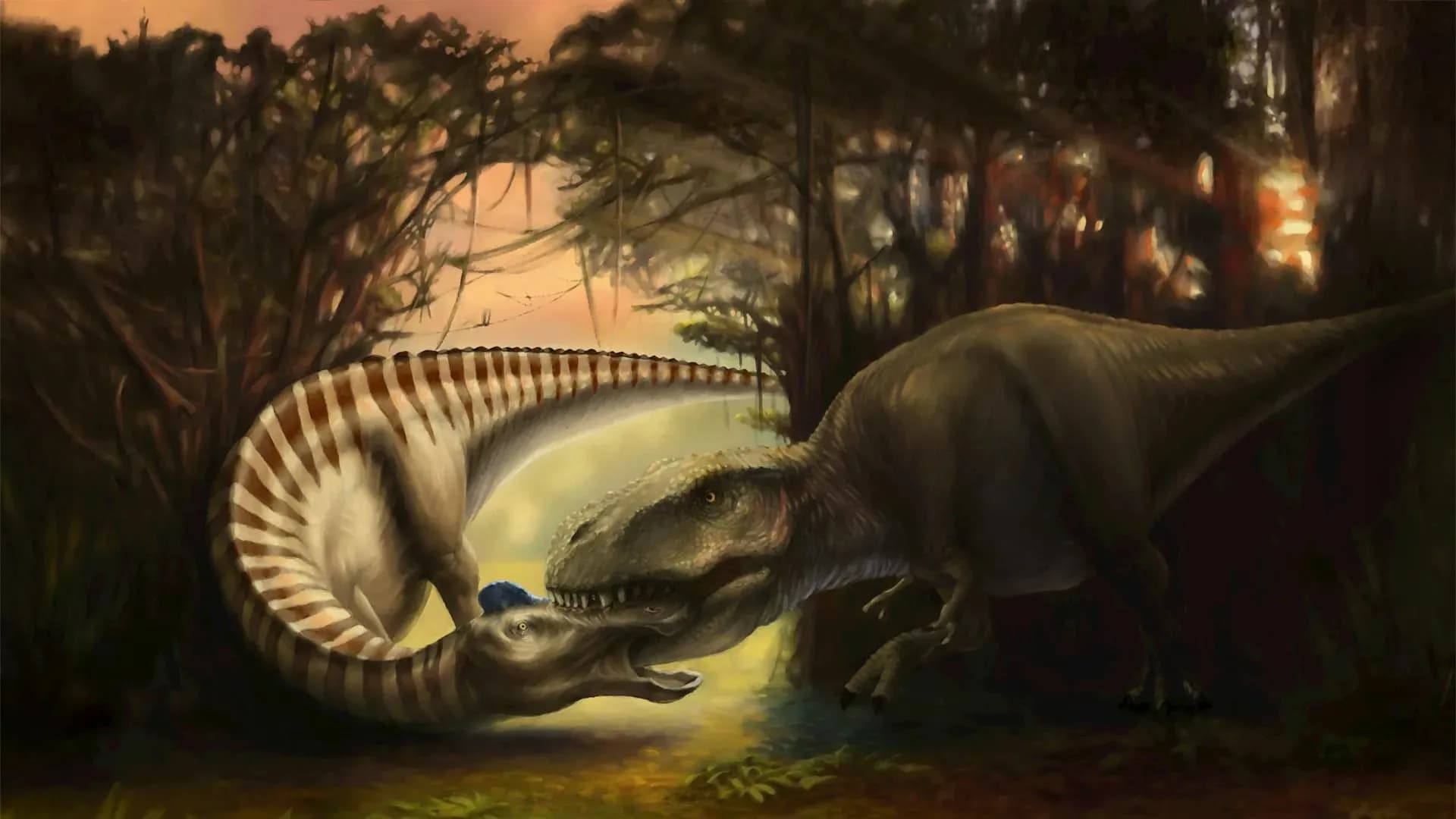
The location of the embedded tooth — lodged directly in the nose region of the skull — carries significant behavioral implications. According to the researchers, the positioning strongly suggests the Edmontosaurus was facing its attacker head-on at the moment of impact, a scenario more consistent with active predation than scavenging.
"Looking at the way the tooth is embedded in the nose of the Edmontosaurus suggests that it met its attacker face-to-face, something that usually happens to an animal that was killed by a predator," Wyenberg-Henzler explained. "The amount of force necessary for a tooth to have become broken off in bone also points to the use of deadly force. For me, this paints a terrifying picture of the last moments of this Edmontosaurus."
The skull itself shows no signs of bone healing around the embedded tooth, which tells its own story. Either the Edmontosaurus died as a direct result of this bite, or it was already dead when the bite occurred. In either case, the sheer power required to snap a tooth off inside bone underscores the brutal effectiveness of Tyrannosaurus as a predator.
"A fossil like this is extra exciting because it captures a behavior: a tyrannosaur biting into this duckbill's face," said Scannella.
What This Means for Our Understanding of Tyrannosaurus
The hunting behavior of Tyrannosaurus has been a subject of passionate scientific debate for decades. Was it primarily a fearsome active predator, or more of an opportunistic scavenger? While most modern paleontologists lean toward the former, direct physical evidence of predatory attacks has remained frustratingly scarce.
This fossil adds a valuable new data point to that ongoing conversation. The combination of tooth identity, bite location, impact force, and lack of healing collectively builds a compelling case that Tyrannosaurus was capable of delivering powerful, targeted, face-on strikes to subdue large prey animals.
As one of the largest terrestrial carnivores in the history of life on Earth, Tyrannosaurus continues to captivate scientists and the public alike. Discoveries like this one — rare, precise, and deeply informative — serve as a reminder that the fossil record still has dramatic stories left to tell.
Key Takeaways
- A nearly complete Edmontosaurus skull was found in Montana's Hell Creek Formation in 2005.
- A broken Tyrannosaurus tooth remains embedded in the skull's nasal region.
- CT scans and tooth comparisons confirmed the attacker's identity as Tyrannosaurus.
- The face-on bite position suggests active predation rather than scavenging.
- The absence of bone healing indicates the animal died at or near the time of the bite.
- The study was published in the journal PeerJ by researchers from Montana State University and the University of Alberta.