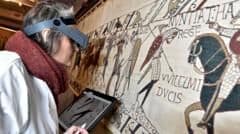
Five Pivotal Scenes From the Bayeux Tapestry That Reveal a Kingdom's Fate
Nearly 1,000 years old and finally back on British soil, the Bayeux Tapestry tells a gripping tale of power, betrayal, and conquest in five unforgettable scenes.

A Masterpiece Returns: The Bayeux Tapestry Comes Home
Power, betrayal, ambition, and brutal warfare — few historical artefacts capture the raw drama of medieval politics quite like the Bayeux Tapestry. Stretching an extraordinary 70 metres and embroidered with remarkable detail, this near-millennium-old treasure chronicles one of the most consequential chapters in English history: the Norman Conquest and the Battle of Hastings in 1066.
After more than 900 years away from British shores, the tapestry has made a historic return to England and will be displayed at the British Museum, offering modern audiences a rare chance to witness its storytelling brilliance firsthand.
With insight from Dr. David Musgrove — co-author of The Story of the Bayeux Tapestry and content director of HistoryExtra magazine and podcast — here are five defining scenes that bring this epic saga to life.
Scene 1: Harold's Mysterious Journey to Normandy
The tapestry opens around 1064 or 1065, introducing Harold, the most influential earl in England and brother-in-law to King Edward the Confessor. At the king's direction, Harold travels across the Channel to Normandy — now part of northern France — in what would prove to be a fateful visit.
There, he joins forces with William, Duke of Normandy, in a military campaign across Brittany. During this early portion of the tapestry, Harold is depicted as a celebrated and heroic figure, suggesting the work was crafted with a clear narrative agenda.
"He's being given arms and armaments by Duke William, and this is really important because the subtext of the first half of the tapestry is essentially to present Harold as a heroic figure," explains Dr. Musgrove.
Scene 2: The Oath That Would Seal Harold's Fate
Perhaps no single moment in the tapestry carries more weight than Harold's oath to William. In this charged scene, Harold is believed to be pledging his allegiance to William as the rightful successor to the English throne following Edward's death.
Yet the imagery tells a more complicated story. Rather than appearing confident or willing, Harold's body language suggests deep internal conflict.
"He actually looks physically contorted and conflicted," Dr. Musgrove observes. "At least that's my take on it. He looks as if he's kind of a bit anguished about having to make this oath."
This sworn promise would become the moral cornerstone of the tapestry's narrative — and Harold's eventual breaking of it would transform him from celebrated hero to condemned villain.
Scene 3: Harold Takes the Crown — and Becomes the Villain
When King Edward the Confessor died in January 1066, Harold seized the throne for himself rather than honouring his supposed oath to support William's claim. It is at this pivotal juncture that the tapestry's tone shifts dramatically.
"So he's gone against this supposed oath, and this is where he becomes the villain of the piece. This is a really important moment," says Dr. Musgrove.
Harold's coronation marks the turning point of the entire narrative — a moment of political betrayal that, according to the tapestry's Norman-influenced perspective, justified William's subsequent invasion of England.
Scene 4: Halley's Comet — An Omen in the Sky
Shortly after Harold's coronation, the tapestry depicts a crowd of onlookers gazing upward in apparent alarm at a blazing comet streaking across the sky. This was the appearance of Halley's Comet in 1066, widely interpreted at the time as a divine portent of things to come.
"You can see all the people staring up and pointing at it," Dr. Musgrove notes.
The inclusion of the comet was far from incidental. Medieval audiences would have immediately understood its symbolic weight — a celestial warning that calamity was approaching and that Harold's reign was built on unstable ground.
Scene 5: The Death of Harold — The Tapestry's Most Iconic Moment
The tapestry reaches its dramatic climax on the blood-soaked battlefield of Hastings, where Harold meets his end. In what has become the most iconic and debated image in the entire work, Harold is depicted being struck by an arrow — reportedly through the eye — in his final moments.
"This is the most famous scene in the tapestry," Dr. Musgrove confirms.
The Latin inscription accompanying the scene reads plainly: Here King Harold is killed. Following their leader's death, the English forces scatter in defeat, bringing the Norman Conquest to its decisive conclusion.
However, even this landmark scene is not without controversy. Scholars continue to debate whether the arrow-struck figure is definitively Harold, or whether the inscription refers to a nearby figure being cut down by a Norman horseman — or whether both images in fact depict Harold at different moments of his death.
"It's undeniable that Harold is dead — the text says it — but the manner of his death is somewhat debated," Dr. Musgrove acknowledges.
Regardless of interpretation, the scene delivers a visceral and unforgettable conclusion to a story that permanently altered the course of English history.
Plan Your Visit
The Bayeux Tapestry will be on public display at the British Museum from 10 September 2026 to 11 July 2027. Given the enormous public interest already generated by its arrival on British soil, securing tickets early is strongly advised.