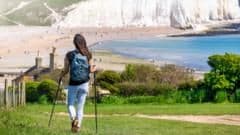
England's King Charles III Coast Path: The World's Longest Coastal Walking Route Now Open
England has officially opened a 2,689-mile coastal footpath — the longest managed coastal walking route on Earth — giving the public unprecedented access to the entire English shoreline.

England's Epic Coastal Trail Is Finally Here
England has officially launched one of its most ambitious infrastructure projects in modern history — a continuous coastal footpath stretching 2,689 miles around the entire English shoreline. Named the King Charles III England Coast Path, it holds the distinction of being the longest managed coastal walking route anywhere in the world, according to Natural England, the government agency responsible for bringing it to life.
For the first time ever, walkers can access England's complete coastline in a single, unbroken trail — from sweeping sandy beaches and dramatic chalk cliffs to windswept dunes, salt marshes, and historic seaside towns.
A Journey Decades in the Making
This monumental project was first set in motion under Prime Minister Gordon Brown's government, and it has taken a remarkable 18 years and seven prime ministers to reach this milestone. The legal groundwork was laid through the Marine and Coastal Access Act of 2009, which established new rights of public access along the coast and enabled years of meticulous planning and on-the-ground construction.
More than 1,000 miles of entirely new footpaths were created as part of the project, with countless additional sections upgraded or improved. Workers resurfaced paths, removed stiles, constructed boardwalks, and installed new bridges to ensure a smooth and consistent experience for walkers.
"It is brilliant — the best thing I'll do in my working life," said Neil Constable, who led the project for Natural England.
For Constable, the sheer length of the route is secondary to what it truly represents: the ability to walk to the English coast from virtually anywhere, turn in either direction, and follow the sea for as long as you choose.
Highlights Along the Route
The path winds through some of England's most breathtaking and diverse landscapes. Among the most celebrated sections is the iconic Seven Sisters chalk downland in East Sussex — a stretch of dramatic white cliffs that has also been newly designated as a National Nature Reserve by Natural England.
Natural England has emphasized that the trail now unlocks land that was previously closed off to the public entirely, including beaches, dune systems, and cliff-top areas situated between the path and the high-water mark. Accessibility improvements have also been made throughout, enabling people with reduced mobility to enjoy far more of the route than ever before.
A Few Adventurous Challenges Remain
While the path is designed to be continuous, there are a handful of points where walkers must temporarily leave the trail. In north-west England, crossing the River Mersey requires a short ferry journey to stay on course.
Perhaps the most memorable challenge lies in south Devon, where the River Erme presents a unique obstacle. With no bridge or ferry available, and privately owned land blocking any inland detour, walkers must wade directly through the river — but only within one hour either side of low tide.
"It's all part of the experience," Constable remarked with good humor.
Built to Withstand a Changing Climate
The King Charles III England Coast Path has been designed with long-term resilience in mind. For the first time in English legal history, the route includes a formal provision allowing sections to be moved inland — referred to as a "rollback" — if coastal erosion or rising sea levels caused by climate change alter the shoreline.
This forward-thinking approach was already tested in early 2025, when heavy winter rains triggered a significant landslip near Charmouth in Dorset, destroying a section of cliff-top path. The route was temporarily closed, and a diversion was put in place — but thanks to the new rollback provision, a permanent 15-metre rerouting was agreed with the landowner and the path was restored within weeks.
"Without this rollback provision in place, that would have taken us months," said Lorna Sherriff, who manages the South West Coast Path, the longest and most hilly stretch of the entire trail.
A Transformational Moment for Public Access
The Ramblers, a charity that has championed greater coastal access in England since the end of World War II, has welcomed the new path with enthusiasm. Jack Cornish, the organization's Director for England, called it "transformational."
"It creates a band of access land from the trail to the high-water mark, so that means you can leave the trail to go and roam the beaches," Cornish explained. "You can picnic — and on an island nation you can really enjoy our coast for the first time."
Currently, approximately 80% of the full route is open to walkers, with the remaining sections expected to be completed before the end of the year.
The Vision of a Complete British Coastal Walk
The opening of the English coast path raises an exciting prospect for long-distance walkers — a continuous coastal circuit of the entire island of Britain.
The new English route already connects seamlessly with the Wales Coast Path, an 870-mile trail that encircles the Welsh coastline. Completed in 2012, the Wales Coast Path was the first route in the world to follow an entire national coastline.
Scotland does not yet have a single official coastal trail, though much of its vast shoreline — often estimated at around 5,500 miles — is freely accessible under the country's longstanding "right to roam" legislation.
Combined, a complete coastal walk around Britain would cover approximately 9,000 miles. Traveling at an average of 15 miles per day with no rest days, completing such a journey would take nearly two years — an extraordinary adventure for the dedicated explorer.