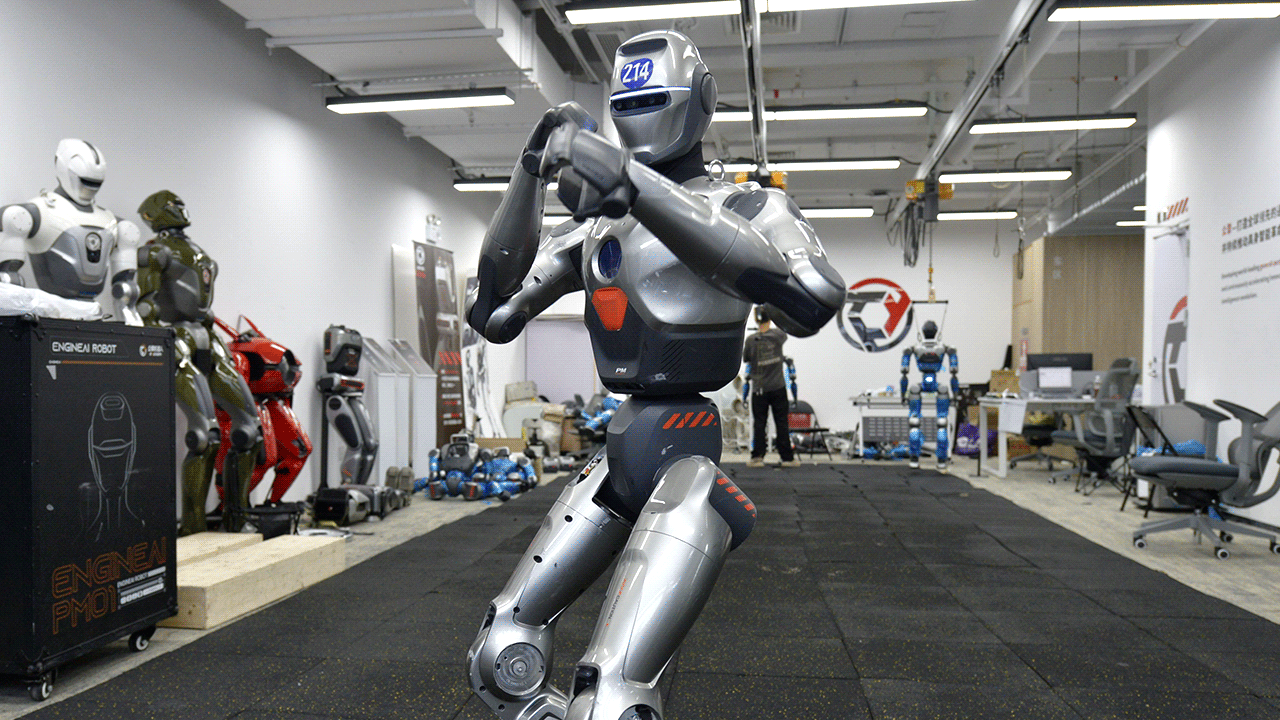
EngineAI PM01: The Compact Humanoid Robot Mastering Balance and Recovery
China's EngineAI PM01 humanoid robot is turning heads — not just for its front flips, but for how it recovers when pushed off balance mid-motion.

China's Compact Humanoid Robot Is Redefining What Balance Really Means
The humanoid robotics race has already produced machines capable of sprinting at 22 miles per hour, sticking backflips and executing precise front flips. Raw athletic performance is no longer the primary benchmark. The new frontier is something far more practical — how a robot responds when things go unexpectedly wrong.
That is exactly the challenge the EngineAI PM01 is built to tackle.
Watch It Dance Through a Shove
In recently released demonstration footage, the PM01 continues dancing even after being deliberately pushed off balance. Rather than freezing or stumbling chaotically, the robot performs a controlled forward slip, absorbs the disruption and smoothly restores its rhythm within seconds. The movement appears fluid and surprisingly natural for a machine.
The robot then follows up with a front flip — not as an isolated stunt, but as part of a broader showcase emphasizing balance, adaptability and physical recovery under stress.
Why Recovery Matters More Than Speed
When the PM01 is shoved, it does not simply power through. It actively recalculates its center of mass, adjusts joint torque across its limbs and corrects its posture in real time. This level of reactive control requires tight coordination between onboard sensors, actuators and AI-driven algorithms working simultaneously.
Front flips present an added degree of difficulty compared to backflips. Rotating the body forward displaces weight ahead of the support base, leaving less margin for error on landing. The PM01 handles this by combining coordinated arm swing, core stabilization and precise landing mechanics — demonstrating controlled dynamic motion rather than pre-programmed showmanship.
Why the PM01's Compact Size Is a Strategic Advantage
Standing just under 4 feet tall, the PM01's smaller stature is a deliberate engineering asset. A lower center of gravity reduces the risk of tipping and demands less rotational force when performing flips. Its lighter frame also distributes landing impact more efficiently across its structure.
For comparison, EngineAI's larger SE01 model measures approximately 4 feet 6 inches in height and weighs around 88 pounds. The PM01 is roughly 10.5 inches shorter and about 17.6 pounds lighter — a meaningful difference in research and development environments where agility and precision take priority over raw power.
Full-sized humanoid robots face significantly greater mechanical stress during high-impact maneuvers. They require stronger actuators, reinforced joints and heavier structural support just to remain stable. Compact platforms like the PM01 can achieve sophisticated movement patterns with considerably less strain on their components.
The AI Hardware Driving the PM01
Beneath its compact exterior, the EngineAI PM01 combines advanced perception technology with serious computational muscle. Key hardware includes:
- Intel RealSense depth camera for spatial awareness and visual mapping
- Dual-chip processing pairing an Nvidia Jetson Orin with an Intel N97 processor
- 24 degrees of freedom across 12 joint motors for smooth, coordinated full-body movement
This architecture enables real-time AI processing, allowing the robot to execute rapid balance corrections the moment it encounters an unexpected push or slip.
In terms of performance, the PM01 walks at speeds of up to approximately 4.5 miles per hour, outpacing competitors like the Booster T1. It sits alongside the Unitree G1 in the compact humanoid segment. EngineAI's focus clearly leans toward refined stability and motion quality over headline-grabbing top speeds.
Addressing CGI Skepticism Head-On
As humanoid robot videos continue to go viral, public skepticism about digital manipulation has grown louder. EngineAI recently responded to CGI accusations directly by releasing footage of its T800 humanoid physically interacting with the company's CEO in an unscripted setting.
In a robotics market crowded with bold claims and polished promotional content, live physical demonstrations carry real weight. They help distinguish genuine engineering progress from carefully edited marketing material.
What This Means for Real-World Robotics
For now, the PM01's footage represents an impressive controlled demonstration. However, the capabilities it highlights — balance retention, impact absorption and rapid recovery — are precisely the skills humanoid robots will need to function safely in real-world environments.
A robot deployed in a hospital corridor, a warehouse floor or even a private home will inevitably encounter bumps, accidental contact and unpredictable terrain. A machine that can absorb a shove, recover from a stumble and continue operating without causing harm or requiring a reset is dramatically more useful than one capable only of performing a flawless rehearsed routine.
As humanoid robots edge closer to everyday deployment, resilience and stability are becoming just as important as athletic spectacle. The more naturally these machines handle disruption, the more confidently people will accept sharing physical spaces with them.
The Real Breakthrough Is After the Push
The robotics industry has already proven it can build machines that flip, sprint and perform. The next milestone is building machines that can be trusted — machines that handle the unexpected with composure and get right back to work.
The EngineAI PM01 is a compelling step in that direction. Its compact design, real-time AI correction and fluid recovery mechanics suggest that the shift from viral demo moments to genuinely reliable humanoid robots may be closer than many expect.

