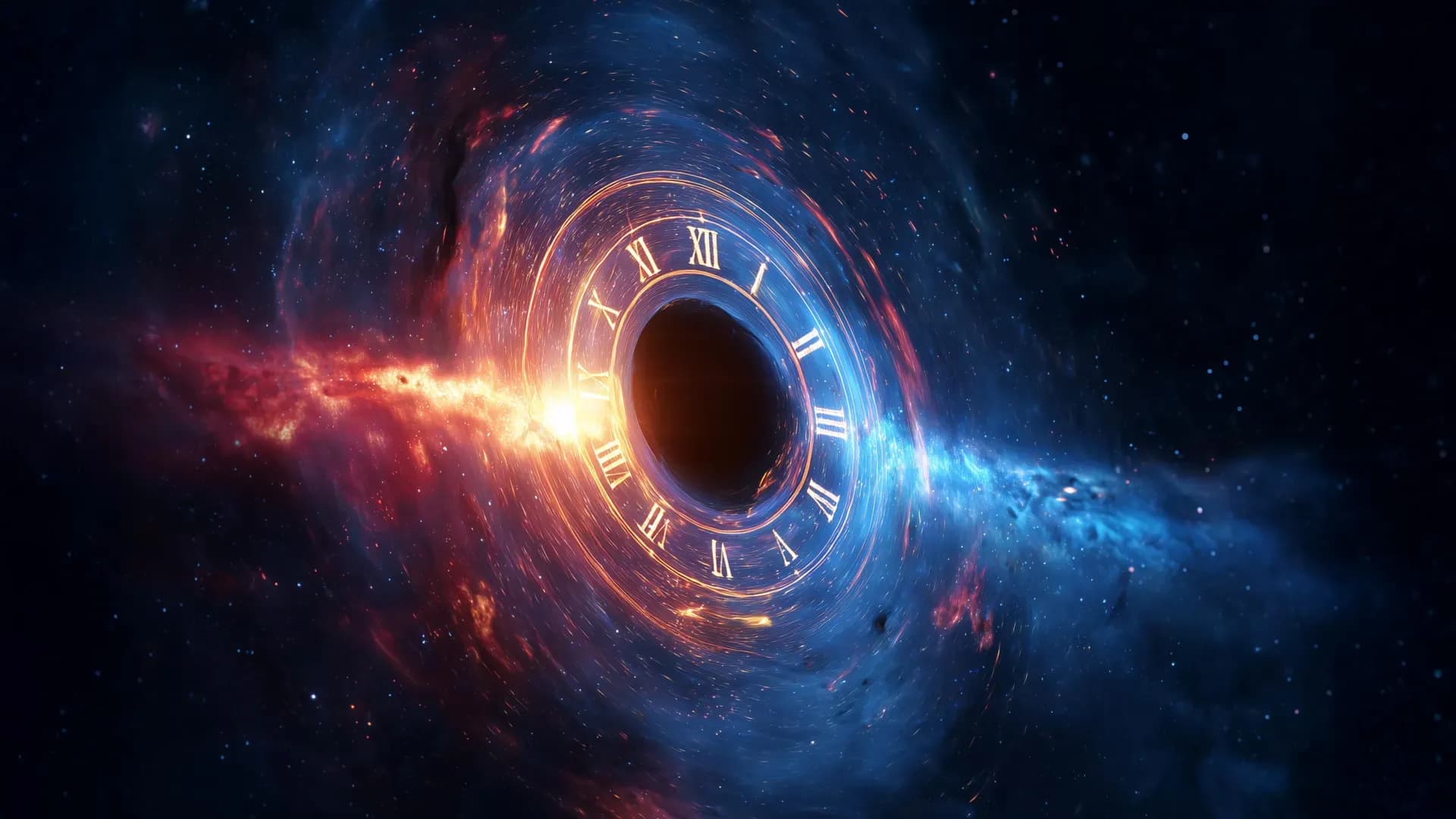
Einstein's Bridge May Reveal Time Flows in Two Directions at Once
New research suggests the famous Einstein-Rosen bridge isn't a cosmic tunnel — it may prove time itself flows in opposite directions, reshaping our understanding of the universe.

What If Wormholes Were Never Really Wormholes?
For decades, the concept of wormholes has captured the imagination of scientists, filmmakers, and science fiction enthusiasts alike. These so-called cosmic tunnels — shortcuts connecting distant corners of the universe — have inspired blockbuster films and countless theoretical papers. But what if the foundational science behind them has been fundamentally misunderstood all along?
Groundbreaking new research suggests that the famous Einstein–Rosen bridge was never about space travel. Instead, it may point to something far more profound: time itself may flow in two directions simultaneously, hidden beneath the surface of quantum physics.
The Original Einstein–Rosen Bridge
In 1935, physicists Albert Einstein and Nathan Rosen were investigating how particles behave in regions of extreme gravitational force. Their work produced what they called a "bridge" — a precise mathematical connection linking two perfectly symmetrical copies of spacetime.
This was never conceived as a passageway for traveling across the cosmos. It was a theoretical tool designed to preserve consistency between gravity and quantum physics. The association with wormholes came much later, introduced by physicists speculating about crossing from one region of spacetime to another — most prominently in research from the late 1980s.
Even those later analyses acknowledged the profound limitations of the idea. Within the framework of Einstein's general relativity, such a journey is simply not possible. The bridge collapses faster than light could ever pass through it, making it non-traversable. In other words, Einstein–Rosen bridges are unstable mathematical structures — not portals.
Yet the wormhole metaphor took on a life of its own in popular culture and speculative physics, far outlasting its scientific credibility.
A Radical Reinterpretation: Time as the Real Bridge
New research from a team of physicists revisits the Einstein–Rosen bridge through a modern quantum lens, building on theoretical work by physicists Sravan Kumar and João Marto.
The central insight involves something most of us take for granted: the direction of time. Most fundamental laws of physics treat time symmetrically — reverse time in their equations and the mathematics still holds. Yet in practice, we only ever experience time moving forward.
When researchers take this time symmetry seriously and apply it to the Einstein–Rosen bridge, the interpretation shifts dramatically. Rather than functioning as a tunnel through space, the bridge can be understood as two complementary parts of a single quantum state. In one component, time flows forward. In the other, it flows in reverse from a mirror-reflected position.
This is not a philosophical abstraction. At the microscopic level, quantum evolution must remain complete and reversible — even when gravity is involved. Both temporal directions are mathematically necessary to fully describe a physical system. The bridge, in this view, is the expression of that requirement.
Why This Matters Near Black Holes
In everyday life, this dual-time structure remains invisible. We are macroscopic beings living in a world governed by entropy — disorder naturally increases over time, giving us a clear, one-directional arrow from past to future.
But near black holes, and in the extreme conditions of an expanding or collapsing universe, both time directions must be accounted for. This is precisely where Einstein–Rosen bridges naturally emerge in the mathematics.
At the boundary of a black hole — the event horizon, that infamous point of no return — information doesn't simply vanish. According to this new framework, it continues to evolve, but along the opposite temporal direction. It crosses into the mirror component of time.
Solving the Black Hole Information Paradox
This reinterpretation carries enormous implications for one of physics' most enduring puzzles: the black hole information paradox.
In 1974, Stephen Hawking demonstrated that black holes slowly radiate energy and can eventually evaporate completely. The disturbing implication was that all information about matter that had fallen into the black hole would be permanently erased — a direct contradiction of quantum mechanics, which demands that information is always preserved.
The new research offers a clean resolution. The paradox only exists if physicists insist on describing the event horizon using a single, one-sided arrow of time — an assumption that quantum mechanics itself never actually requires.
If both time directions are included in the full quantum description, nothing is truly lost. Information exits our temporal direction and re-enters along the reversed one. Completeness and causality remain intact — no exotic new physics required.
Hints From the Cosmos: A Pre-Big Bang Universe
The implications extend beyond black holes to the very origin of our universe.
Interestingly, potential evidence for this hidden temporal structure may already exist in observational data. The cosmic microwave background — the faint radiation left over from the Big Bang — displays a subtle but persistent asymmetry, showing a slight preference for one spatial orientation over its mirror image.
This anomaly has puzzled cosmologists for roughly two decades. Standard models assign it an extremely low probability of occurring by chance. But when mirror quantum components are included in the description, the anomaly becomes far less surprising.
The Big Bang as a Bounce, Not a Beginning
This leads to an even more startling possibility. What humanity has long called the Big Bang may not have been the absolute beginning of everything. Instead, it may represent a quantum bounce — a transition point between two time-reversed phases of cosmic evolution.
In this scenario, our universe could be the interior of a black hole that formed within a parent cosmos. As a closed region of spacetime collapsed, it bounced back and began expanding, giving rise to the universe we observe today.
Black holes in this framework act as bridges not just between time directions, but between entirely different cosmic epochs. Wormholes aren't needed — the bridge is temporal, not spatial.
Could Dark Matter Be Relics From Before the Big Bang?
If the bounce model holds, it also generates testable predictions. Remnants from the pre-bounce phase — particularly smaller black holes — might have survived the transition and persisted into our expanding universe.
Some of the mysterious unseen matter scientists currently attribute to dark matter could, in this view, consist of exactly such relics. This opens a remarkable possibility: that the unexplained mass haunting galaxies across the cosmos may be ancient survivors of a universe that existed before our own.
Completing Einstein, Not Overturning Him
This reinterpretation of Einstein–Rosen bridges offers no cosmic shortcuts, no time travel, and no hyperspace travel of the kind beloved by science fiction. It offers something more significant: a coherent quantum framework for gravity in which spacetime embodies a fundamental balance between opposing flows of time.
Critically, it does not dismantle Einstein's theory of relativity or contradict quantum mechanics. Rather, it bridges the long-standing gap between them — completing both without rejecting either.
The next major revolution in physics may not involve traveling faster than light. Instead, it may reveal that at the deepest microscopic level, and across the full arc of a bouncing universe, time itself flows in both directions at once.