Devoted for Life: The Aging Nuns of Uganda and the Fight for Their Final Years
Uganda's elderly nuns gave decades to teaching, healing, and serving others. Now, as they face their final years, a new program fights to give them the care they deserve.

Devoted for Life: The Aging Nuns of Uganda and the Fight for Their Final Years
In a quiet cemetery at the Little Sisters of St. Francis convent in Nkokonjeru, central Uganda, rows of white crosses stand adorned with pink and yellow flowers. Sister Jane Frances Nakafeero moves deliberately among the graves, pausing at one after another. "This one was a nurse," she says. A few steps further: "This one was a teacher. This one was a social worker. This one was a doctor."
The convent serves as both a beginning and an ending. Young women arrive here to begin their formation as nuns, take their vows, and are sent into communities across the region. In time, those same women return to be laid to rest within its grounds. "The motherhouse," Nakafeero explains, "is where we begin and where we end."
A Growing Crisis Hidden Behind Convent Walls
Beyond its role as a training ground and a final resting place, the convent in Nkokonjeru also houses retired sisters — women who have spent their entire adult lives in service to others. Nakafeero, who serves as regional superior of the order, is deeply troubled by the conditions these women now face.
Palliative care — the specialized medical and emotional support provided to patients nearing the end of life — only emerged as a formal discipline in the 1960s. Awareness and funding for it remain limited, particularly within religious institutions. In African congregations, which already operate with far fewer financial resources than their American and European counterparts, the challenge is especially severe.
At the Nkokonjeru convent, younger nuns assist their elderly sisters with daily tasks — helping them to and from bed, serving meals, and offering companionship. Yet the retired women lack even basic necessities: adult diapers, functioning wheelchairs, hearing aids, and warm blankets are all in short supply.
A Chance Encounter That Sparked a Partnership
In 2023, Nakafeero attended a meeting of the African Palliative Care Association and laid out these hardships in detail. Her words resonated with Jean Callahan, former chair of the Irish Hospice Foundation and a member of the association's advisory board, who was visiting Uganda to review two Irish-funded projects.
As she listened to Nakafeero, Callahan thought of her own grandmother, Sybil, who had lost her husband in the 1950s and subsequently traveled from Ireland to Tanzania to serve as a nun. "These women, who could have been my grandmother's colleagues, are being left at the end of their lives without the basic human supports they should have," Callahan says.
That shared recognition prompted the two women to act. Together, they launched a pilot program in partnership with the African Palliative Care Association, designed to bring hospice-level support to aging nuns. The initiative, which commenced in September 2025, aims to address both medical and material needs. It also incorporates psychological support, structured activities for retired sisters, and dedicated training for the younger nuns responsible for their care.
Building a Foundation for the Future
The program is still in its early stages. Researchers under the leadership of Eve Namisango, director of the African Palliative Care Association, are currently conducting needs assessments with approximately 50 retired sisters belonging to the Little Sisters of St. Francis. While the majority of these women are Ugandan, the order also includes sisters from Kenya and Tanzania.
Following the assessment phase, Namisango and her team plan to begin training caregivers, with a goal of introducing structured palliative care across Ugandan convents by 2027 — and eventually extending it throughout the African continent.
"They have served humanity for all their useful years," Namisango says of the nuns. "They deserve decent, person-centered care."
According to Vatican figures, approximately 82,000 nuns currently live and serve across Africa. The African Palliative Care Association estimates that between 8,000 and 10,000 of them may be in need of end-of-life care.
Daily Life in the Convent's Final Chapter
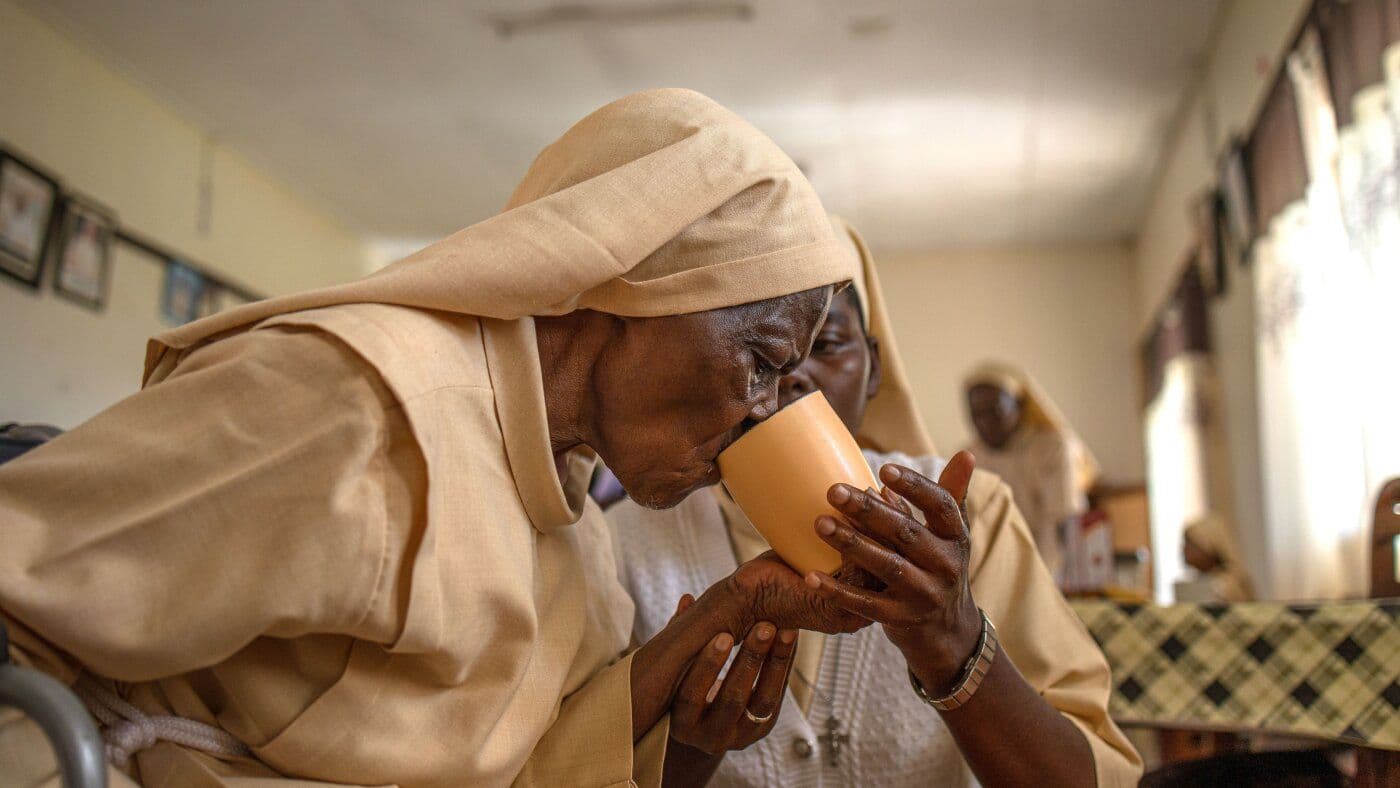
For the 14 retired sisters currently residing at Nkokonjeru, each morning begins with prayer. Many can no longer walk and gather in wheelchairs, gray hair just visible beneath their habits, as they recite their devotions together. A young priest, Father Joseph Balikuddembe, moves among them to offer communion — and afterward visits those too frail to leave their beds.
Breakfast follows: hard-boiled eggs, mashed plantain, and bread, eaten at assigned places around worn wooden tables. Afterward, some sisters are wheeled outside into the warmth of the morning sun. But the convent has only seven wheelchairs for roughly ten residents with mobility limitations, and several of those chairs are in poor condition — wheels stiff, hand brakes unreliable. Many sisters return to their rooms.
Father Balikuddembe worries about more than physical comfort. "They have retired, but their brains need to be kept active," he says, concerned that the women have too little to engage them mentally and socially.
Lives Well Lived, Now Quietly Fading
Sister Mary Hedwig Agoya arrived at the Nkokonjeru convent in 1951, when she was just 14 years old. She was welcomed by the order's founder, Mother Kevin Kearney — an Irish woman who had made the journey to Uganda in 1903 and went on to establish numerous hospitals over the following five decades. Kearney, now a candidate for sainthood, helped the young Agoya into her khaki habit and veil. "She embraced me," recalls Agoya, now 89.
Agoya spent the next 40 years as a teacher. Retirement, she admits, has brought a quieter — and at times emptier — rhythm to her days. "It becomes a bit dull," she says, her voice roughened with age. She prays in the morning, before lunch, and at bedtime. Most of the sisters who entered the convent alongside her have since passed away.
Sister Rosemary Luyiga, now 95, lives in a simply furnished room — a single bed, a chair, a black-and-white portrait of her mother as a young woman, and a candle marking the centennial of the Little Sisters of St. Francis. She first arrived at the convent in 1944, at the age of 12, and went on to run a school teaching domestic skills to young girls. She lived through the Second World War and Uganda's independence from British rule, though she recalls little of those broader events. "I don't think we were very much interested," she says quietly. What she remembers most clearly are the ten different postings where she served — each one recorded in neat blue ink on a single sheet of paper.
A Call to Honor Those Who Served
The women of the Little Sisters of St. Francis gave their lives in service — to students, to patients, to communities that had little else to rely on. As they enter their final years, the hope is that a growing awareness of their needs, combined with dedicated programs like the one now taking shape, will ensure they are not forgotten. They spent a lifetime caring for others. Now, at last, others are beginning to care for them.