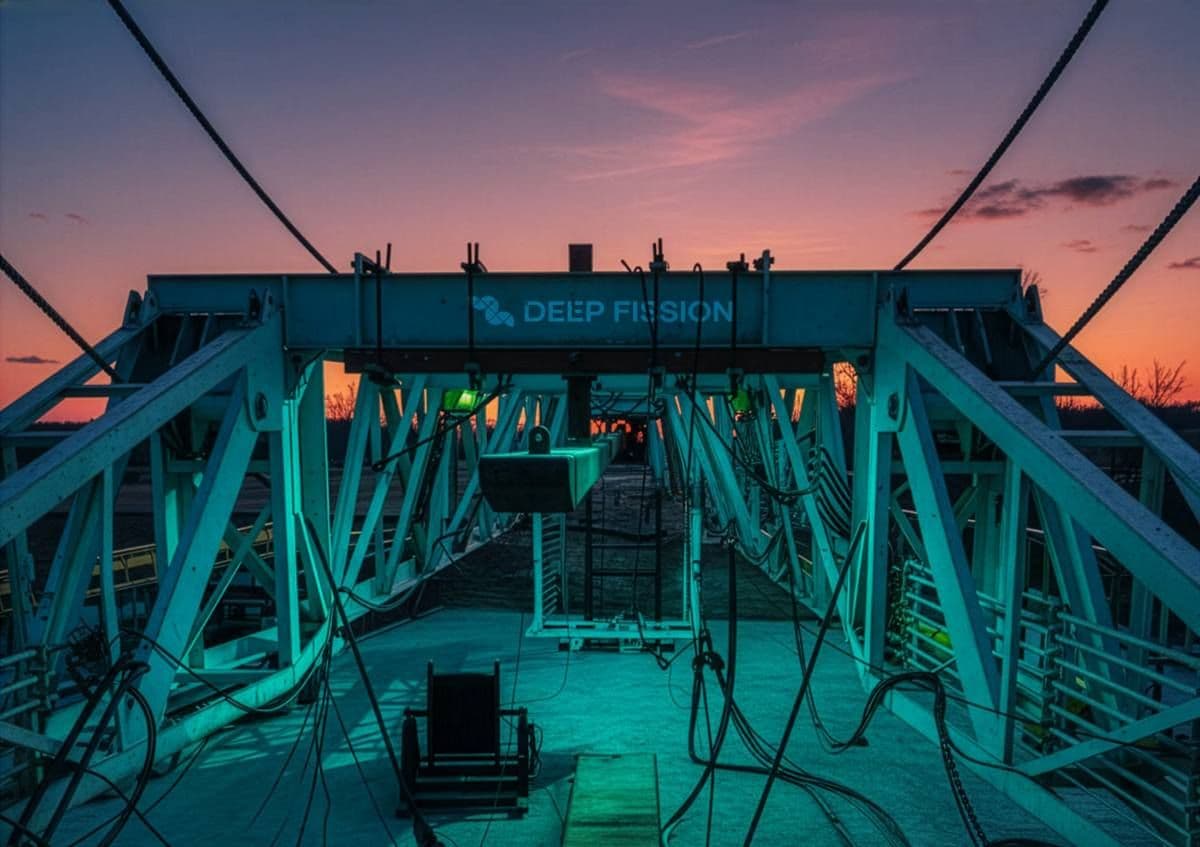
Deep Fission's Second Shot at Going Public Raises More Questions Than Answers
Nuclear startup Deep Fission is pursuing a $157M Nasdaq IPO, but its worsening financials and stalled progress leave investors with serious doubts.

Nuclear Startup Deep Fission Is Going Public — Again
If the name Deep Fission sounds familiar in the context of stock market listings, that's because this isn't the first time the underground nuclear reactor startup has attempted to enter the public markets. The company recently announced plans for a Nasdaq IPO targeting $157 million in fresh capital — but a closer look at its financials and technical progress suggests investors should tread carefully.
A Previous 'Public' Listing That Never Really Was
Back in September of last year, Deep Fission made headlines when it completed a reverse merger with Surfside Acquisition, a Delaware-based shell company. The deal — a common shortcut that allows private companies to achieve a public listing by absorbing an already-listed entity — raised $30 million through a private placement priced at $3 per share.
However, that listing turned out to be public in name only. While the transaction technically made Deep Fission a reporting company with SEC obligations, its shares never actually traded on any exchange. The company had previously indicated it would list on the OTCQB, a marketplace designed for early-stage companies that don't qualify for major exchanges like the NYSE or Nasdaq. Yet no trace of the company appeared on that platform, and Deep Fission itself confirmed in its S-1 filing that its stock had never been publicly traded.
The company declined to address questions on the matter, citing the customary quiet period ahead of its IPO.
Bigger Ambitions, Shakier Foundations
This time around, Deep Fission is pursuing a full Nasdaq IPO at a price range of $24 to $26 per share — a valuation that could reach up to $1.66 billion. That's a striking figure for a startup that, just one year ago, was reportedly struggling to close a $15 million funding round.
What makes the ambition even more eyebrow-raising is the picture painted in the S-1 filed on May 20, which is arguably more concerning than the December filing that preceded it. Key milestones have slipped. The company previously aimed to achieve nuclear criticality — the threshold at which a chain reaction becomes self-sustaining — by July 2026. That target has now been quietly dropped, with no replacement date offered.
Going Concern Warning Remains
Perhaps most telling is the persistence of a "going concern" warning in the new filing — the same cautionary language that appeared in December. In plain terms, if the IPO doesn't succeed, Deep Fission could exhaust its funds within the next 12 months.
The company's financial deterioration since December adds further weight to that concern. Its cumulative deficit climbed from $56.2 million to $88.1 million as of March. In just the past six weeks, cash and cash equivalents fell by roughly $6.4 million — approximately 7% of its reserves — indicating a significant and accelerating cash burn.
Underground Drilling: Harder Than It Sounds
On the technical side, Deep Fission has shifted its focus toward drilling operations, which some observers interpret as an acknowledgment that burrowing into the earth is considerably more complex than originally anticipated.
The company began drilling the first of three planned test wells in March, with the well designed to collect geological data down to a depth of 6,000 feet. At just eight inches in diameter, however, this test well is far smaller than what commercial operations would require.
Scaling Up Presents Enormous Challenges
For commercial deployment, Deep Fission says it will need boreholes measuring between 30 and 50 inches in diameter and extending a full mile underground — dimensions that already exceed what's standard in the oil and gas industry. The company has yet to settle on a specific diameter, which means its reactor design also remains unfinalized. Until it can determine what size hole it can reliably drill, the entire engineering roadmap stays in flux.
What's Changed — And What Hasn't
One notable development since December is an $80 million equity investment, which includes $20 million from Blue Owl, a data center development firm that also signed a non-binding memorandum of understanding for potential future power plants. Despite that injection of capital, the going concern warning remains in place, suggesting the funding hasn't meaningfully stabilized the company's outlook.
It's possible Deep Fission is sitting on encouraging internal data not yet disclosed in its public filings. But given the scale of what's riding on this IPO, that explanation seems optimistic at best.
Riding the Nuclear Hype Wave?
A more straightforward explanation is that Deep Fission and its backers are looking to capitalize on a surge of investor enthusiasm surrounding fission-based energy. Just last month, fellow nuclear startup X-energy went public in an upsized IPO, signaling strong market appetite for the sector.
However, the comparison isn't entirely flattering to Deep Fission. X-energy is already generating revenue and has made considerably more progress through the Nuclear Regulatory Commission's complex licensing process. That contrast underscores an important reality in the nuclear sector: valuation and technical progress are not the same thing, and enthusiasm can outpace reality by a wide margin.
The Bottom Line
Deep Fission is seeking a nine-figure valuation on the strength of a compelling vision — underground nuclear reactors powering AI data centers — but its own filings reveal a company that is burning through cash, missing milestones, and still figuring out the basics of how to drill a big enough hole. Whether investors will look past those red flags in a market hungry for nuclear plays remains to be seen.