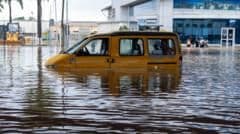
Deadly Floods Devastate Ghana's Capital Accra as Another Powerful Storm Approaches
At least 13 lives have been lost in Accra after record-breaking rainfall triggered catastrophic flooding. Authorities warn a second storm is closing in.

Deadly Floods Strike Accra as Ghana Braces for More Rain
At least 13 people have lost their lives in Ghana's capital, Accra, following an intense bout of torrential rainfall that unleashed catastrophic flooding across the city. The Ghana National Fire Service (GNFS), which has been actively leading rescue operations, confirmed the death toll while warning that the number could climb further as recovery efforts continue.
Authorities have issued urgent advisories urging residents to remain indoors if they are in a safe location, or to evacuate immediately to higher ground. The warning comes as the Ghana Meteorological Agency has forecast additional heavy rainfall sweeping across southern Ghana — including Accra — with a significant storm system advancing from the east.
Widespread Destruction Across the City
Although much of the floodwater from Sunday night's downpours has started to drain away, the scale of the destruction is stark. Low-lying neighborhoods bore the brunt of the disaster, with social media footage showing homes and vehicles completely submerged and numerous buildings reduced to ruins.
The flooding also ignited a serious fire at a rubber manufacturing facility within the city, compounding the emergency. A coordinated response involving the police, military, fire service, and the National Disaster Management Organisation has been mobilized across affected areas. The interior ministry confirmed these units were deployed to protect lives and safeguard property.
To date, the GNFS has successfully rescued more than 470 people trapped by the rising waters.
Record Rainfall Linked to Climate Change
President Mahama revealed that preliminary measurements indicated approximately 140mm of rain fell on Accra during the event — a staggering figure when compared to the highest single-day rainfall recorded last year, which stood at roughly 56mm. Writing on X, the president suggested this dramatic increase was a clear indicator of the accelerating impact of climate change.
The meteorological agency echoed these concerns and issued additional safety guidance, advising citizens to avoid sheltering beneath trees, steer clear of downed electrical wires, and under no circumstances attempt to walk or drive through floodwaters.
Residents Recount Harrowing Experiences
For many Accra residents, the flooding brought personal loss and distress. Philip Mensah told AFP that his cherished collection of 1970s vinyl records had been completely submerged. Schoolteacher Patience Naa Adjeley Adjei described spending hours battling to keep water from entering her room.
"I have mopped my room more than eight times," she said. "I can't even step outside because both my room and the street outside are flooded."
Power Shut Down as Precaution
The Ghana Grid Company Limited (GRIDCo) and the Electricity Company of Ghana (ECG) jointly announced temporary power cuts to flood-affected sections of the capital. In a shared statement, the two bodies described the shutdown as a necessary measure after floodwaters compromised power infrastructure at multiple substations, creating serious risks for both equipment and personnel.
Illegal Structures and Poor Drainage Worsen the Crisis
Experts and officials alike have pointed to Accra's inadequate drainage network as a major factor amplifying the impact of flooding. Blocked gutters and the proliferation of illegal structures built over natural waterways have long been identified as critical vulnerabilities.
Following an aerial survey of the city on Monday, President Mahama ordered the immediate demolition of all such unauthorized structures. "The irresponsible actions of a few individuals end up putting entire communities at risk," he stated.
Accra, one of Africa's fastest-growing urban centers with a population exceeding four million, has faced devastating floods before. In 2015, severe flooding triggered an explosion at a fuel station that claimed approximately 150 lives.
Calls for Urgent Urban Planning Reform
WaterAid Ghana's director, Ewurabena Yanyi-Akofur, called on authorities to implement stronger urban planning frameworks and disaster preparedness strategies. She stressed that what Accra is experiencing is not a one-off weather anomaly.
"What we are witnessing in Accra is not an isolated weather event, but part of a pattern intensified by climate change and rapid, unplanned urbanisation," she said, urging systemic action to protect communities before, during, and after extreme weather events.

