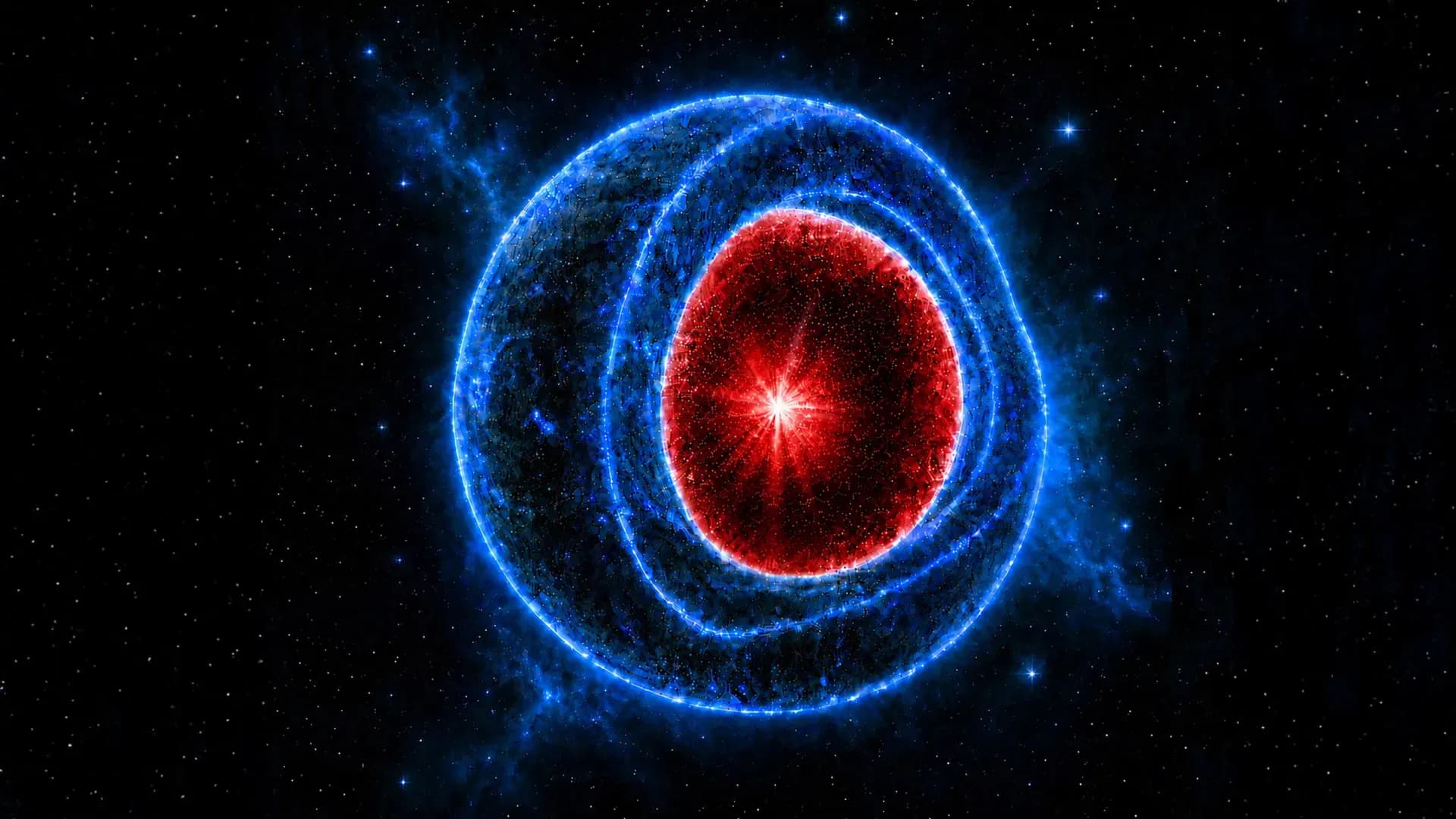
Collapsing Stars May Spark New Universes Rather Than Black Holes, Scientists Say
A groundbreaking theoretical study proposes that dying stars might birth miniature universes instead of black holes, forming mysterious objects called gravastars.

Could a Dying Star Give Birth to an Entire Universe?
What if some of the objects we've long believed to be black holes are actually something far stranger? A provocative new theoretical study suggests that when a massive star reaches the end of its life and begins to collapse, the result might not be a black hole at all. Instead, the implosion could spark the creation of a tiny, self-contained universe — one that pushes back against gravity and prevents the formation of a singularity entirely.
The resulting object, known as a gravastar, has been theorized for roughly 25 years. But until now, scientists had no concrete explanation for how one could actually form. That gap may finally be closing.
How Stars Live and Die
Massive stars spend their lives generating light and heat through nuclear fusion — a process that converts hydrogen and other elements into energy within their cores. This energy produces an outward pressure that counterbalances the crushing inward pull of gravity, keeping the star stable.
Eventually, however, the fuel runs out. Without that sustained outward pressure, gravity wins. The star begins collapsing under its own immense weight, theoretically compressing all of its mass down into an infinitely small point called a singularity — the defining feature of a black hole.
The Problem With Black Holes
While black holes are firmly embedded in mainstream physics, they carry some deeply unsettling implications. How can matter equivalent to billions of suns be compressed into a single, dimensionless point? How can spacetime become infinitely curved at a singularity without the known laws of physics breaking down completely?
At such extreme conditions, our current understanding simply cannot provide reliable answers. Compounding the mystery is the black hole's event horizon — a boundary beyond which nothing, not even light, can escape or be observed. This makes it effectively impossible to study whatever lies within.
These unresolved questions have led some researchers to ask whether certain objects we classify as black holes might actually be something else entirely.
Enter the Gravastar
One compelling alternative is the gravastar — short for gravitational vacuum condensate star. Like black holes, gravastars would be extraordinarily dense and massive, giving them a powerful gravitational presence that would make them nearly indistinguishable from the outside.
However, gravastars differ in one fundamental way: they contain no singularity and no event horizon. Instead of collapsing into a single point, the interior of a gravastar would be filled with dark energy — a mysterious form of energy that generates outward pressure. This pressure counteracts gravity and halts the collapse before a singularity can form.
For many theoretical physicists, gravastars are an appealing concept precisely because they sidestep the most troubling aspects of black holes. Yet for decades, a critical question lingered: how could a gravastar actually come into existence from the collapse of ordinary stellar matter?
A New Solution: The Mini Universe Theory
Theoretical physicists Daniel Jampolski and Professor Luciano Rezzolla of Goethe University Frankfurt have now proposed what they describe as the first dynamic solution to Einstein's equations of General Relativity that explains how a collapsing star could produce a gravastar.
According to their model, the gravitational collapse of a massive star may trigger the birth of a miniature universe within the collapsing material itself. This process would bear a striking resemblance to the Big Bang that gave rise to our own cosmos — a rapid expansion driven by dark energy from within.
How the Mini Universe Prevents Collapse
As the newly formed mini universe expands from inside the collapsing star, it exerts an outward force that directly opposes the inward pull of gravity. Under the right conditions, these two forces reach a stable equilibrium — the collapse is halted, and a gravastar is born.
Jampolski, who developed the solution as part of his master's thesis under Rezzolla's supervision, explains the sequence of events: "The Big Bang of the emerging universe can unfold once the star has already collapsed almost to the point of becoming a black hole."
He further notes that the extreme compression of matter at such late stages of collapse may give rise to entirely new physical phenomena — effects that current physics has yet to fully describe. "It is easier to imagine that the Big Bang occurs only at a very late stage, when matter has already been compressed to an extreme degree, thereby giving rise to new effects," he said.
Not a Rejection of Black Holes — But an Open Mind
It's important to note that this research doesn't challenge the existence of black holes. Professor Rezzolla is emphatic on this point, stating that black holes remain "the most natural and simplest solution to the fate of gravitational collapse."
Rather, this work reflects the scientific commitment to exploring the full range of possibilities — particularly where knowledge is incomplete. As Rezzolla put it: "As scientists in general, and as theoretical physicists in particular, it is essential to maintain an unbiased approach towards what we do not know and hence explore both the accepted wisdom and the more exotic interpretations. History teaches us that it is not unusual for the latter to become the former."
Why This Discovery Matters
If gravastars do exist and can form through this mechanism, it would represent a significant shift in our understanding of stellar death and the nature of extremely compact objects in the universe. It would also offer a potential path around some of physics' most persistent paradoxes — the infinities and information-loss problems associated with black holes.
For now, the theory remains to be tested against observations, and the search for ways to distinguish gravastars from black holes continues. But for the first time in 25 years of debate, scientists may finally have a plausible answer to how these exotic objects could actually be born.