Chemical Tank Crack Triggers State of Emergency, Forces 50,000 to Flee California City
A cracked chemical tank at a California aerospace plant is pushing authorities to the brink as 50,000 residents remain under evacuation orders amid explosion fears.
Emergency Declared in Garden Grove as Aerospace Plant Chemical Tank Threatens Explosion
A Southern California city is gripped by a dangerous crisis after a chemical storage tank at a major aerospace manufacturing facility developed a crack, prompting officials to declare a state of emergency and order tens of thousands of residents to evacuate immediately.
What Is Happening at GKN Aerospace?
The unfolding emergency centers on the GKN Aerospace facility located in Garden Grove, California, where a 34,000-gallon tank — holding approximately 7,000 gallons of a hazardous chemical — began showing dangerous signs of instability. Emergency responders first detected the problem on Thursday, though the precise cause of the malfunction has yet to be determined.
When firefighters moved in late Saturday to assess conditions firsthand, they discovered something alarming. According to TJ McGovern, interim county fire chief for the Orange County Fire Authority, crews who approached the tank to observe the situation directly found evidence of a potential crack in the structure.
The Dangerous Chemical at the Center of the Crisis
The tank in question sits in the southeastern section of the GKN Aerospace campus and contains methyl methacrylate — a clear, colorless, and highly volatile liquid widely used in the production of resins and plastics. What makes this chemical particularly dangerous is its tendency to react exothermically, meaning it releases heat energy during a chemical reaction.
When this kind of reaction takes place inside a sealed container, pressure can build rapidly and catastrophically, effectively transforming the tank into a potential explosive device. Officials confirmed that the chemical inside had already begun exceeding safe temperature thresholds, raising the risk of a sudden and violent rupture.
50,000 Residents Ordered to Evacuate
Authorities wasted no time issuing evacuation orders once the severity of the situation became apparent. Residents in the surrounding area of Garden Grove were first instructed to leave their homes on Friday after officials warned of the explosion risk. As of Sunday, approximately 50,000 people remained under an active evacuation order while emergency response teams continued to work around the clock to contain the threat.
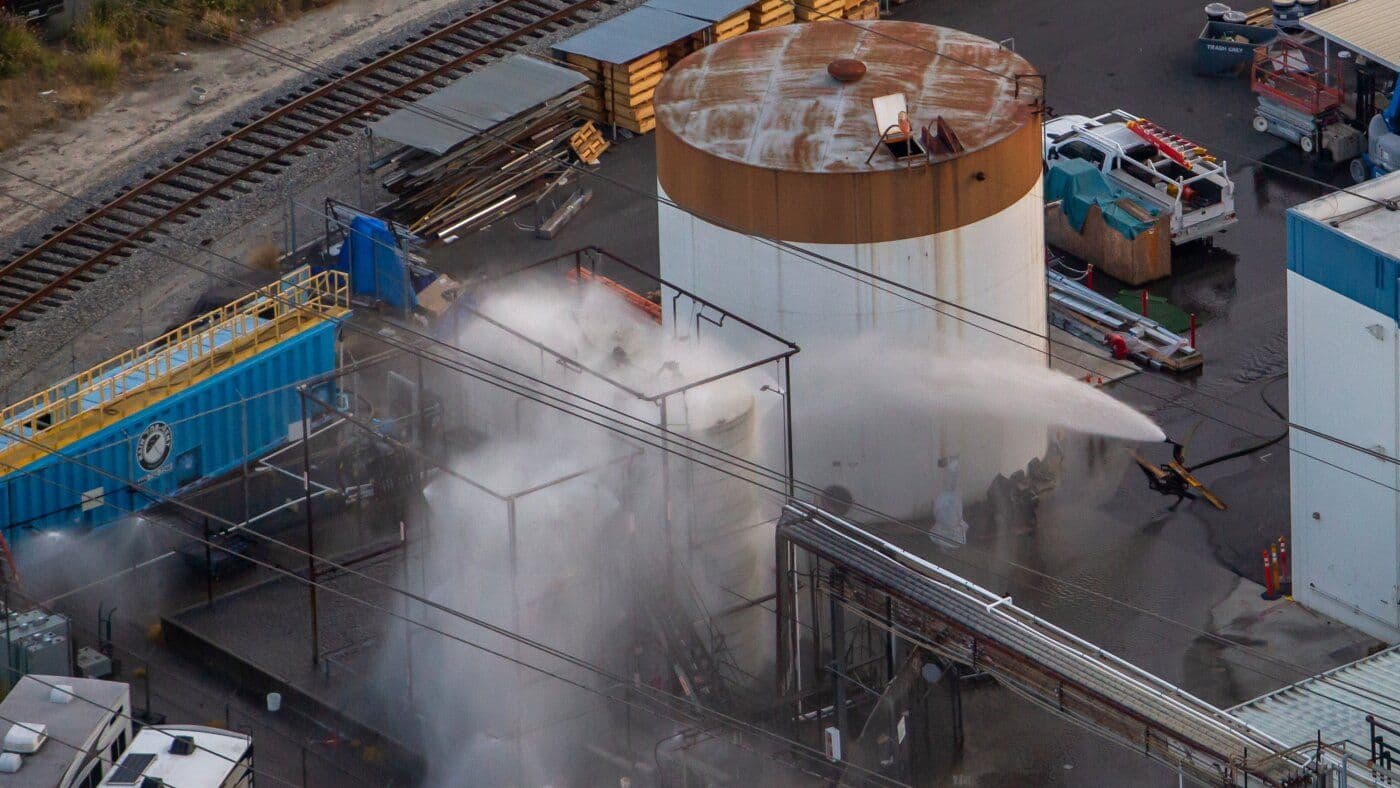
Aerial footage captured firefighting crews directing large volumes of water onto the overheating tank in an effort to reduce its temperature and prevent a catastrophic failure.
What Comes Next?
Authorities have not yet provided a clear timeline for when residents may be allowed to return home. Emergency responders are continuing to monitor the tank closely while working to stabilize conditions at the facility. The situation remains fluid, and officials are urging evacuated residents to stay away from the area until further notice.
The incident has raised broader questions about chemical storage safety protocols at aerospace and industrial manufacturing facilities, particularly those operating in densely populated urban areas.

