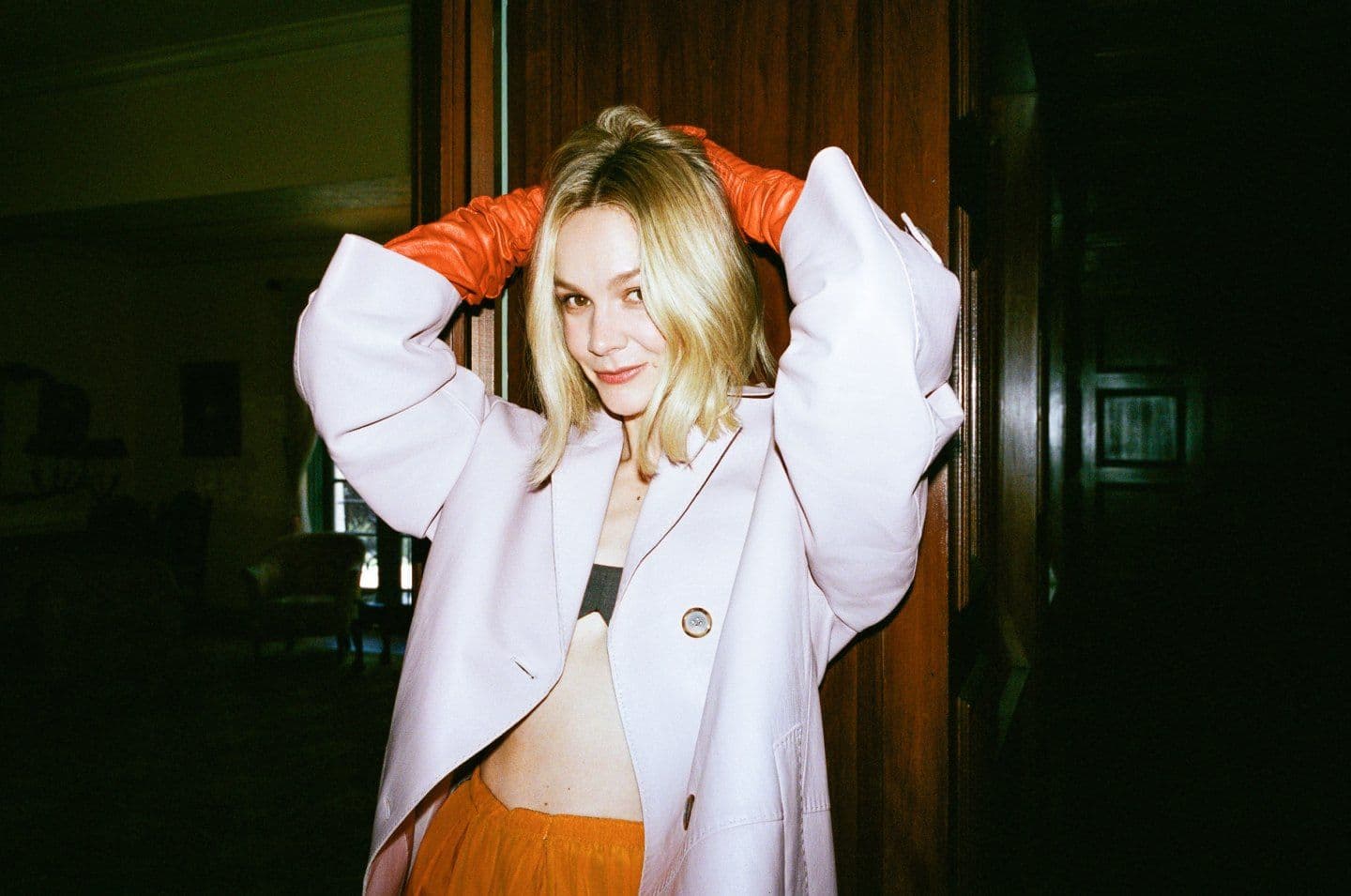
Carey Mulligan Breaks Free: How 'Beef' Season 2 Unleashed Her Wild Side
Oscar nominee Carey Mulligan trades prestige drama for raw chaos in Netflix's Beef Season 2, punching faces and killing coyotes along the way.

Carey Mulligan Finally Lets Loose in Netflix's 'Beef' Season 2
For most of her career, Carey Mulligan has been the gold standard of restrained, sophisticated acting. Three Oscar nominations. Period dramas. Socially conscious films. The kind of résumé that earns the label "Serious Actress" with a capital S. But Netflix's second season of Beef has changed all of that — and Mulligan couldn't be happier about it.
A Role Unlike Anything She's Done Before
When Mulligan first read the scripts for Beef Season 2, one scene stopped her cold: her character kills a coyote in cold blood during episode five. That was all she needed. "I called my agent immediately and was like, 'There's this fucking bit with a coyote, I've got to do it,'" she recalls.
Created by Lee Sung Jin, who describes the show as part The Sopranos, part Ingmar Bergman, the new season centers on a bitter, escalating war between Oscar Isaac's country club manager Josh and his wife Lindsay, portrayed by Mulligan. The feud gets captured on video by Josh's Gen Z employees — played by Charles Melton and Cailee Spaeny — who use the footage as blackmail leverage against a couple they believe has it all: money, status, and the happiness that's supposed to come with both.
For Mulligan, the role was a deliberate departure. Her close friend and collaborator, filmmaker Emerald Fennell, describes her as "naughty" — a side that audiences had never really seen on screen. Beef gave her the chance to change that. "I was delighted that she punches someone in the face," Mulligan says with clear satisfaction over breakfast at the Hotel Bel-Air in Los Angeles.
Getting the Language Just Right
Mulligan's commitment to the role extended even to its profanity. Concerned that some of the insults in the script felt too American for her British character, she took matters into her own hands. She compiled and sent showrunner Lee Sung Jin — whom she calls Sonny — a comprehensive list of genuinely offensive British swear words. "I was like, 'I should definitely call someone a cunt,'" she says flatly.
The role arrived on the heels of Maestro, Bradley Cooper's black-and-white Leonard Bernstein biopic in which Mulligan delivered a quietly devastating performance as Felicia Montealegre Bernstein. The tonal contrast between that film and Beef could hardly be more extreme — and that contrast was precisely the point.
From Serious Drama to Dark Comedy: A Career Reset
At the time she signed on to Beef, Mulligan had spent years in projects centered on weighty social themes — Suffragette, Promising Young Woman, She Said — and had become a familiar face in conversations about feminism and sexual violence. It was important work, but it wasn't the whole picture.
In Beef, her character's anxieties are more intimate and universally relatable: longing for children, fantasizing about divorce, considering a facelift. The show's central theme — the desperate conviction that one specific thing will finally make life complete — runs through both seasons like a dark thread. It's a question worth putting to Mulligan directly: has she ever felt that way herself?
Her answer: no, not really.
A Grounded Upbringing That Shaped Her Perspective
Mulligan grew up on the outskirts of London in what she describes as a comfortable, happy household — not wealthy by any glamorous standard, but rich in culture and encouragement. Her Welsh mother worked as a university lecturer; her father, originally from Liverpool, climbed from clearing tables at a hotel restaurant all the way to running the business. Art was always accessible: her mother brought her to the theater regularly, and a school visit from actor and Downton Abbey creator Julian Fellowes sparked her interest in pursuing acting professionally.
She auditioned for the top British drama conservatories — RADA, Guildhall, and LAMDA — and was rejected by all three. Rather than devastation, she felt a degree of perspective. "It actually didn't feel like the end of the world because I saw how competitive it was," she says. "And I also used a Sarah Kane piece about suicide for my monologue — that isn't exactly a crowd-pleaser."
At her parents' encouragement, she enrolled in an English literature program at another university, took a gap year pulling pints at a pub, and began hunting for auditions. Remembering that Fellowes was the only actor she'd ever met, she emailed him on a whim. His wife, Emma, connected Mulligan with a casting agent running an open call for the 2005 film adaptation of Pride & Prejudice, starring Keira Knightley and Matthew Macfadyen. Mulligan landed the role of Kitty Bennet — and the rest followed naturally.
That role led to a stage production at London's Royal Court Theatre, then a six-month stint on the Dickens adaptation Bleak House, and eventually an episode of Doctor Who. "By that point, I realized, 'Oh, this is probably my job,'" she says. Her ambitions at the time were modest: supporting roles on television, the occasional play, perhaps small parts in film.
The Role That Changed Everything
Then came An Education. What started as a small British film about a teenage girl's romance with an older man — "craft service was a tea and a packet of biscuits," Mulligan notes — became a critical sensation that earned her a surprise Best Actress Oscar nomination. Suddenly she found herself campaigning alongside Meryl Streep, Helen Mirren, and Sandra Bullock.
The experience was disorienting. Red carpets and photo shoots felt alien and uncomfortable. "Having my first child fixed that for me," she says. "Suddenly standing around in your pants is not so awful because you've done way worse in front of doctors and midwives."
By the time she returned to the Oscars in 2024 for Maestro, everything felt different — smaller, calmer, more familiar. She arrived late due to traffic and ended up watching the opening monologue from the wings alongside theater staff. "I had this vantage point of the audience, and I was looking out at all these brilliant artists, and it was actually just a group of people I've known for a long time."
Reuniting With Oscar Isaac — A Friendship Forged on Set
Mulligan first met co-star Oscar Isaac in 2010 on the set of the noir thriller Drive, directed by Nicolas Winding Refn. She played the lead opposite Ryan Gosling, while Isaac portrayed her absent husband. The two stayed at Refn's Hollywood Hills home during night shoots downtown.
"The first time I ever met Carey was in Nick's living room before we started shooting, and I remember it was exciting because we were both young and really on the cusp of something," Isaac recalls. "That feeling lasted about a week, and then we became jaded. But it was great."
Life Beyond the Camera
At 25, Mulligan reconnected with an old camp friend, Marcus Mumford, at a concert in Nashville. His band, Mumford & Sons, was rapidly rising to fame. They began dating and were married a year later. "I was conscious that it would be perceived by people as being young to get married, but I was like, 'Well, we've known each other forever, so it doesn't count,'" she says. The couple shares three children and frequently appears together publicly — on red carpets, at concerts, and most recently backstage when Mumford performed on Saturday Night Live.
"I went with him to perform on SNL recently, and it was so nerve-racking, but it's also fun, as my whole job that day was just to tell them they're doing great," she says.
In Beef, Mulligan's character maintains a secret text flirtation with an ex-boyfriend. The backstory she and the creative team developed involves a university romance with a minor royal that briefly thrust her into the tabloid spotlight. During early editing, showrunner Lee used Marcus Mumford's headshot as a stand-in avatar for the character's love interest — along with real paparazzi photos of the couple. When the time came to finalize those scenes, Lee asked Mulligan's permission to use the real images. She politely declined. Instead, she offered up photos of her longtime best friend, director Rightor Doyle — the two were photographed constantly during Mulligan's early twenties in New York while she performed in The Seagull. "The photos are awful, but there are loads of them," she says.
Refusing to Be Just 'The Girlfriend'
As Mulligan's profile grew after An Education, finding genuinely substantial roles became its own challenge. She quickly learned to identify scripts in which the female character existed solely to support the male lead. "You can spot it a mile off when someone's just in the movie to serve that kind of purpose, so you can quickly be like, 'Oh, that's just a girlfriend,'" she says.
Having worked with the same UK agent, Victoria Belfrage, since she was 18 has helped insulate her from the pressures that push many actors into taking roles purely for commercial reasons. It's a stability that has allowed her to be selective — and to wait for something as genuinely thrilling as Beef to come along and blow the doors wide open.

