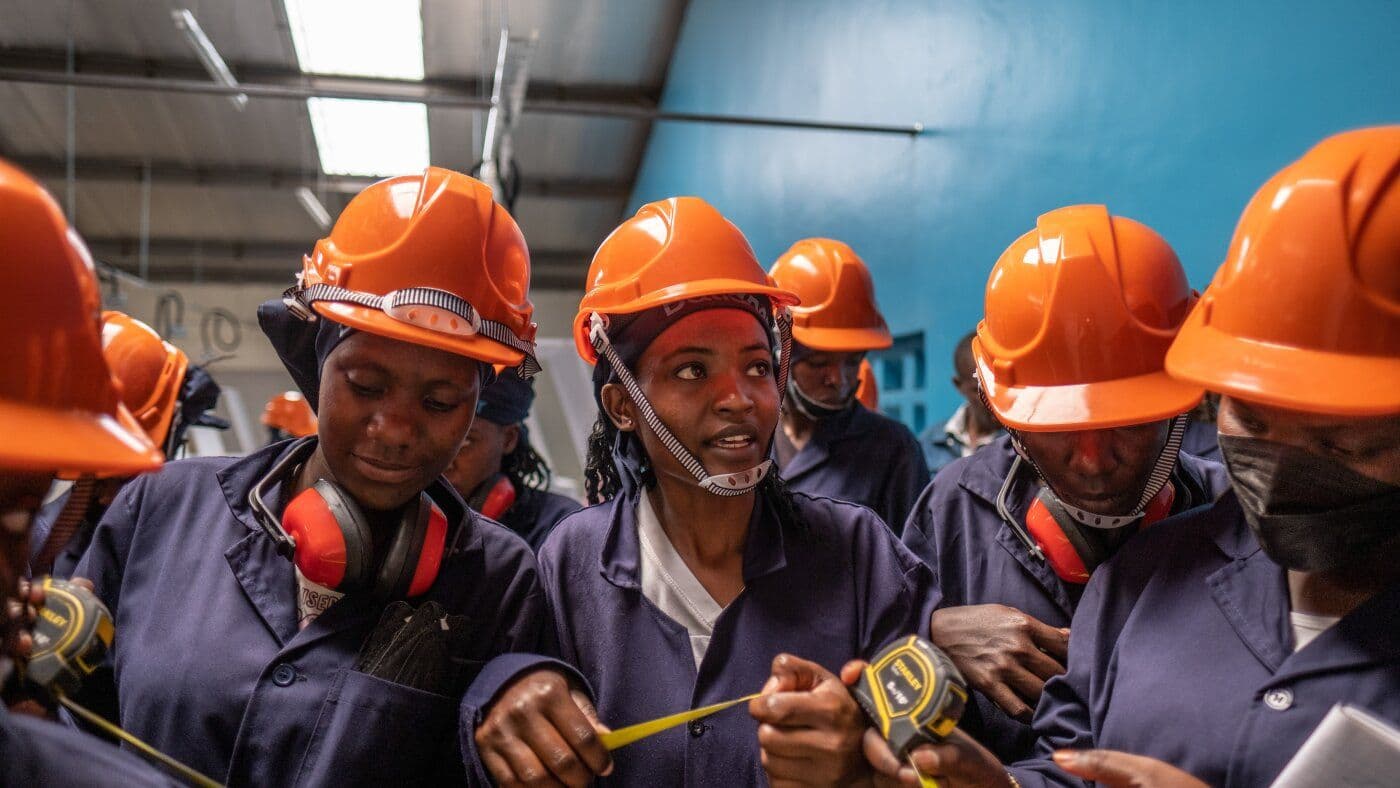
Breaking Ground: How Kenyan Women Are Shattering Barriers in the Construction Industry
Women represent just 3% of Kenya's construction workforce. One nonprofit is changing that — one skilled graduate at a time.

A Industry Built by Men — Until Now
Step onto the factory floor at Furniture International on the outskirts of Nairobi, and the noise is relentless — circular saws whirring, hammers striking, machinery grinding. To be heard, you have to raise your voice. For 24-year-old Diana Ojiambo, that took some getting used to.
"At first, I was very shy," she admits, guiding cabinet panels through a PVC edging machine, a blue bandana keeping her braids in place. "I didn't know how to stand in front of people and speak up. But now I can."
Ojiambo is not alone. Scattered across the same workshop floor, three other women sand and assemble cabinetry while 23-year-old Jane Mwangi — now a supervisor — moves methodically between stations, checking measurements and keeping the workflow on track. Twelve months ago, not one of them had set foot inside this industry.
A Workforce Gap That's Hard to Ignore
Kenya's construction sector is booming, especially in Nairobi, where cranes and scaffolding have become fixtures of the skyline as the industry swells into a multi-billion-dollar powerhouse. Yet despite this explosive growth, women remain almost invisible within it.
Data from Kenya's National Construction Authority reveals that women account for a mere 3% of the country's accredited construction artisans. Those who do find work in the sector are overwhelmingly channeled into low-paid, informal roles — hauling sand, carrying water, sweeping sites — rather than being trained for skilled, higher-paying positions. On top of that, women in Kenya continue to shoulder a disproportionate share of unpaid domestic and caregiving responsibilities, making it even harder to enter and advance in demanding trades.
Buildher: Rewriting the Rules
Founded in 2019, Nairobi-based nonprofit Buildher was created specifically to dismantle these barriers. The organization runs intensive year-long training and internship programs covering carpentry, tiling, painting, and other specialist finishing trades — equipping women with the practical skills needed to compete for steadier, better-compensated roles in the sector.
The results speak for themselves. Buildher reports that it has trained more than 1,000 women since its launch, with graduates typically increasing their average daily earnings by five to six times within a year of completing the program — jumping from roughly $1.50 per day to between $11 and $12. A 2024 study conducted by global development advisory firm Dalberg further found that approximately 65% of Buildher graduates remained employed in construction a full year after finishing the course.
The Vision Behind the Movement
"I had seen women get stuck in low-paying jobs, and it was like a mental barrier where they couldn't see the potential right in front of them," says architect and Buildher cofounder Tatu Gatere. "So I wanted to help women see that."
Gatere understands the challenge from personal experience. Even as women began climbing into leadership roles within architecture firms, construction sites remained unwelcoming — often hostile — territory. "You're supposed to be a decision maker, but you'd still be getting catcalled and harassed by men," she reflects.
Much of Buildher's growth has been organic, spreading through word of mouth as graduates return to their communities and encourage friends and neighbors to apply. The simple act of seeing another woman succeed in a trade, Gatere explains, can be enough to make the possibility feel real.
From Kibera to the Workshop Floor
For Diana Ojiambo, a single mother of two living in Nairobi's Kibera informal settlement, the program arrived at a critical moment. Unemployed and struggling to provide for her children, she heard about Buildher through a friend and decided to take a chance.
"My life was so challenging," she says. "But now I can support myself, I can support my kids."
Her ambitions don't stop there. Within the next year, Ojiambo plans to launch her own carpentry business back in Kibera. She's candid about the skepticism she still encounters from some male colleagues. "Inside this company, some of the men still think we ladies are not fit for this kind of work," she says. "But if you know what you want, and you believe in yourself, you show them that whatever they can do, you can do better."
Inside the Training Center
Early on a clear weekday morning, young women gather outside the cobalt-blue entrance of Buildher's training facility in Nairobi's busy Baba Dogo industrial district. The campus sits within Spectrum Business Park, a network of warehouse buildings tucked behind green corrugated rooftops.
Inside one workshop, trainees crouch over a concrete floor, carefully spreading tile adhesive before dragging notched trowels through it to create uniform ridges. Trainer Robert Ndungu circulates between them, kneeling occasionally to demonstrate correct technique before the women scrape the adhesive back into buckets and begin the process again.
"These women come here knowing nothing about tiling," Ndungu says. "By the end of this training, they are able to work, earn money and improve the life of their family. That really inspires me."
In a nearby conference hall, 16 new trainees have just completed orientation and are settling in for an introductory session on solar installation — a newly launched course reflecting Buildher's expansion into additional technical fields.
Training the Whole Person, Not Just the Worker
Gatere is quick to point out that mastering a trade represents only part of what women need to succeed in this environment. Many trainees arrive carrying burdens that reach far beyond the workshop — financial hardship, childcare obligations, resistance from husbands or parents uncomfortable with women taking on construction roles, and genuine fear of harassment in male-dominated workplaces.
Buildher's response has been to build a support system that addresses these challenges head-on. The program includes regular physical conditioning — calisthenics, lifting drills, and strength training to prepare women for physically demanding work. Yoga and mindfulness sessions are held alongside technical classes, helping trainees develop resilience, focus, and confidence under pressure.
Beyond fitness, Buildher employs a dedicated mental health coach and an on-site nutritionist. Trainees also participate in group wellness sessions every two weeks, a structure developed directly from feedback about the personal and professional difficulties women faced throughout the program.
Results Beyond the Paycheck
The Dalberg study — drawing on survey responses from 354 women working across Kenya's construction industry — suggests these holistic investments are delivering meaningful returns. Buildher graduates reported not just higher incomes but also increased participation in household decision-making and stronger connections within their communities.
"They also take more pride in what they do," notes Naoko Koyama, a Dalberg partner who contributed to the research. She argues that the combination of technical and soft-skills training offers a replicable model for challenging gender exclusion across a range of male-dominated industries.
One More Story of Transformation
Among those attending a yoga session on campus is 27-year-old Ruth Kiarie, a single mother who enrolled in Buildher's painting and decorating program just two weeks prior. Her interest in the trade was sparked while volunteering to renovate classrooms in Kibera as part of a community leadership initiative — proof that for many women, the path into construction begins not in a factory, but in the heart of their own neighborhood.
Stories like Kiarie's, Ojiambo's, and Mwangi's are becoming more common. And as Buildher continues to grow — expanding its course offerings, deepening its support structures, and sending more graduates into the workforce — the construction industry in Kenya may never look quite the same again.