Brain Cells Have a Hidden 'Gatekeeper' Structure — and It Could Be the Key to Stopping Alzheimer's
Scientists at Penn State uncovered a tiny internal skeleton inside neurons that controls what brain cells absorb — and when it breaks down, Alzheimer's-linked proteins flood in.
A Tiny Skeleton With a Big Job
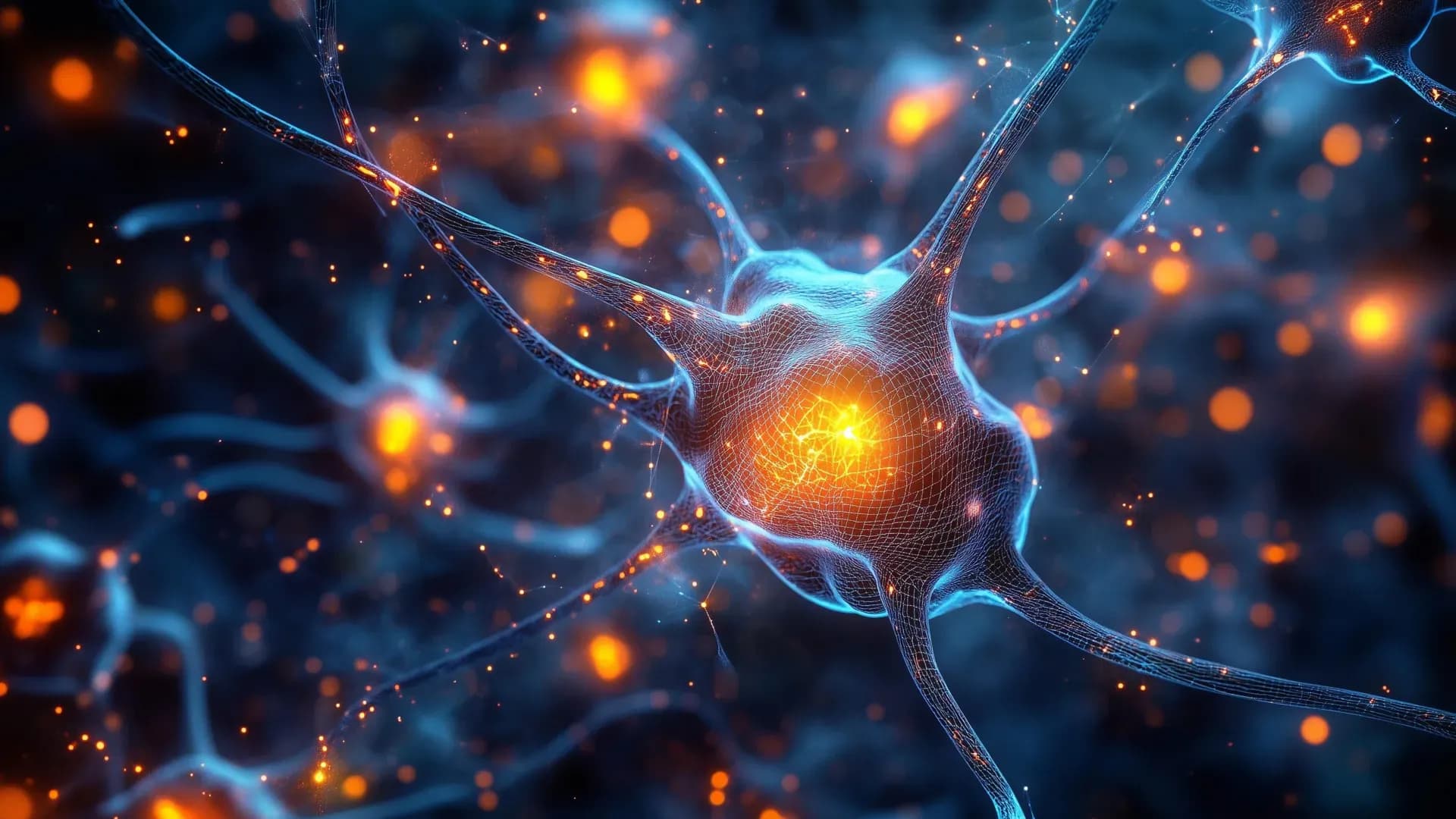
Deep inside every neuron in your brain, a microscopic lattice structure quietly works to control what enters and what stays out. For decades, scientists assumed this internal framework was little more than a passive support system — the biological equivalent of scaffolding holding a building upright. New research from Penn State University has completely overturned that assumption, revealing that this structure is actually an active gatekeeper that regulates how brain cells absorb material from their surroundings.
When this gatekeeper weakens, the consequences may be devastating — including a rapid influx of proteins directly tied to Alzheimer's disease.
What Is the Membrane-Associated Periodic Skeleton?
The structure in question is called the membrane-associated periodic skeleton, or MPS. Positioned just beneath the outer surface of neurons, it is built from repeating rings of proteins arranged in a precise lattice pattern. Ruobo Zhou, assistant professor of chemistry, biochemistry, molecular biology, and biomedical engineering at Penn State — and one of the scientists who originally helped discover the MPS back in 2013 — led the new research, which was published in the journal Science Advances.
Zhou and colleagues used super-resolution microscopy to observe the MPS at the nanoscale — a scale roughly 10,000 times smaller than the width of a human hair. What they saw challenged everything previously understood about the structure's role.
How the Gatekeeper Controls Cellular Uptake
Neurons are constantly pulling material in from the fluid that surrounds them. This intake process, known as endocytosis, delivers essential nutrients, signaling molecules, and fragments of the cell's own outer membrane back inside. It plays a foundational role in learning, memory formation, and the everyday maintenance that keeps neurons healthy.
The Penn State team discovered that the MPS actively governs nearly every major form of this uptake process. Rather than sitting idle, the lattice determines where substances can enter the cell and precisely when that entry is permitted.
"You can think of it as a gatekeeper, guarding this physical barrier to not allow nutrient uptake to happen," said Zhou. "When a neuron needs to take in a specific nutrient, this gatekeeper will open the gates and let it in."
In controlled laboratory experiments using neurons grown in petri dishes, researchers selectively damaged or reinforced portions of the MPS and tracked how the cells responded. When the structure was disrupted, neurons absorbed material at a dramatically accelerated rate — confirming that an intact MPS normally keeps uptake in check.
A Dangerous Feedback Loop
One of the study's most alarming findings was that the MPS can actually contribute to its own destruction. When endocytosis speeds up — whether due to aging, disease, or structural disruption — the increased uptake triggers molecular signals inside the neuron. Those signals instruct proteins within the cell to actively cut apart sections of the MPS lattice, creating more entry points and allowing even greater absorption of external material.
This self-reinforcing cycle means that once the gatekeeper begins to fail, the breakdown can accelerate rapidly — a troubling dynamic that mirrors what researchers observe in aging brains and early-stage neurodegenerative disease.
The Alzheimer's Connection
To directly examine what this breakdown means for Alzheimer's disease, the research team engineered neurons to produce elevated levels of amyloid precursor protein (APP) — a molecular marker closely associated with the condition.
When the MPS was weakened in these neurons, APP was absorbed far more quickly than normal. Once inside the cell, APP was processed into amyloid-beta 42, a toxic protein fragment that is widely regarded as a hallmark of Alzheimer's pathology. Neurons with a compromised MPS accumulated increasing concentrations of this harmful fragment and showed significantly more indicators of cell death.
"We created a model which is very much like Alzheimer's disease and found that in some aging neurons, or neurons under pathologic conditions, the endocytosis of toxic proteins was enhanced, which caused stressing conditions, ultimately leading to neuron deaths," said Jinyu Fei, lead author on the study and a graduate student in Penn State's chemistry department.
A Cycle That Could Drive Neurodegeneration
The findings point to a dangerous progression: as the MPS deteriorates with age or disease, neurons absorb more toxic proteins, which in turn weakens the lattice further, triggering even greater amyloid accumulation and eventually cell death. This cycle may silently unfold long before any outward symptoms of Alzheimer's appear.
A New Therapeutic Target on the Horizon
The implications for treatment are significant. If the MPS can be preserved or stabilized, it may be possible to interrupt this damaging chain of events at a very early stage — before neurons are irreparably harmed.
"We think this could open the door for future therapies such as a protein target for neurodegenerative disease treatment," Fei said. "Preserving or stabilizing the MPS might offer a way to slow the early, hidden cellular changes that precede Alzheimer's symptoms."
Zhou echoed that optimism, noting that for years researchers have struggled to identify the precise molecular machinery behind endocytosis in neurons. Understanding the MPS's active role fills a critical gap.
"When endocytosis — this nutrient uptake and regulation — goes wrong, then there's protein aggregation that will build up in the brain, which is the hallmark of neurodegenerative diseases such as Alzheimer's and Parkinson's," Zhou explained.
What Comes Next
The study was funded by the National Institutes of Health and conducted by a team that also included doctoral candidate Yuanmin Zheng, undergraduate student Caden LaLonde, and graduate student Yuan Tao.
While therapeutic applications remain years away, the discovery reshapes how scientists understand neuron biology and offers a compelling new direction for Alzheimer's research. The brain's hidden gatekeeper, it turns out, may hold the key to keeping it healthy.