Blue Heron: How Canada's Most Celebrated Film of 2026 Defied Every Expectation
Sophy Romvari's deeply personal debut feature is now the best-reviewed film of the year — and its journey to theaters is as remarkable as the movie itself.

The Quiet Rise of a Cinematic Sensation
Sophy Romvari never allowed herself to dream too big. When she set out to make her debut feature film, Blue Heron, the Canadian filmmaker deliberately kept her ambitions grounded, channeling her energy into what she could actually control — crafting an intensely personal story on her own creative terms. A splashy festival acquisition? A theatrical release across North America? Those kinds of outcomes weren't even on her radar.
"I had absolutely no expectation of theatrical distribution for an independent Canadian personal drama in 2026," she admits. "I figured it would go straight to streaming. The message you hear as a new filmmaker is always the same: it's a bad time, nobody's taking risks."
And yet, there she is — seated on a sun-drenched Hollywood restaurant patio, barely finding a moment to touch her chopped salad between thoughtful reflections on her film's extraordinary journey. Blue Heron didn't go to streaming. Instead, it's receiving a carefully orchestrated theatrical rollout across North America under the banner of the prestigious Janus Films. According to both Rotten Tomatoes and Metacritic, it currently stands as the best-reviewed film released in 2026 and has claimed awards at major international festivals, including Locarno — where it made its world premiere — and Toronto, where Janus secured the distribution rights.
Even amid this remarkable moment, Romvari keeps her perspective firmly in check. "My life has been a combination of part-time jobs, editing work, and arts grants," she says. "The real goal is figuring out whether I can build a sustainable career that lets me keep making films."
A Filmmaker Shaped by Loss and Memory
Romvari, 35, built her reputation through an intimate body of short films — raw, confessional works that dug into her family's history and emotional wounds. She grew up on Vancouver Island alongside her parents and three brothers, the family having emigrated from Hungary just before her birth. Her acclaimed short Still Processing confronted the deaths of two of her older brothers, while Norman, Norman tenderly examined her bond with her aging dog in the shadow of mortality.
Blue Heron represents the culmination of this autobiographical journey. While it is not a documentary, it is deeply rooted in Romvari's personal history — specifically the shockwave left by the sudden death of her troubled eldest brother.
"I feel like a transformed person after making this film," she reflects. "I've done everything I possibly could to understand and process that chapter of my life and my family's life. Exploring it through art has allowed me to move forward in a way I don't think would have been possible otherwise."
A Story Told Across Two Timelines
Set in Vancouver, Blue Heron unfolds across two distinct narrative periods. The first half immerses viewers in an intimate family drama through the eyes of young Sasha — played by Eylul Guven — Romvari's childhood stand-in, as she quietly observes the mounting tension between her mother (Iringó Réti) and her increasingly withdrawn brother Jeremy (Edik Beddoes). Midway through the film, the story leaps forward to the aftermath of Jeremy's death, where an adult Sasha, now portrayed by Amy Zimmer, works as a filmmaker attempting to reconstruct what happened and why.
The film's two timelines converge in a moving and unexpected climax that recreates a pivotal moment from Romvari's past — or at least appears to do so.
"Someone watching this film would assume that particular scene is exactly how it happened," she says, "but honestly, I don't remember that specific conversation occurring. People may watch this beat for beat and believe it's a literal account of my life. That's something I have to accept as a filmmaker who has made herself vulnerable."
Patience, Craft, and Cinematic Influences
For all its emotional rawness, Blue Heron is a remarkably controlled piece of filmmaking — precise, disciplined, and visually considered. This was a deliberate choice born from years of refinement. Romvari spent considerable time sharpening her visual instincts and narrative focus before committing to her feature debut.
Her list of cinematic inspirations is eclectic and telling. She references the sweeping master compositions of Robert Altman's Short Cuts, the gut-punch intimacy of Jonathan Caouette's Tarnation, Mike Leigh's Secrets and Lies, and Joanna Hogg's The Eternal Daughter. She even pulls up an email she sent to her lead actress, Amy Zimmer, with the subject line "Subtle Women's Cinema" — a curated mood board of quiet, observational storytelling.
"Letterboxd is essentially my brain," she jokes, laughing as she scrolls through her phone.
But perhaps the most significant influence on Blue Heron was time itself. "First features are often overloaded with ideas, and I think waiting a little longer worked in my favor," she explains. "I had more creative distance from the material than I would have had in my twenties. When you're working with limited resources, you don't know if you'll ever get another shot. I wanted to be absolutely certain I was making the most of this one."
Funded by Canada, Built on Determination
Romvari navigated the Canadian arts funding system to bring Blue Heron to life — receiving a research grant to write the screenplay and a production grant to shoot it. She credits that infrastructure as transformative.
"When I started making work in Canada, I didn't fully appreciate the privilege of living in a country with access to arts funding," she says. "The version of this film I might have made within the American system would have looked very different — and I'm not confident it would have found distribution."
Government support, however, didn't eliminate the need for grit. Romvari began casting the film before production funding was confirmed. "You just have to say, 'I'm a filmmaker and I'm making a movie.' That declaration alone is half the battle."
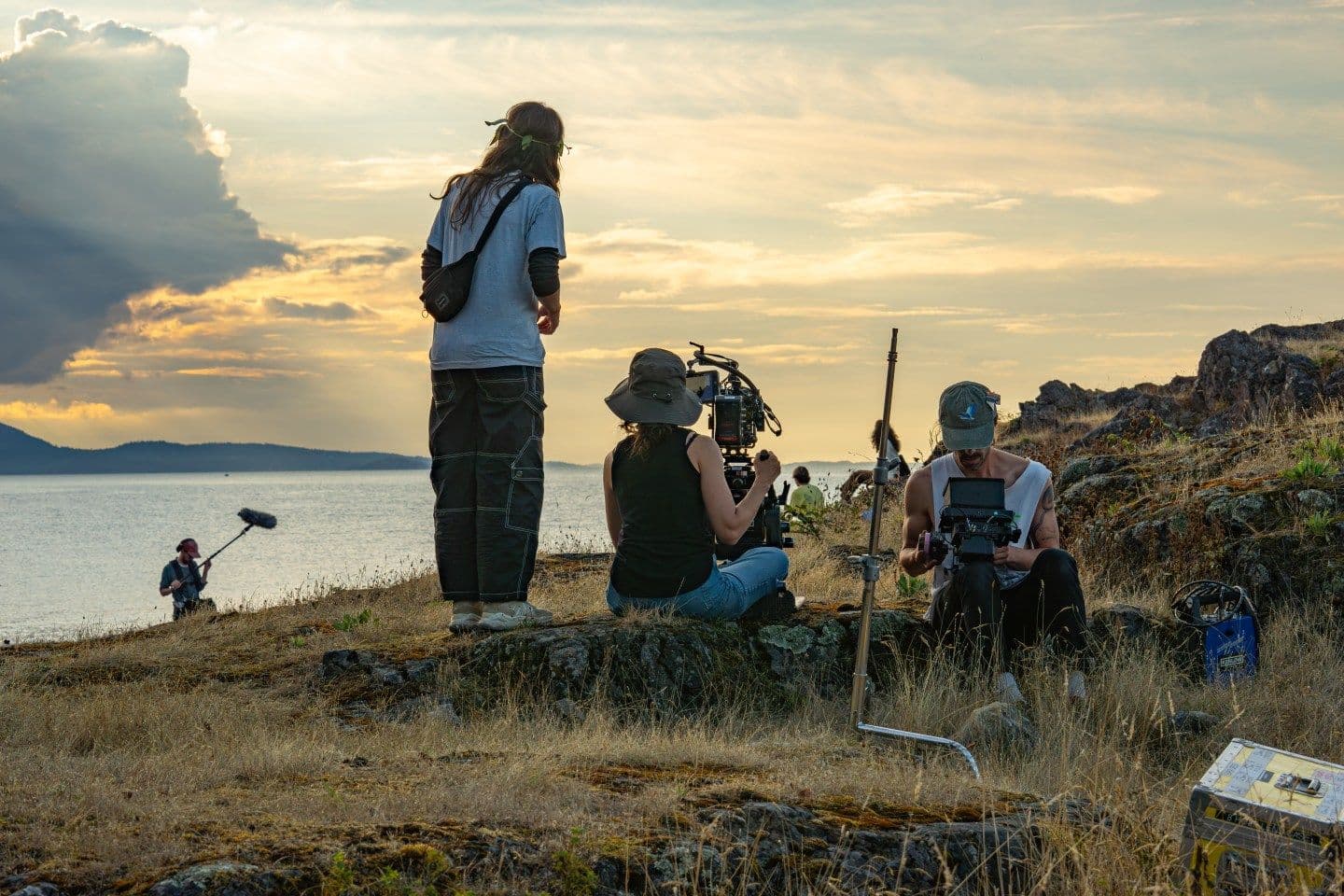
After a summer shoot wrapped, Romvari spent the entire Toronto winter camped out in her editor Kurt Walker's living room, cutting the film. To cover her expenses during post-production, she took a job as a supervisor at her local movie theater. She still works there part-time today — and had the surreal experience of introducing a special preview screening of Blue Heron on that very screen, then walking home across the street to eat leftovers and walk her dog while the film played, before returning for the Q&A.
The Joy Behind the Grief
Romvari describes the Blue Heron shoot as, somewhat surprisingly, a "blast" — a word that initially seems at odds with the weight of the subject matter. But it speaks to something essential about who she is as a filmmaker. To bring her brother back to life through memory, she had to revisit painful recollections with her parents — who have since watched and deeply appreciated the finished film — only to discover their versions of events sometimes diverged significantly from her own. Reconstructing her late brother through the prism of her childhood self required extraordinary emotional excavation.
Yet threading through all of that difficulty is a question that gives Blue Heron its meta-textual richness: Why did I become a filmmaker?
For Romvari, the answer is as simple as it is profound — because she loves it, completely and without reservation.
"A lot of filmmakers seem to resent parts of the process," she says. "I couldn't imagine doing this unless I loved it as much as I do. Every single day required emotional, intellectual, and social energy. You have to be present, ready to solve problems, ready to lead. I surprised myself with how much I was able to sustain that — and enjoy it."
As their conversation winds down, Romvari glances at her plate and laughs softly: "I ate three bites of my salad."
For a filmmaker with this much to say — and this much more still to make — that sounds about right.

