Blazars May Be the Source of the Most Powerful Neutrino Ever Recorded
A record-breaking neutrino detected beneath the Mediterranean Sea has puzzled scientists — and blazars, the universe's most violent objects, may hold the answer.

A Record-Breaking Particle From the Depths of Space
Something extraordinary struck deep beneath the Mediterranean Sea on February 13, 2023 — a single subatomic particle carrying more energy than anything of its kind ever recorded. This cosmic neutrino, measured at approximately 220 PeV, shattered previous records by more than tenfold and left the scientific community scrambling for answers.
Three years after its detection, researchers may finally have a lead. A new study published in the Journal of Cosmology and Astroparticle Physics points to blazars — among the most violent and extreme objects in the known universe — as the likely origin of this unprecedented particle.
What Are Blazars and Why Do They Matter?
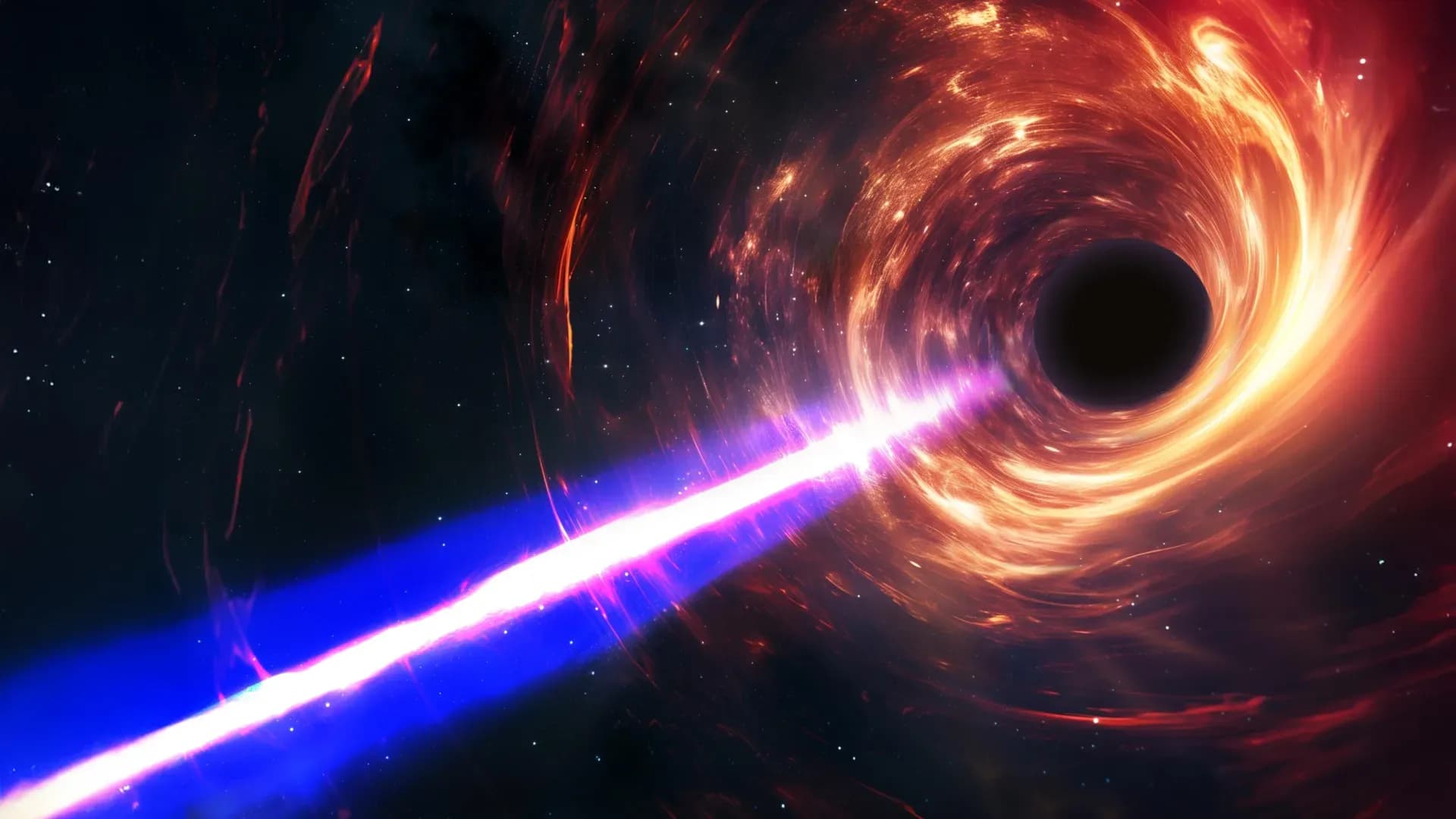
Blaars are a specific type of active galactic nuclei powered by supermassive black holes. What makes them uniquely dangerous — and uniquely interesting — is the enormous jets of plasma they fire directly toward Earth at near-light speeds. These cosmic cannons are capable of accelerating particles to staggering energies, making them prime suspects in the hunt for ultra-high-energy neutrino sources.
The idea isn't entirely new. Blazars have previously been linked to high-energy neutrino events, but never at an energy scale quite like this.
The Detective Work Behind the Discovery
The neutrino was first captured by KM3NeT/ARCA, a deep-sea neutrino observatory anchored off the coast of Sicily. Remarkably, the detector was — and still is — only partially constructed. At the time of the detection, just 21 of its planned detection lines were active, representing roughly 10% of its intended capacity. Despite operating well below full power, the instrument recorded a signal unlike anything previously observed.
Researchers approached the investigation the way a forensic team might analyze a crime scene. They built simulations, tested hypotheses, and cross-referenced their findings with real-world data.
No Electromagnetic Counterpart Found
In most high-energy cosmic events, scientists expect to find a matching electromagnetic signal — gamma rays, X-rays, or radio waves arriving from the same region of the sky at roughly the same time. In this case, no such counterpart was identified.
According to Meriem Bendahman, a researcher at INFN Naples and a member of the KM3NeT collaboration, this absence doesn't eliminate the possibility of a single point-like source, but it does push scientists toward a broader explanation.
"This leads us to consider that our neutrino may come from a diffuse background — that is, from a flux of neutrinos including contributions from many sources," Bendahman explained.
This reasoning guided the team toward a population-level blazar model rather than seeking a single catastrophic event.
Simulating a Population of Blazars
To test their hypothesis, the research team employed AM3, an open-source simulation tool, to model realistic blazar populations. Many of the input parameters — including magnetic field strength and emission region sizes around supermassive black holes — were drawn from existing observational data.
Two variables were deliberately adjusted during the simulations:
- Baryonic loading — the ratio of energy carried by protons versus electrons, which directly influences neutrino production rates.
- Proton spectral index — which determines how proton energies are distributed and whether those energies can reach extreme levels.
For each simulation run, scientists calculated both neutrino output and the corresponding gamma-ray emissions, then compared those results against actual observational records.
Cross-Referencing With IceCube and Fermi
The study drew on data from three major observatories: KM3NeT/ARCA, the IceCube Neutrino Observatory in Antarctica, and NASA's Fermi Gamma-ray Space Telescope. Crucially, the researchers paid attention not only to what these instruments detected, but also to what they hadn't detected.
Notably, IceCube and other neutrino detectors have not recorded comparable ultra-high-energy events. This rarity is itself a data point — any credible explanation must account for why such detections are so infrequent.
The blazar population model held up under this constraint. The team also verified that their proposed blazar population would not generate gamma-ray emissions exceeding the known extragalactic gamma-ray background as measured by Fermi. The results remained consistent.
"We modeled a realistic population of blazars with physically motivated parameters, and we found that this population could explain the origin of this ultra-high-energy event, while also being consistent with the constraints we have regarding gamma-ray and neutrino observations," Bendahman stated.
What Comes Next for KM3NeT
Despite the compelling findings, scientists are careful to emphasize that confirmation requires more data. The KM3NeT observatory is still under construction, and its current detections represent only a fraction of what will eventually be possible.
"With the full detector and more data, we will be able to perform more powerful statistical analyses and open a new window on the ultra-high-energy neutrino universe," Bendahman noted.
Once fully operational, KM3NeT could dramatically expand humanity's ability to detect and study extreme cosmic events — and potentially confirm or challenge the blazar hypothesis once and for all.
A New Window Into the Universe's Most Extreme Accelerators
If the blazar theory is ultimately validated, the implications extend far beyond this single neutrino event. It would fundamentally alter scientists' understanding of how blazars function and just how powerful these cosmic engines can become.
"We have never observed such a high-energy neutrino before, and if it turns out to come from cosmic accelerators like blazars, it would give us new insight into how these objects can emit particles at energies beyond what we previously expected," Bendahman concluded.
For now, the universe's most energetic neutrino remains one of astrophysics' most tantalizing open mysteries — but the pieces are slowly beginning to fall into place.