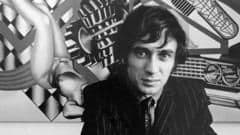
Birmingham Finally Honors Peter Phillips, the Pop Art Pioneer It Left Behind
Peter Phillips helped shape the global pop art movement, yet his hometown of Birmingham largely ignored his legacy — until now.

Birmingham Reclaims Its Forgotten Pop Art Pioneer
For decades, Birmingham quietly overlooked one of its most extraordinary creative sons. Peter Phillips — a founding force behind the international pop art movement — lived, worked, and died without ever receiving the recognition his hometown owed him. That is finally about to change.
Following his passing in June 2025, a landmark outdoor exhibition is set to celebrate Phillips's life, his trailblazing artistic achievements, and the deep, lasting imprint that Birmingham left on his work.
A Pioneer Who Stood Alongside the Greats
Phillips occupied rare artistic company during his career. He stood shoulder to shoulder with figures such as David Hockney, Pauline Boty, and Sir Peter Blake in Britain, while across the Atlantic he moved in the same circles as Andy Warhol and Roy Lichtenstein — artists who would go on to define an entire cultural era.
Art historian, author, and exhibition curator Ruth Millington describes Phillips as a "key figure" in the global pop art movement and one of its most significant British contributors. In her view, he was also, quite simply, "one of Birmingham's most overlooked creative figures."
"Of all the British pop artists, he was the closest to the Americans," Millington explained. "He exhibited with them in New York, and when he moved there in 1964, Lichtenstein became his friend. He was very much in the inner circle."
Rooted in Birmingham From the Very Beginning
Born in Bournville in 1939, Phillips began his formal artistic training at Moseley School of Art at just 13 years old, before progressing to Birmingham School of Art. That early education in the city proved far more than a stepping stone — it became the foundation of his entire visual identity.
"He was quite clear that his imagery and style both come from Birmingham," Millington noted. "He learned an airbrush technique there which you see in his paintings throughout his whole career."
Growing up surrounded by Birmingham's industrial landscape and thriving car manufacturing culture fed directly into his art. Engines, car parts, and mechanical forms — disassembled and reconstructed on canvas — became defining motifs of his work.
Phillips later moved to London to study at the prestigious Royal College of Art, where his peers included Blake, Boty, and Hockney. Despite subsequently living and working in London, New York, Zurich, and Australia, he never shed what Millington describes as his "distinct Brummie humour" — or his connection to the city that shaped him.
A Mover, Shaker, and Organiser of a Movement
Phillips's influence extended well beyond the canvas. In 1961, he was instrumental in staging an exhibition widely credited with launching British pop art onto the world stage. He also appeared as one of four artists featured in Ken Russell's acclaimed 1962 film Pop Goes the Easel, and contributed creative idents to the BBC's Four Goes Pop series.
"He was a real mover and shaker of the movement," said Millington. His early commercial success gave him the freedom to operate on his own terms — travelling widely and working independently, rather than remaining in London to cultivate relationships with the art press.
"He was, I think, this Brummie outsider until the end of his life," she reflected.
Pop Goes Brum! — An Exhibition for Everyone
The upcoming free outdoor exhibition, titled Pop Goes Brum!, will be held at Snow Hill Square in Birmingham from 9 to 30 June. Developed in partnership with Birmingham School of Art and funded by Birmingham's Colmore BID, the show will highlight Phillips's pioneering contributions to pop art while reconnecting the city with its long-neglected cultural hero.
The exhibition will also feature new works by current students from Birmingham School of Art, ensuring that Phillips's influence continues to inspire the next generation of artists from his home city.
"I thought a street art exhibition would be the perfect way to remember him," said Millington. "Anybody can see it, it's free and part of popular culture today — and his story has not been told. I really wanted him to be remembered in a significant way."
Melanie Williams of Colmore BID added: "This exhibition not only honours his legacy but also reconnects Birmingham with one of its most significant cultural trailblazers."
A Foundation to Carry His Legacy Forward
In a fitting tribute to a man who dedicated his life to nurturing art and culture, Phillips's family has established The Peter Phillips Foundation in his memory. The foundation will provide support for emerging artists, ensuring that the creative spirit he embodied continues to flourish for years to come.
Birmingham may have been slow to recognise its pop art prince — but with Pop Goes Brum!, the city is finally making amends.